

Every element heavier than helium was made inside a star. The carbon in your cells, the oxygen in your lungs, the iron in your blood: all of it forged in nuclear furnaces that lived and died before our solar system existed. But those stars had to come from somewhere. Before them came a generation of stars so ancient, so massive, and so brief that they burned out before anything else in the universe had formed. We have never seen one directly. In the spring of 2026, two independent research teams announced they may have found the next best thing: a fingerprint.
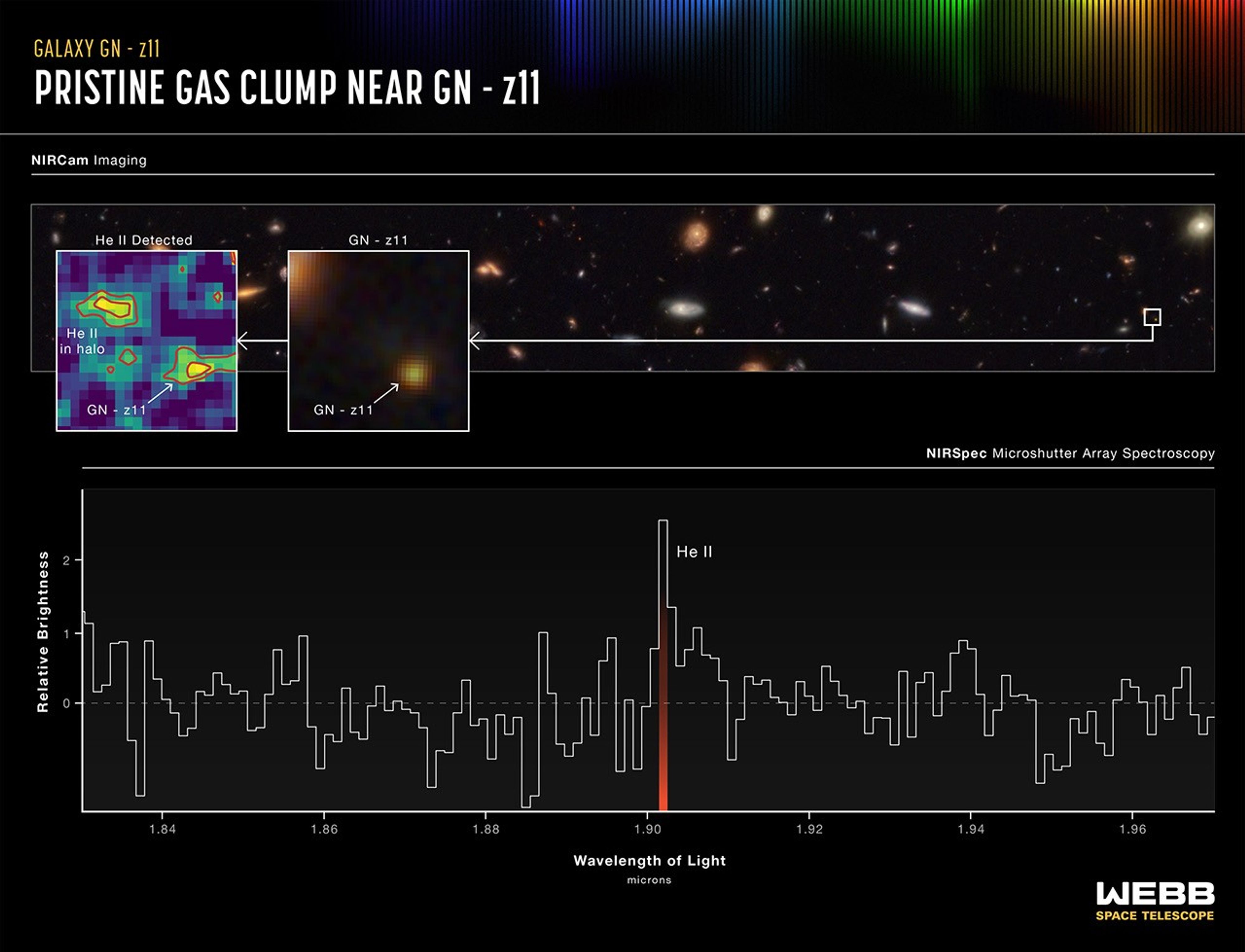
In March 2026, astrophysicists Roberto Maiolino at the University of Cambridge and Elka Rusta at the University of Florence posted companion papers to the arXiv preprint server (arXiv:2603.20362 and arXiv:2603.20363) describing new observations of a small, faint object designated Hebe, found nestled three kiloparsecs from the galaxy GN-z11. The findings represent, in the authors’ assessment, the strongest evidence yet for Population III stars: the universe’s theoretical first generation, composed entirely of the primordial hydrogen and helium left over from the Big Bang.
GN-z11 is one of the most studied objects in the early universe. It sits in the constellation Ursa Major, observed as part of the Great Observatories Origins Deep Survey (GOODS), and it appears to us as it existed just 430 million years after the Big Bang, when the universe was barely 3 percent of its current age. Using JWST’s NIRSpec-IFU instrument, a near-infrared spectrograph capable of mapping chemical signatures across a wide field with precise spatial resolution, Maiolino’s team resolved a helium emission signal near Hebe, first detected in 2024 but previously too ambiguous to interpret conclusively, into two distinct components. Independently, Rusta’s team detected a hydrogen emission line from the same location using separate analysis methods. Neither team found any signature of heavier elements.
Why the First Stars Matter
Population III stars have been a theoretical prediction for decades. In the immediate aftermath of the Big Bang, the universe contained only hydrogen, helium, and trace amounts of lithium. Heavier elements did not exist. The first stars that formed from this pristine gas were, according to models, radically different from anything that came after: likely between 10 and 100 solar masses, burning at extreme temperatures, flooding the surrounding universe with ultraviolet radiation, and dying in supernovae that seeded the cosmos with the first carbon, oxygen, and iron.
Because they were so massive, they lived only a few million years. By the time the universe was a billion years old, every Population III star had already died. We cannot observe them directly. What we can look for are gas clouds that preserve the conditions of that earlier era: regions where the chemistry remains primordial, unpolluted by the metals that later stellar generations scattered everywhere. Hebe appears to be exactly that.
The detection of doubly ionized helium, and the absence of any metal lines, is consistent with a cluster of Population III stars irradiating the surrounding gas. Only extremely massive, extremely hot, metal-free stars produce enough high-energy photons to doubly ionize helium at the inferred levels. The independent hydrogen detection from Rusta’s team anchors the identification from a second angle. When two teams, using different instruments and different approaches, converge on the same object and the same interpretation, the hypothesis moves from speculative to credible in a way that a single detection cannot.
What makes Hebe’s location particularly compelling is its proximity to GN-z11, a galaxy already known to host an active supermassive black hole of two million solar masses, an extraordinary presence for such an early epoch. Theorists are examining whether Hebe sits within a so-called minihalo: a small concentration of primordial gas, shielded from the metal enrichment that contaminated the surrounding universe, where Population III star formation could have continued unusually late. The relationship between Hebe, GN-z11, and its central black hole remains an open question with significant implications for how the first galaxies assembled. You can explore how stars are born, and what determines their fate, in our piece on the stellar lifecycle.
What Comes Next
Both papers remain preprints, posted to arXiv but not yet through formal peer review. The immediate next step is independent follow-up: additional teams, additional instruments, different wavelength ranges. JWST’s Mid-Infrared Instrument (MIRI) could provide further constraints on the temperature and mass distribution of any stellar population in Hebe, and planned deep-field campaigns already in JWST’s schedule may capture complementary data without requiring dedicated observing time.
The ultimate goal remains a confirmed, peer-reviewed detection of Population III stellar signatures that holds up to scrutiny from the full community. That may require multiple independent detections across different objects: a single galaxy halo, however compelling, is not a census. But each credible detection narrows the parameter space, sharpens the models, and brings the first chapter of stellar history into clearer focus.
Somewhere, 13.4 billion light-years from here, in a gas cloud that formed before Earth, before the sun, before the first grain of sand, something blazed briefly and left a signal so faint it took the most sensitive space telescope ever built to read it. We are, at last, beginning to understand the very first light.
