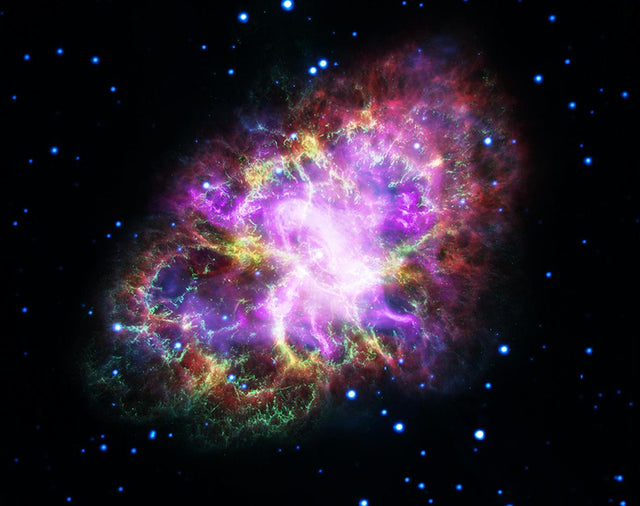
The iron inside your body was forged in dying stars. That part is established science: massive suns burn through their fuel over millions of years, build up iron in their cores, and when they can no longer hold themselves together, they explode, scattering everything they ever made across the galaxy. What is less known is this: some of that stellar wreckage is still arriving. Right now, today, atoms of radioactive iron produced in a supernova explosion are drifting through our atmosphere and settling onto Earth’s surface.
It sounds like myth. It is measurable physics. And scientists have just found the evidence locked in 80,000-year-old Antarctic ice.
The discovery
A study published May 13, 2026, in Physical Review Letters confirms that Earth has been accumulating iron-60, a radioactive isotope produced only in supernova explosions, for at least 80,000 years. The research was led by Dr. Dominik Koll of the Helmholtz-Zentrum Dresden-Rossendorf (HZDR) in Germany, with colleagues including Prof. Anton Wallner and Annabel Rolofs of the University of Bonn.
The evidence came from ice. The team processed roughly 295 kilograms of Antarctic cores recovered by the European EPICA drilling project, spanning a timeline from 40,000 to 81,000 years ago. They compressed that mass down to a few hundred milligrams of pure dust, then subjected it to the Heavy Ion Accelerator Facility in Canberra, Australia, one of the few instruments on Earth sensitive enough to detect individual exotic atoms.
They found seven atoms of iron-60. Seven, in nearly 300 kilograms of ice. And that tiny number is enough to rewrite our understanding of where our Solar System currently is.
Why iron-60 changes everything
Iron-60 cannot form on Earth. The pressures and temperatures required to produce it exist only in the cores of massive, dying stars. It has a half-life of 2.6 million years, which means any iron-60 present when our planet formed 4.6 billion years ago has long since decayed into nothing. If iron-60 is showing up in 80,000-year-old ice, it arrived from somewhere else, recently, in cosmic terms. Only a supernova could have sent it.
Our Solar System is currently passing through what astronomers call the Local Interstellar Cloud: a vast, tenuous structure of gas and dust that fills the space around us in every direction. Researchers have long suspected this cloud was seeded by ancient supernova activity. The iron-60 in the Antarctic ice is the chemical fingerprint that confirms it.
Dr. Koll’s team found something else in the data, too. The iron-60 concentration in the oldest ice (from 60,000 to 81,000 years ago) was roughly five times lower than in more recent samples. That gradient tells a story: our Solar System has been gradually drifting deeper into the cloud over tens of thousands of years, and as we go deeper, more stellar ash falls on us. “This means that the clouds surrounding the Solar System are linked to a stellar explosion,” Dr. Koll noted.

For the entire span of recorded human history, and for the entire existence of anatomically modern humans on Earth, we have been living inside the debris field of a dead star. Early humans crossed land bridges and painted their hands on cave walls while this invisible rain of stellar iron was already building up in the ice sheets. The connection between the lives and deaths of stars and the chemistry of our living world is not merely historical: it is ongoing.
What comes next
The Solar System will not stay inside the Local Interstellar Cloud for much longer, in astronomical terms. Current estimates suggest we are near the cloud’s outer edge and will exit it within a few thousand years. To understand what Earth looked like before we entered, Dr. Koll’s team is now collaborating with the Alfred Wegener Institute on Beyond EPICA, an international effort to recover ice samples dating back as far as 1.5 million years. If those ancient samples contain no iron-60, the absence will mark, frozen in ice, the exact moment our Solar System first crossed into the supernova cloud.
What that boundary looks like in the data will answer something no instrument has ever measured before: not just that we passed through a dead star’s debris, but precisely when the drift began.
Somewhere in the oldest ice on Earth is a layer that records the precise moment a dead star’s reach finally caught up with us.