
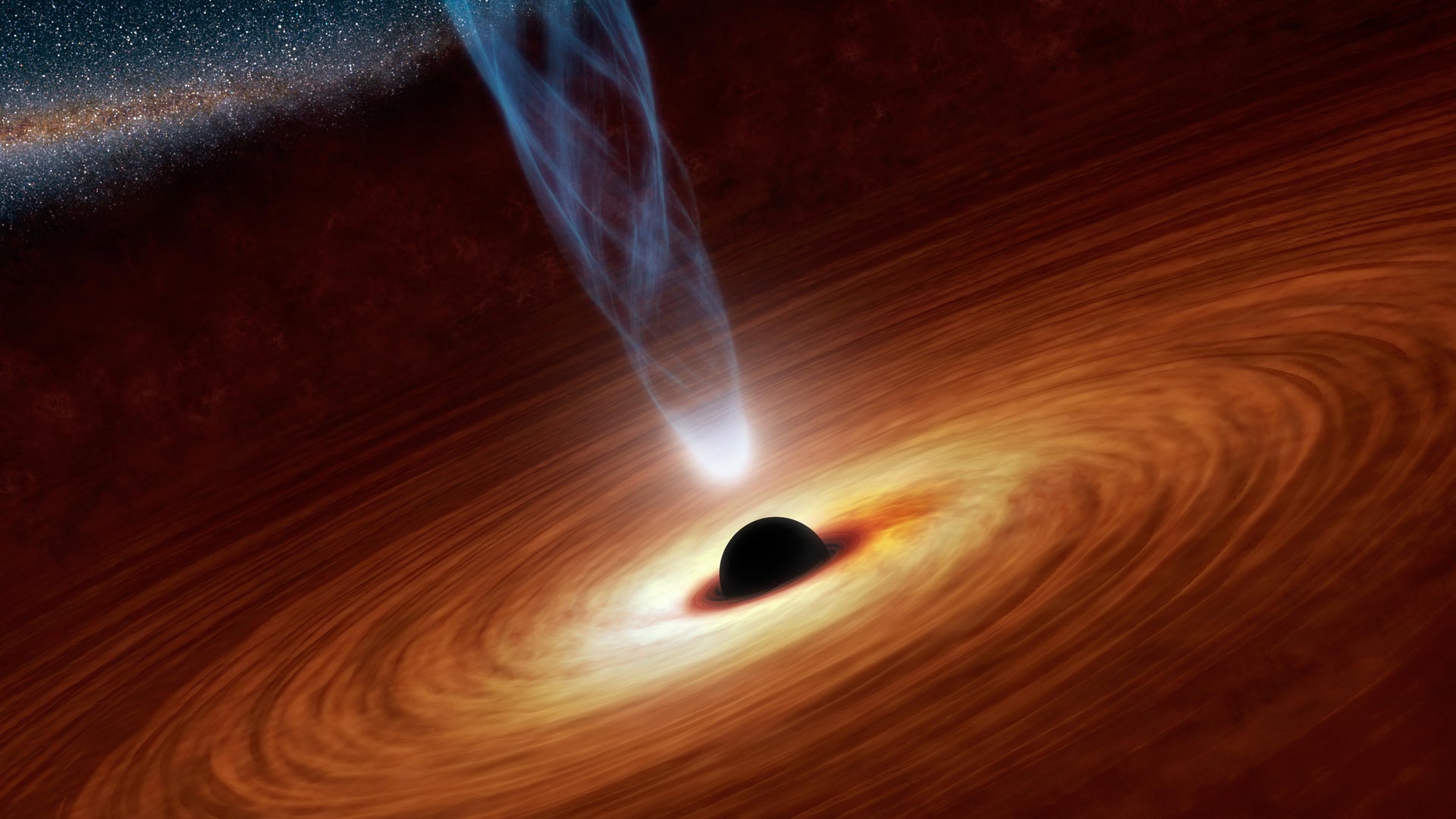
Black Holes: Where the Rules Change
Every black hole began as something that could no longer hold itself together. What remained rewrote the laws of physics.
What Remains
There is something unsettling about a place the universe keeps secrets from itself.
A black hole is not a thing. It is an absence — a region where matter was once so dense it folded spacetime shut. No light escapes. No signal returns. Whatever crosses the boundary stays. Not destroyed, exactly. Just unreachable. Forever.
They are born from collapse. A star that has burned through its fuel, lost its outward pressure, and surrendered to gravity so completely that nothing — no force in the known universe — can stop the infall. The most powerful objects in existence begin with surrender.
“The black holes of nature are the most perfect macroscopic objects there are in the universe: the only elements in their construction are our concepts of space and time.”
— Subrahmanyan Chandrasekhar
They come in sizes. The universe builds them all.
Stellar Mass
Born from the death of massive stars. A few dozen kilometres across — a city-sized object with the mass of a sun.
Intermediate
Too large for a single star’s death, too small to anchor a galaxy. Only recently confirmed — their origin remains open.
Supermassive
Anchoring nearly every galaxy. Sagittarius A* holds 4 million solar masses. M87* holds 6.5 billion. How they grew so massive remains unknown.
The Event Horizon
There is a distance from the centre of a black hole at which escape becomes impossible. Not improbable. Not difficult. Impossible. This is the event horizon — where the escape velocity exceeds the speed of light itself.
The horizon is invisible. There’s no wall, no surface, no flash of warning. An astronaut crossing it would notice nothing in the moment. But to a distant observer watching them approach, something extraordinary happens: the astronaut slows. Their light redshifts. Time, as seen from outside, stretches toward infinity. They never quite arrive — they fade, frozen on the threshold.
Below, you’re looking straight at a black hole from a spacecraft. Drag the slider to approach it. Watch the sky warp around the shadow. Watch your clock and theirs diverge.

In April 2019, the Event Horizon Telescope — a network of radio dishes spanning the globe, acting as a single Earth-sized instrument — captured the first direct image of a black hole’s shadow.
M87*. Fifty-five million light-years away. Six and a half billion times the mass of our Sun. The bright ring is superheated plasma bent around the photon sphere. The dark centre is the shadow of the event horizon.
The image took two years to process. When it arrived, it looked exactly like the math predicted.
Image: EHT Collaboration / ESO
The Accretion Disk
Here is the paradox: the darkest object in the universe creates the brightest light.
Matter falling toward a black hole doesn’t plunge straight in. It spirals. Friction heats the infalling gas to millions of degrees — first infrared, then visible light, then X-rays. The innermost ring, just outside the event horizon, reaches temperatures that make the surface of a star look cold.
The disk itself is warped by gravity. From certain angles, the far side appears to bend over the top and under the bottom — light following curved spacetime along impossible paths.
Rotate the view below. Watch the disk reshape as your perspective shifts.

Cygnus X-1 — one of the first confirmed stellar-mass black holes — was discovered not by sight, but by the X-ray glow of matter spiraling around an invisible point. We couldn’t see the black hole. We saw what it was doing to everything around it.
The physics you just rotated — we’ve been watching it for decades.
Image: NASA/CXC/SAO
Drawn to the Boundary
We will never visit a black hole. The nearest known stellar-mass black hole is roughly 1,500 light-years away — close by cosmic standards, impossibly far by ours. And even if we could make the journey, tidal forces would dismember any spacecraft long before the horizon.
And yet.
We built a telescope the size of a planet to photograph one. We wrote equations to describe the inside of a place no equation can reach. We simulate the approach because we cannot make the journey. We point our most sensitive instruments at the most lightless places in the universe and wait for a signal that, by definition, will never come.
“Wonder has its own gravitational pull. The most extreme object in the universe is also the most studied, most modelled, most obsessed-over. We can’t look away.”
A black hole is spacetime pushed past the breaking point. But it is also a mirror — held up to the species that insists on looking, on building instruments, on approaching the boundary, even knowing it can never cross and return.
That impulse — to go to the edge, to look into the dark, to see what the rules become when everything we know stops applying — might be the most human thing in the universe.
Frequently Asked Questions
What happens if you fall into a black hole?
It depends on the size. For a stellar-mass black hole (a few times the mass of our Sun), tidal forces would “spaghettify” you before you crossed the event horizon: the gravitational difference between your head and feet would stretch you into a strand of matter. For a supermassive black hole like M87* (6.5 billion solar masses), tidal forces at the event horizon are gentle enough that you might cross without noticing. From an outside observer’s perspective, you would appear to slow down and freeze at the horizon, redshifted into invisibility. From your own perspective, you would cross in finite time and fall toward the singularity.
How were black holes first discovered?
The concept emerged from general relativity: Einstein’s 1915 field equations allowed solutions describing regions of extreme density, though Einstein himself doubted they existed in nature. Cygnus X-1, identified in 1964 as a powerful X-ray source, became the first strong black hole candidate. By the 1990s, observations of stars orbiting our galaxy’s centre confirmed the existence of Sagittarius A*, a supermassive black hole at the Milky Way’s core. The first direct image arrived in April 2019, when the Event Horizon Telescope captured M87* at a distance of 55 million light-years.
What is the difference between a stellar-mass and a supermassive black hole?
Stellar-mass black holes form when a massive star (generally above 20 solar masses) collapses at the end of its life. They range from a few to roughly 100 solar masses. Supermassive black holes, found at the centres of most large galaxies, contain millions to billions of solar masses. How they formed remains an open question: they may have grown from smaller black holes merging and accreting matter over billions of years, or from the direct collapse of enormous gas clouds in the early universe. A third class, intermediate-mass black holes, is the subject of active research.