
The Stellar Lifecycle
Every star’s fate is written at birth. Set the mass. Watch a life unfold.
Before There Was Light
Every atom of iron in your blood was forged in a star that died before the Earth existed. You never got to choose which star. But here — just this once — you do.
Before any of that, though, there was darkness. Not the darkness of night — night still has starlight, city glow, the faint warmth of a nearby sun. This was the darkness of a molecular cloud: a region of space so cold and so diffuse that a cubic meter of it contained fewer molecules than the best vacuum we have ever created on Earth.
And yet — gravity. The weakest force in the universe by an almost laughable margin. Forty orders of magnitude weaker than electromagnetism. A child’s magnet defeats the gravitational pull of the entire planet. But gravity has something the other forces don’t: patience. It never turns off. It never reverses. It accumulates, grain by grain, across millions of years, pulling dust toward dust in the cold dark.
Somewhere inside that cloud, a knot forms. Not because anything special happened — because nothing happened for long enough. The knot grows. Pressure builds. Temperature rises. And somewhere in the center of that collapsing mass, something begins to glow. Not yet a star. A protostar. A promise of light, wrapped in a cocoon of the dust that made it.
“Gravity is patient. It has nothing but time. And time is the one thing the universe has in abundance.”
How bright that promise burns, how long it lives, what it creates inside itself, and how it eventually dies — all of that is determined by one thing. Not chemistry. Not location. Not luck. Mass. How much stuff fell in.
A single number writes the entire story of a star. And for the first time, you get to choose it.
One Number Writes Everything
Set the mass of your star. Everything else — its color, its temperature, its lifespan, what elements it forges in its core, and how it eventually dies — follows from this single choice.
A Life Measured in Fusion
A star is a balancing act. Gravity pulls inward. Radiation pressure pushes outward. For as long as fusion continues, the star holds. The moment fuel runs out, gravity wins. It always wins eventually.
The fuel is hydrogen. In the core, hydrogen nuclei fuse into helium — releasing energy. When hydrogen runs out, helium fuses into carbon. Then carbon into neon. Neon into oxygen. Oxygen into silicon. And finally, silicon into iron.
Each step is faster than the last. Horrifyingly faster. A massive star might burn hydrogen for millions of years. Helium for hundreds of thousands. Carbon for a few hundred. And silicon — the final fuel before collapse — for a single day.
Iron is the ash. When silicon fuses into iron, it’s the last exothermic reaction the star will ever have. Iron fusion absorbs energy instead of releasing it. In less than a second, the core collapses. The star has been alive for millions of years. It dies in the time it takes you to blink.
What Stars Leave Behind
Every element heavier than hydrogen was forged inside a star. The calcium in your bones, the iron in your blood, the silicon in your phone’s processor. You are, literally, made of dead stars.
The Cycle Has No Edge
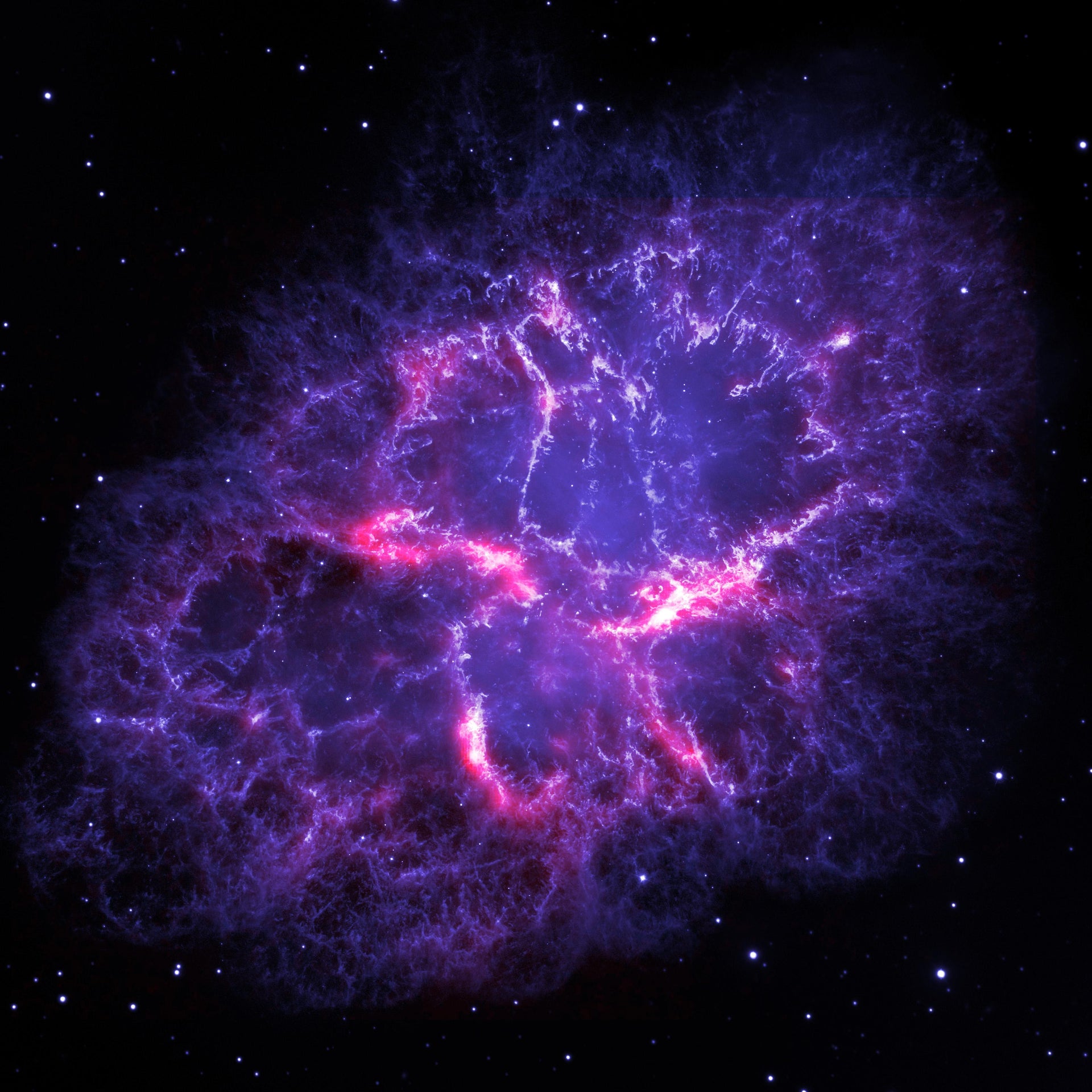
Stars die, but their death seeds new stars. The nebula from a gentle exhalation becomes the nursery for the next generation. The supernova debris — heavy with iron and gold and uranium — collapses into new molecular clouds, where gravity begins its patient work again.
This is the universe’s only manufacturing process. Gravity, fusion, collapse, repeat. There is no factory. There is no blueprint. There is only the cycle: matter falls inward, energy pushes outward, and in the space between those two forces, everything that has ever existed was made.
“There is no waste in the universe. There is only transformation. Every ending is an ingredient.”
Frequently Asked Questions
What determines how long a star lives?
Mass. This is the central paradox of stellar life: the more massive a star, the shorter it lives. A star like our Sun has enough hydrogen fuel to burn for roughly 10 billion years (it is currently about halfway through). A star 10 times our Sun’s mass burns through its fuel in tens of millions of years. The most massive stars, at 50 to 100 solar masses, may live only a few million years before exploding as supernovae. A small red dwarf star burns so slowly it could live for trillions of years, far longer than the current age of the universe.
What is a neutron star?
A neutron star forms when a massive star (roughly 8 to 20 solar masses) collapses at the end of its life in a supernova explosion. The core compresses so intensely that electrons and protons are forced together to form neutrons. The resulting object packs more mass than our Sun into a sphere roughly 20 kilometres across. A teaspoon of neutron star material would weigh approximately a billion tonnes on Earth. Some neutron stars spin hundreds of times per second, sweeping beams of radiation across the galaxy with the regularity of a lighthouse: we call these pulsars.
Where do the elements in the human body come from?
Almost every atom heavier than hydrogen and helium was forged inside a star. The carbon in your cells, the oxygen in your blood, the calcium in your bones: all of it was built by nuclear fusion in stellar interiors and scattered into space when those stars died, either by stellar winds or supernova explosions. The heaviest elements, including gold, platinum, and uranium, were forged in the extreme conditions of neutron star mergers. You are, in the most literal sense, made of dead stars. The universe built you from the inside of things that no longer exist.
What happens to stars like our Sun when they die?
When a Sun-like star exhausts its hydrogen fuel, it expands into a red giant, swelling to perhaps 200 times its current size (in our Sun’s case, engulfing Mercury, Venus, and possibly Earth). It then sheds its outer layers in a beautiful expanding shell of gas called a planetary nebula, leaving behind a dense, cooling remnant called a white dwarf: roughly Earth-sized, but with half the Sun’s mass packed inside. Over billions of years, the white dwarf cools and fades. This is the fate of the vast majority of stars in the universe.