

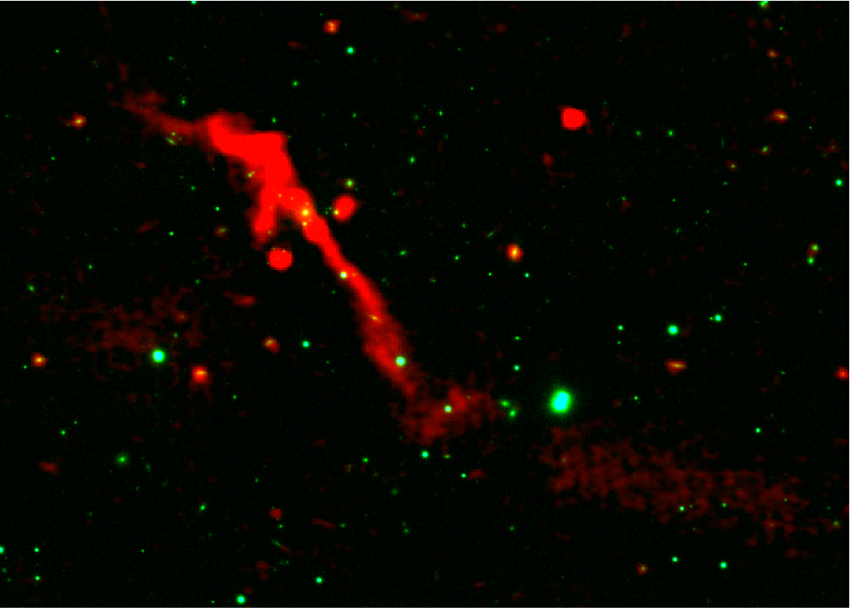
Somewhere in the universe, 100 million years passed in silence. A supermassive black hole at the heart of galaxy J1007+3540 had shut itself off: its jets extinguished, its furious output cooling into faint, ancient plasma that spread across the surrounding galaxy cluster and slowly faded. Then something changed. The black hole fired again. And what astronomers captured when they looked is not so much an explosion as a reckoning, a structure of plasma and radio light now stretching nearly a million light-years across space, ten times wider than our entire galaxy.
The image does not look like a textbook diagram. One lobe is compressed, warped, pushed inward by the dense gas pressure of a surrounding galaxy cluster. The other extends outward, fading. Threaded through both is the bright signature of the fresh jets, compact and fierce at the center, broadcasting the news that the silence is over.
The discovery
The finding was published in April 2026 in the Monthly Notices of the Royal Astronomical Society by a team led by Shobha Kumari of Midnapore City College in India, working alongside co-authors Sabyasachi Pal, Surajit Paul, and Marek Jamrozy. Their analysis combined observations from two of the most sensitive radio telescope arrays operating today: LOFAR, the Low Frequency Array distributed across Europe and centered in the Netherlands, and India’s uGMRT, the upgraded Giant Metrewave Radio Telescope.
The data told a layered story. LOFAR, sensitive to the faint, low-frequency glow of ancient plasma, revealed the outer lobes of J1007+3540: relics of an eruption cycle that ended roughly 100 million years ago, now compressed on one side by the pressure of the surrounding cluster environment. The uGMRT observations confirmed an ultra-steep radio spectrum in that compressed northern region, a hallmark of aging plasma that has lost most of its energy over cosmic time. Overlying both was something newer: a compact, bright jet signature at the galaxy’s core, undeniable evidence of recent reactivation.
“It’s like watching a cosmic volcano erupt again after ages of calm,” said Kumari in a statement accompanying the Royal Astronomical Society’s press release, “except this one is big enough to carve out structures stretching nearly a million light-years across space.”

Why this matters beyond one galaxy
J1007+3540 belongs to a class of objects that astronomers call episodic radio galaxies: systems where the supermassive black hole at the center has not been continuously active, but has cycled through distinct periods of eruption separated by long stretches of quiet. These objects are theoretically important, but clear examples have been difficult to catch. J1007+3540 is now among the most unambiguous cases ever observed, with multiple eruption cycles visible simultaneously in a single image.
What makes black hole jets more than a spectacular light show is their effect on the surrounding environment. When jets fire, they inject enormous amounts of energy into the hot gas of a galaxy cluster, heating it and suppressing the collapse of gas clouds that would otherwise form new stars. This process, called AGN feedback, is one of the key mechanisms by which supermassive black holes regulate the growth of entire galaxy clusters over billions of years. A black hole that cycles on and off, as J1007+3540 clearly does, applies that feedback in pulses, and the cluster’s gas has to absorb and recover from each one.
If you’ve explored the physics of event horizons and relativistic jets in IMBRIUM’s deep-dive on black holes, J1007+3540 shows what jet cycles look like from the outside, written in radio light across a structure that dwarfs anything in our cosmic neighborhood.
What comes next
The team plans follow-up observations at higher angular resolution to map the inner jet structure in finer detail and to understand what triggered J1007+3540’s reawakening. One leading hypothesis is that a fresh inflow of gas from the surrounding cluster environment fell onto the black hole, re-igniting the accretion process that powers the jets. If confirmed, it would suggest a self-regulating cycle: the black hole heats the cluster gas, the gas stops feeding the black hole, the jets fade, the cluster gas cools and rains back inward, and the cycle begins again.
As LOFAR and uGMRT survey programs extend their reach across wider areas of sky, astronomers expect to identify many more episodic radio galaxies hiding in plain sight, their past and present eruptions recorded in fading plasma and fresh radio emission. Each one is a record of a process that has been shaping the large-scale structure of the universe for billions of years, one hundred-million-year silence at a time.
There is a galaxy cluster out there that has absorbed this eruption, survived the silence, and is now absorbing the next one. It has been doing so, without an audience, for longer than complex life has existed on Earth.
