

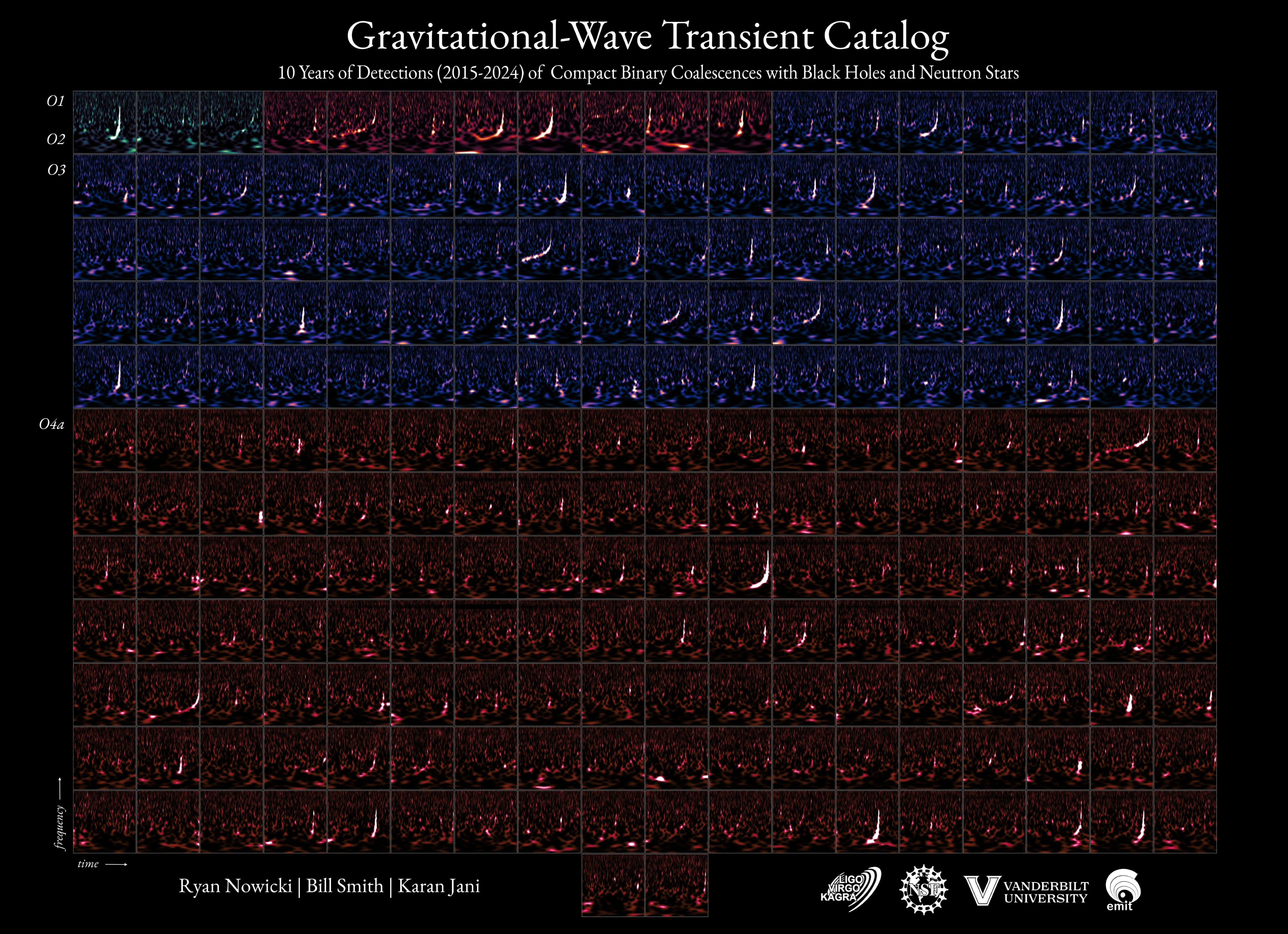
Every collision happened in silence. No flash, no debris field, no shockwave racing through gas. Just a shiver in spacetime itself, a ripple so faint it would stretch a four-kilometre laser beam by less than the width of a proton. And yet, if you know how to listen, the universe is full of them.
The LIGO, Virgo, and KAGRA observatories have now heard 391 gravitational-wave events across four observing runs: black holes swallowing black holes, neutron stars crashing into neutron stars, and the occasional mismatched pair of one devouring the other. A new catalog, published in March 2026, more than doubled the confirmed count in a single release. But the real surprise was not the volume. It was one collision, detected six years ago, that turned out to be moving wrong.
The GWTC-4 Catalog That Doubled the Count
On 5 March 2026, the LIGO-Virgo-KAGRA (LVK) Collaboration published GWTC-4.0, the fourth version of its Gravitational-Wave Transient Catalog, in a special issue of The Astrophysical Journal Letters. The update adds 128 new events from the first segment of the fourth observing run (O4a, May 2023 to January 2024). The formal catalog now contains 218 confirmed detections, more than doubling the 90 events compiled from all three previous runs.
Among the new entries are some extraordinary outliers. GW231123 captured two black holes spiralling together, each roughly 130 times the mass of our Sun, making it the heaviest binary merger ever detected. These masses suggest the black holes were themselves products of earlier collisions. Another event, GW231028, featured both black holes spinning at approximately 40 percent the speed of light, the fastest inspiral spins observed. And GW231118 paired two black holes of wildly unequal mass, one nearly twice as heavy as the other.
The catalog also delivered a new, independent measurement of the Hubble constant, the rate at which the universe is expanding: 76 kilometres per second per megaparsec. Gravitational waves offer a fundamentally different yardstick from the methods astronomers have used for decades, and every new merger sharpens the measurement.
The One That Moved Wrong
The most provocative result came not from the new catalog, but from a second study published six days later. On 11 March 2026, researchers re-analysed an event first detected on 5 January 2020: GW200105, a black hole swallowing a neutron star.
Using a new gravitational-wave model developed at the University of Birmingham’s Institute of Gravitational Wave Astronomy, the team measured something no one had confirmed in this type of collision before. The two objects were not spiralling inward on a neat circular path. They were tracing an ellipse, an oval, and the researchers ruled out a circular trajectory with 99.5 percent confidence. The merger produced a black hole roughly 13 times the mass of our Sun. But it was the shape of the orbit, not the size of the result, that mattered.

Why an Oval Orbit Changes Everything
To understand why this is extraordinary, you need to know what gravitational-wave astronomers have come to expect. Binary systems that form together, two stars born from the same cloud orbiting each other for billions of years, gradually lose energy through gravitational radiation. That slow leak circularises their orbits long before they finally merge. By the time LIGO can detect them, the path should be almost perfectly round.
GW200105 was not round. “The orbit gives the game away,” said Geraint Pratten, a Royal Society University Research Fellow at the University of Birmingham. “Its elliptical shape just before merger shows this system did not evolve quietly in isolation but was almost certainly shaped by gravitational interactions with other stars, or a third companion.”
This points to a fundamentally different formation channel: dynamical capture. In dense stellar environments, like the cores of globular clusters where thousands of stars crowd into a few light-years, a black hole and a neutron star can encounter each other by chance, lock into a gravitational embrace, and merge on a timescale too short for their orbit to circularise. It is a chance encounter, not a long partnership.
“This is convincing proof that not all neutron star–black hole pairs share the same origin,” said Gonzalo Morras of the Universidad Autónoma de Madrid and the Max Planck Institute for Gravitational Physics.
The re-analysis also corrected earlier measurements. Previous studies, which assumed a circular orbit, had underestimated the black hole’s mass and overestimated the neutron star’s. The new model, which measured both eccentricity and precession simultaneously for the first time in this event type, brought both values into sharper focus.
What Comes Next
The 218 events in GWTC-4.0 represent only the first nine months of a run that lasted two and a half years. The full O4 campaign, which concluded in November 2025, detected roughly 300 merger candidates in total, with 173 still awaiting detailed analysis. A formal catalog covering the rest of O4 is expected in the coming years.
The next observing run, designated IR1, is planned to begin between September and October 2026. With each upgrade the detectors grow more sensitive: LIGO can now detect binary neutron star mergers at distances up to 360 megaparsecs (roughly one billion light-years). Black hole mergers register from tens of times farther.
The eccentric orbit of GW200105 opens a new line of inquiry. If dynamical captures are common in dense stellar environments, more eccentric mergers should surface as analysis of the remaining O4 data continues. Each one will be a clue to the invisible architecture of star clusters and the chance gravitational encounters that shape them.
Three hundred and ninety-one ripples in the dark, and we are only just learning to read the shapes they trace on their way to silence.

