
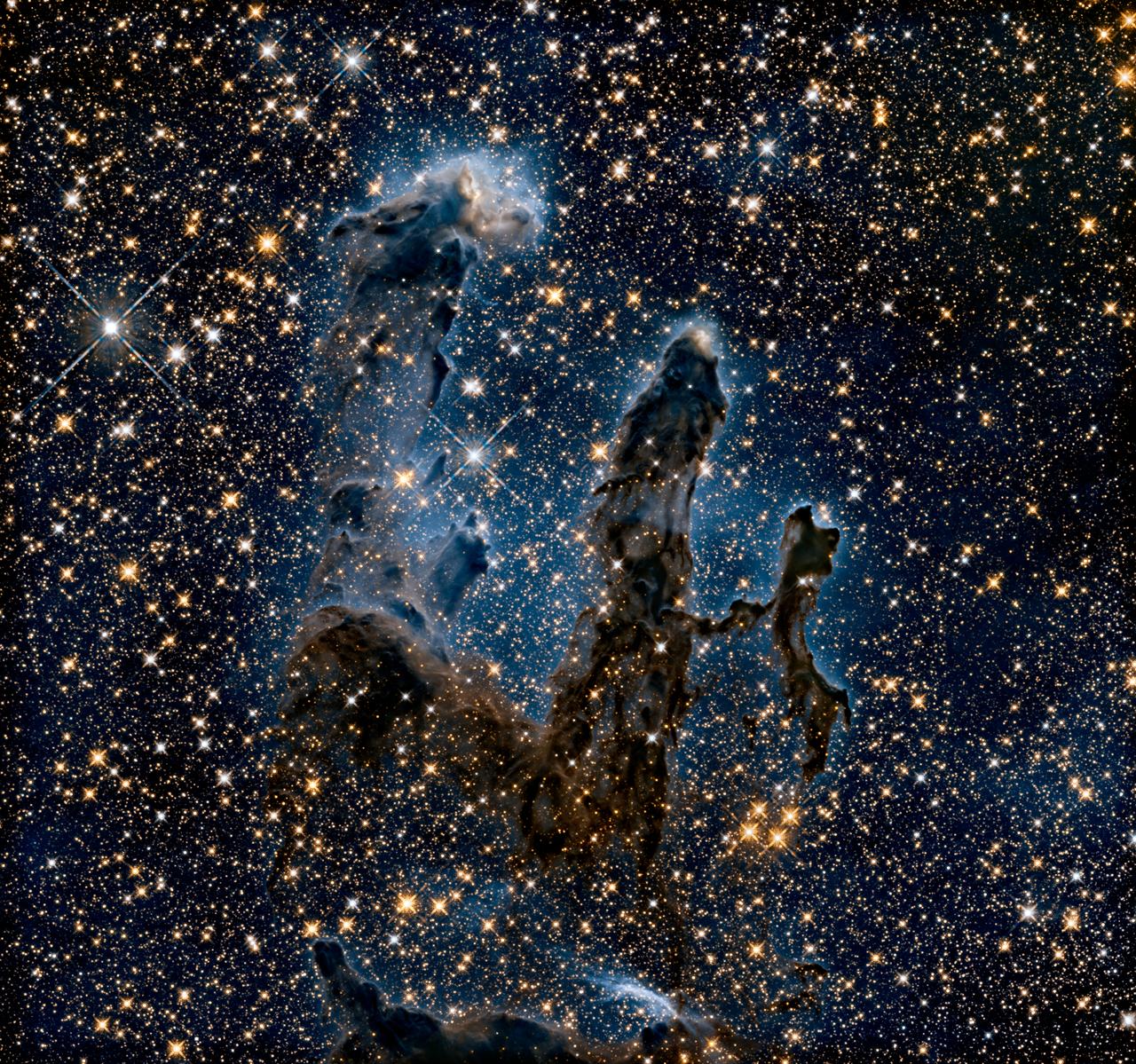
The Pillars of Creation Are Already Gone
You are looking at a photograph of something that may no longer exist. The light showing its destruction hasn’t reached us yet.
You Are Looking at Something That May Already Be Gone
On April 1, 1995, the Hubble Space Telescope pointed its Wide Field and Planetary Camera 2 at a small region of the Eagle Nebula and captured what would become the most iconic photograph in the history of astronomy. Three colossal columns of cold molecular hydrogen, backlit by the fierce ultraviolet radiation of nearby newborn stars, rising like cathedral spires out of a glowing mist.
They called them the Pillars of Creation.
The name was not metaphor. Inside those columns, shielded from the radiation that is slowly eroding them from without, new stars are forming. Protostars still accreting matter, still collapsing under their own gravity, not yet hot enough to ignite fusion. The pillars are a nursery. The stars being born inside them will, eventually, destroy them.
But that slow destruction may already be irrelevant. Because something faster got there first.
“We are seeing the pillars as they were 6,500 years ago. If the supernova interpretation is correct, the pillars have already been destroyed — we just haven’t received the news yet.”
— Nicolas Flagey et al., Spitzer Science Centre, 2007
The Eagle Nebula sits approximately 6,500 light-years from Earth. Every photon arriving at Hubble’s sensors in 1995 left the nebula around 4500 BCE — before the first Egyptian dynasty, before Stonehenge, before writing. We are not looking at the pillars as they are. We are looking at a memory.
And that memory may be of something that no longer exists.
Inside the Pillars, Stars Are Being Born
The Pillars of Creation are not solid. They are columns of cold, dense molecular hydrogen — H₂ — mixed with dust grains and trace molecules. Each pillar is roughly 4 to 5 light-years tall. For scale: our entire solar system, from the Sun to Neptune’s orbit, spans 0.0009 light-years. You could fit over 5,000 solar systems end-to-end inside a single pillar.
At the tips of each pillar sit dense knots of gas called Evaporating Gaseous Globules — EGGs. These are the birthing chambers. When an EGG accumulates enough mass, it collapses under its own gravity, heats up, and eventually ignites hydrogen fusion. A new star is born.
The pillars survive because the EGGs at their tips are dense enough to shield the column behind them from the ultraviolet radiation flooding in from the nearby open cluster NGC 6611 — a collection of roughly 460 young, massive O- and B-type stars, barely 1 to 2 million years old, blazing with hundreds of thousands of times the Sun’s luminosity.
The pillars are what’s left. Once, this region was a single, vast molecular cloud. The stars of NGC 6611 formed inside it, then began destroying it from within. The pillars are the last remnants — the columns that happened to have dense enough tips to survive the onslaught a little longer than the surrounding material.
They are simultaneously a birthplace and a ruin. Stars are forming inside structures being sculpted into oblivion by the previous generation of stars.
Sculptures Carved by Radiation
The O-type stars of NGC 6611 emit ultraviolet radiation thousands of times more intense than anything in our solar neighbourhood. This radiation ionises the surfaces of the pillars, heating the outermost layer of gas until it boils away into space. The process is called photoevaporation.
The pillars are being eroded from the outside in. Numerical models suggest this grinding alone would disperse the pillars on timescales of a few hundred thousand years — a blink in cosmic time. They are beautiful precisely because they are dying. Radiation sculpts; gravity accumulates. The result is architecture that looks designed but is merely the residue of destruction.
To feel the scale of what is being destroyed, try placing our solar system inside a pillar.
The pillars are vast. And photoevaporation, while relentless, is slow. At current erosion rates, the pillars might endure another 100,000 years. But in 2007, a different instrument saw something that changed the timeline entirely.
A Supernova May Have Already Destroyed Them
In 2007, NASA’s Spitzer Space Telescope observed the Eagle Nebula in infrared and found something that shouldn’t have been there: a massive shell of hot dust, glowing at wavelengths invisible to Hubble, sitting immediately adjacent to the pillars.
The interpretation, presented by Nicolas Flagey and colleagues at the 209th meeting of the American Astronomical Society: a supernova detonated within NGC 6611. The blast wave has already reached the pillars. The hot dust shell is the smoking gun — material heated by a shock wave that has already passed through.
If the supernova interpretation is correct, the shock wave hit the pillars approximately 6,000 years ago. The pillars were dispersed — shredded, heated, scattered into the surrounding nebula. But the light from that event left the Eagle Nebula 6,000 years ago, travelling toward us at the speed of light. It hasn’t arrived yet. It is still approximately 1,000 light-years away.
We will see the destruction in about 1,000 years. Until then, we see ghosts.
Important caveat: The supernova interpretation is not universally accepted. Some astronomers argue the hot dust could be heated by stellar winds from O-stars rather than a supernova blast. The evidence is suggestive but not conclusive. The paradox, however, does not require the supernova to be true — even under photoevaporation alone, the pillars we see no longer look like what we are seeing. 6,500 years of erosion has changed them, and we cannot know how.
Use the timeline below to feel the gap between what happened and what we see.
The Information Has Not Arrived
This is not like looking at an old photograph. You can take an old photograph and then walk outside to see what the place looks like now. You can verify. You can update your information.
With the Pillars of Creation, you cannot. The information about their current state is physically travelling toward you at 300,000 kilometres per second, and it has not arrived. No amount of technology can retrieve it faster. No future telescope, no faster computer, no cleverer algorithm. The light is in transit. It will arrive when it arrives.
It is like receiving a letter that was mailed before the sender died. The letter tells you they are fine. They are not. But you do not know that yet. You cannot know it yet. The postal system has a speed limit, and the letter is still in the mail.
Everything we see in the night sky is the past. The further we look, the deeper into history we see. The Pillars of Creation make this visceral — because the thing we’re looking at may no longer be there at all.
When the James Webb Space Telescope turned its infrared eyes on the same region in October 2022, it was not looking at a more recent version of the pillars. The light it collected left the nebula at the same time as the light Hubble collected — 6,500 years ago. JWST sees the same moment in different wavelengths. Not a newer moment. The same moment, stripped of dust.
Infrared Strips the Veil Away
In visible light, the pillars are opaque. Dust absorbs and scatters optical wavelengths. You see the surface — the sculpted edges, the glowing tips, the shadowed interiors. You do not see what is inside.
In near-infrared (JWST NIRCam), dust becomes translucent. Suddenly, thousands of previously hidden stars appear. Hundreds of young stellar objects — protostars still wrapped in accretion disks, only a few hundred thousand years old — glow through the columns. The pillars are full of children.
In mid-infrared (JWST MIRI), the stars vanish entirely — they do not emit much at these wavelengths. Only the dust itself glows: ghostly blue-grey columns, darkest where densest. You are seeing the architecture of future star systems — the raw material that will, given enough time, collapse into new worlds.
Toggle between wavelengths below to see what each reveals.


The pillars are dying. But their children — the protostars hidden inside — will outlive them. When the columns finally disperse, whether by slow erosion or sudden violence, the young stars will emerge into open space, fully formed. The nursery will be gone, but the graduates will endure.
Every Nursery Is Destroyed by Its Own Children
The Pillars of Creation are not unique. Every star-forming region in the universe follows the same script. Gas collapses. Stars ignite. The most massive stars — the O-types, the blue giants — flood their surroundings with radiation and, eventually, explode. The radiation and the explosions destroy the very cloud that made them.
This is not a flaw in the process. It is the process. Stellar feedback — the energy that young stars pour back into their environment — prevents molecular clouds from converting all their mass into stars at once. Without it, galaxies would have exhausted their gas supply billions of years ago. Nothing new would be forming. The universe would be full of old, dead stars and nothing else.
The destruction is the regulation. The killing is the kindness. Every nursery must die so that its material can disperse, cool, accumulate again somewhere else, and form a new generation of stars in a new cloud, in a new region, millions of years later.
The Pillars of Creation are one frame in this cycle. We happened to look at the right moment — after the stars were born but before the pillars were fully erased. A century earlier and Hubble would have seen a denser, less sculpted cloud. A thousand years later, and there may be nothing to photograph at all.
You are made of material that was once inside a pillar like these. Some molecular cloud, some nursery, some set of EGGs that collapsed and ignited, billions of years before the Eagle Nebula existed. That cloud is gone now. The star it made lived and died, and its debris became you.
The pillars may already be gone. Their children will not mourn them. They will shine for billions of years, forge heavy elements in their cores, and when they die, scatter those elements across space. And somewhere, far away and far in the future, new pillars will rise from the debris — and the cycle will begin again.