
Timeline of the Universe
From the first 10⁻⁴³ seconds to the death of the last star. Scroll through 13.8 billion years.
The Big Bang
In the first 10⁻³² seconds, the universe was smaller than a proton and hotter than anything that has existed since. Space itself was being created — not expanding into something, but generating the something.
Then inflation. In 10⁻³⁶ seconds the universe expanded by a factor of 10²⁶. Every particle was flung away from every other particle faster than light — not because they moved, but because space itself stretched between them.
The Particle Epoch
For one millionth of a second the universe was a quark-gluon plasma — a roiling soup of matter and antimatter annihilating each other in an endless cascade of creation and destruction.
For every billion antimatter particles, there were a billion and one matter particles. That tiny asymmetry — one extra grain of matter per billion — is everything you have ever seen or touched or loved.
Nucleosynthesis
For twenty minutes the universe was a nuclear reactor. Protons and neutrons slammed together at millions of degrees, fusing into the lightest elements — hydrogen, helium, and a whisper of lithium.
Then the temperature dropped below the fusion threshold, and the reactor shut down. In those twenty minutes, the universe forged nearly all the hydrogen and helium it would ever have. Everything heavier would have to wait for stars.
The Fog Clears
For 380,000 years the universe was a blinding fog — photons could not travel more than a few steps before scattering off free electrons. Then the temperature fell below 3,000 K, electrons bound to nuclei, and atoms formed for the first time.
Suddenly the fog lifted. Light streamed freely across the cosmos for the first time. That light is still travelling — stretched by 13.8 billion years of expansion into microwaves. We call it the Cosmic Microwave Background, and it is the oldest photograph in existence.
The Dark Ages
For 200 million years, the universe was transparent but dark. No stars, no light sources — just vast clouds of neutral hydrogen drifting through an expanding void, waiting for gravity to do its work.
In the deepest silence the cosmos has ever known, gravity was quietly pulling gas into the first density fluctuations. Somewhere in the darkness, the first collapse had begun.
First Light
The first stars were monsters — hundreds of times the mass of our Sun, burning at 50,000 K, blazing blue-white against 200 million years of darkness. Population III stars, astronomers call them. None survive today.
Their ultraviolet radiation tore electrons from surrounding hydrogen, carving expanding bubbles of ionized gas. More stars ignited. Bubbles overlapped and merged. In a few hundred million years, the entire universe was reionized — lit from within.
The Cosmic Web
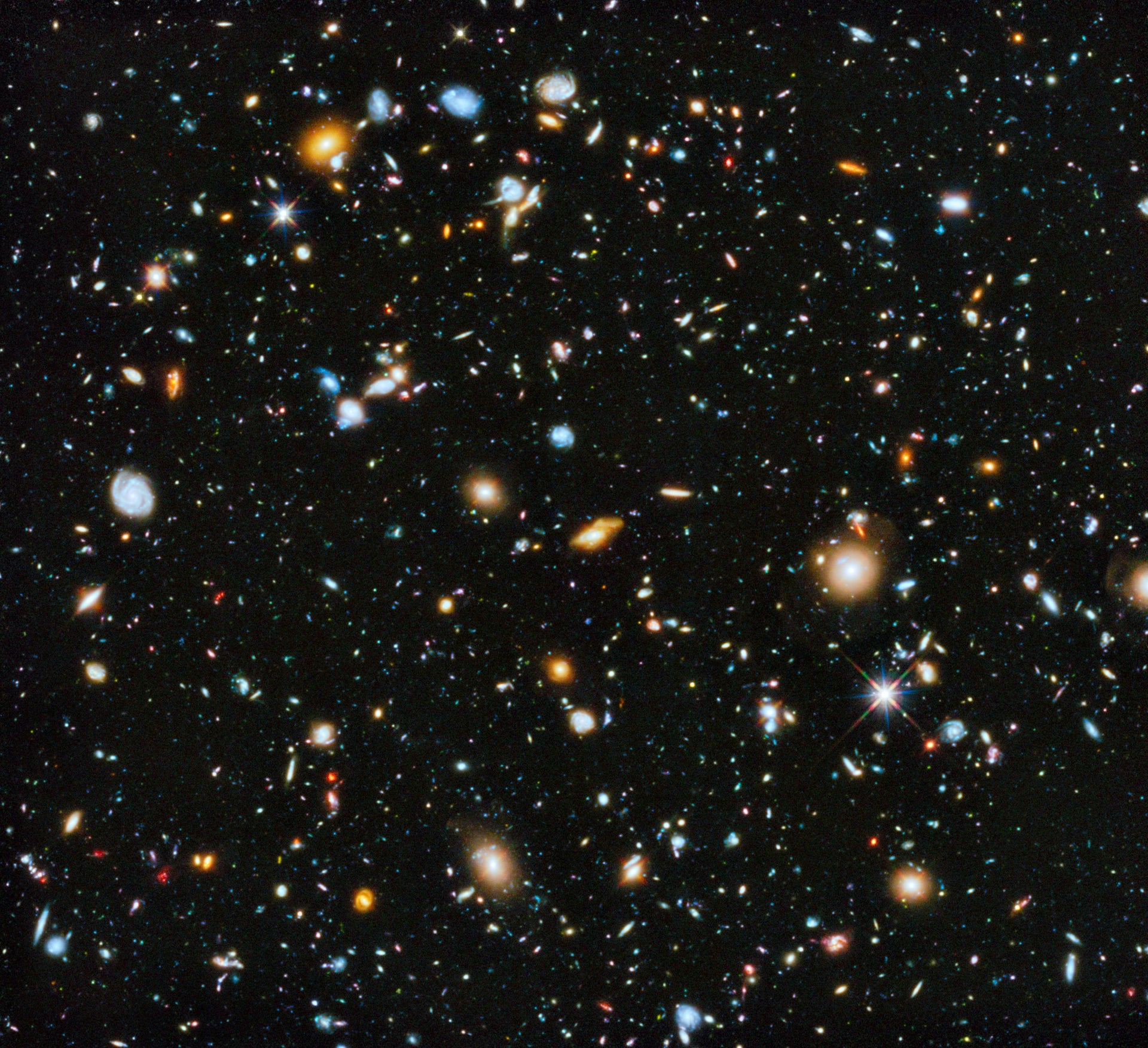
Gravity sculpted the cosmos into a web of luminous filaments and dark voids. At every intersection where filaments crossed, matter collapsed into spinning disks of gas and stars — galaxies.
Our own Milky Way formed 13.2 billion years ago at one such intersection. A hundred billion stars settled into a spiral 100,000 light-years across — unremarkable among the two trillion galaxies that would eventually fill the observable universe.
Our Star, Our World
Nine billion years after the Big Bang, in an unremarkable arm of an unremarkable galaxy, a cloud of gas and dust collapsed. At its center a yellow dwarf star ignited. Around it, a spinning disk of debris clumped into eight planets.
The gas giants formed first — Jupiter in three million years, Saturn shortly after. Then the rocky worlds: Mars, Earth, Venus, Mercury. On the third rock from the Sun, liquid water pooled on the surface. Chemistry became biology. The universe had made something that could look back at itself.
The Long Goodbye
Time accelerates. Five billion years from now, the Sun swells into a red giant and swallows the Earth. Stars burn through their fuel and die — the blue ones first, then the yellow, then the red. The last red dwarfs flicker out in 100 trillion years.
Black holes evaporate over unimaginable timescales. Protons themselves decay. In 10¹⁰⁰ years, the universe is nothing but cold, empty space — a few stray photons drifting through an infinite void. It ends as it began: in darkness.