

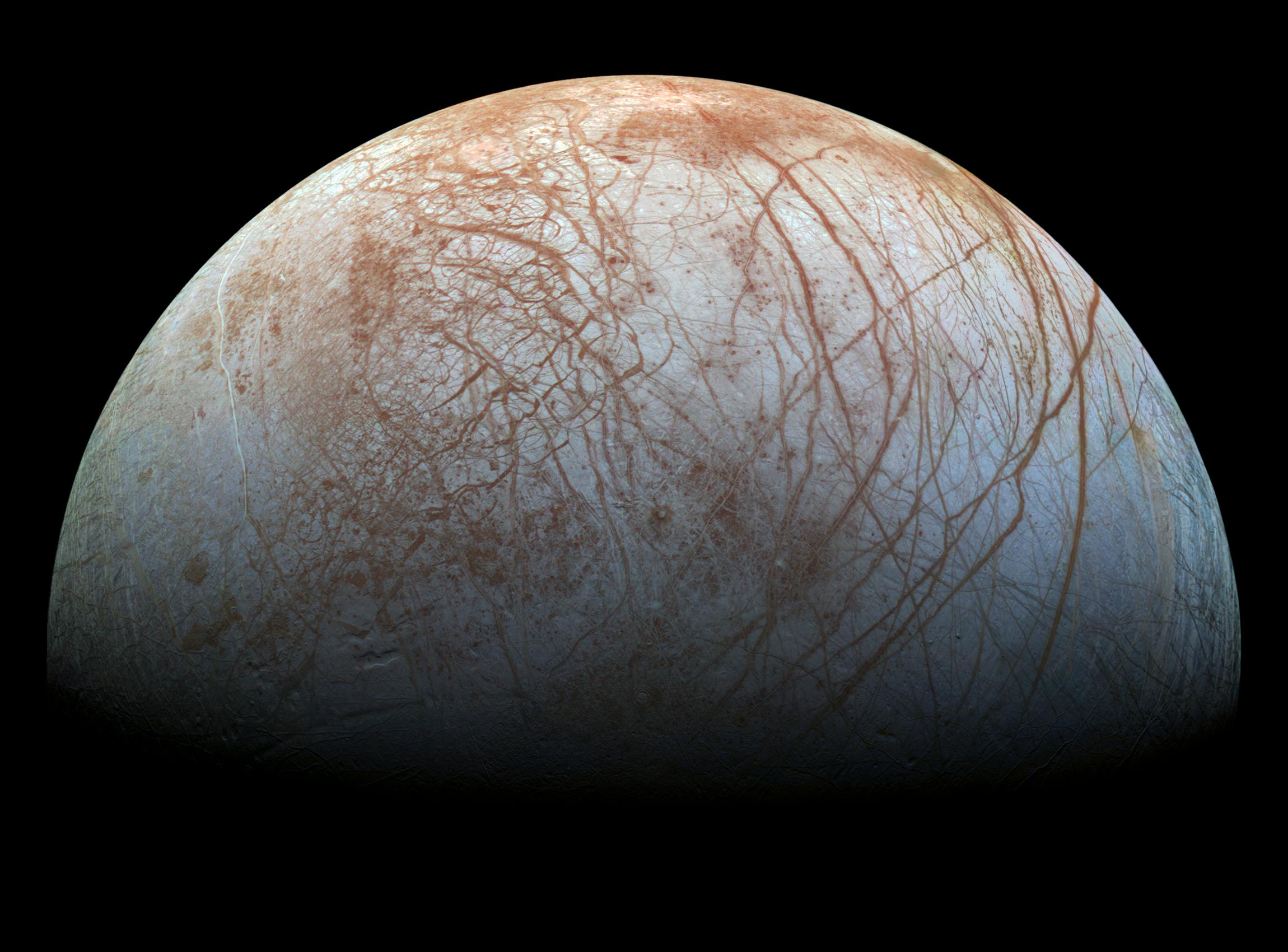
There is an ocean on Europa. Not a remnant, not a trace — a living body of water, sealed beneath 10 to 30 kilometers of fractured ice, holding roughly twice the liquid volume of every sea on Earth. It has been there for billions of years, kept from freezing by Jupiter’s gravitational grip, which kneads the moon’s interior like dough and generates enough internal heat to sustain a world of water in the dark.
We have suspected this since the Galileo spacecraft first detected Europa’s anomalous magnetic field in the late 1990s — a field that only makes sense if a layer of electrically conductive, saline water sits beneath the ice. Now, for the first time, we have sent something built specifically to find out what is in that ocean.
A Basketball Court Crossing the Solar System
Europa Clipper launched on October 14, 2024, aboard a SpaceX Falcon Heavy from Kennedy Space Center. With its solar arrays fully deployed, the spacecraft spans more than 100 feet (about 30 meters) — roughly the width of a basketball court — making it the largest planetary science mission NASA has ever flown. At Jupiter, that entire array will generate just 700 watts of electricity. Sunlight at that distance is 25 times weaker than it is at Earth, and the spacecraft was designed around that constraint from the beginning.
The mission is already on course. Europa Clipper made a gravity assist at Mars on March 1, 2025, skimming 884 kilometers above the surface to reshape its trajectory. That pass was not wasted: the spacecraft used it to test REASON, its ice-penetrating radar, bouncing signals off the Martian plains for 40 minutes and returning 6 gigabytes of instrument data. The radar performed exactly as expected. An Earth gravity assist follows on December 3, 2026. Jupiter arrival is set for April 2030.
Once in the Jovian system, Europa Clipper will orbit Jupiter — not Europa, whose intense radiation would quickly destroy the spacecraft — and make 49 close flybys of the moon over four years, swooping as low as 25 kilometers (16 miles) above the ice. On every pass, all nine science instruments will fire simultaneously.
What the Instruments Are Looking For
Each instrument was designed around a specific gap in our knowledge. REASON will transmit radar pulses through the ice shell, mapping its internal structure and searching for pockets of liquid water that may lie close to the surface — places where the boundary between ocean and crust is thin enough to be relevant to life. MASPEX, the mass spectrometer, will taste whatever escapes into space. The Hubble Space Telescope has observed what appear to be cryovolcanic plumes erupting from Europa’s surface; if Clipper passes through one, MASPEX could detect organic compounds, salts, and gases that would reveal the ocean’s chemistry directly. E-THEMIS, a thermal imager, will identify warm regions in the ice where heat from below may be bringing liquid close to the surface.
And the magnetometer — already deployed to its full 8.5-meter boom — will take precise measurements of the induced magnetic field on every flyby. Where Galileo could only confirm the ocean’s existence, Europa Clipper’s repeated passes will let scientists calculate the ocean’s depth, salinity, and the thickness of the ice shell above it with far greater confidence.
The question Clipper is designed to answer is not “is there an ocean?” That is already well established. The question is whether that ocean is habitable: whether it contains liquid water, chemical energy, and the organic building blocks that, on Earth, are sufficient conditions for life. Finding all three would not confirm life on Europa. But it would bring us to the edge of that conversation in a way that nothing has before. To understand what that would mean for our place in the universe, it helps to consider civilization in the terms of the Kardashev Scale — and to ask what it means to move from a species that wonders about life elsewhere to one that has reason to believe.
What Comes Next
Europa Clipper’s prime mission runs from 2030 through approximately 2034. The data it returns will take years to analyze fully, but the mission’s findings will directly shape everything that follows. A habitability assessment — the right chemistry, the right temperatures, the right proximity of water to the ice surface — would give future planners the scientific justification for a lander. That mission does not yet have a name or a budget. But it has, in Europa Clipper, the scout that could make it unavoidable.
The spacecraft is already out there, crossing the void, instruments checking out, solar arrays catching the fading light of a sun that grows more distant every day.
Beneath 30 kilometers of ice, something has had four billion years to figure out how to survive — and we are finally close enough to ask.

