
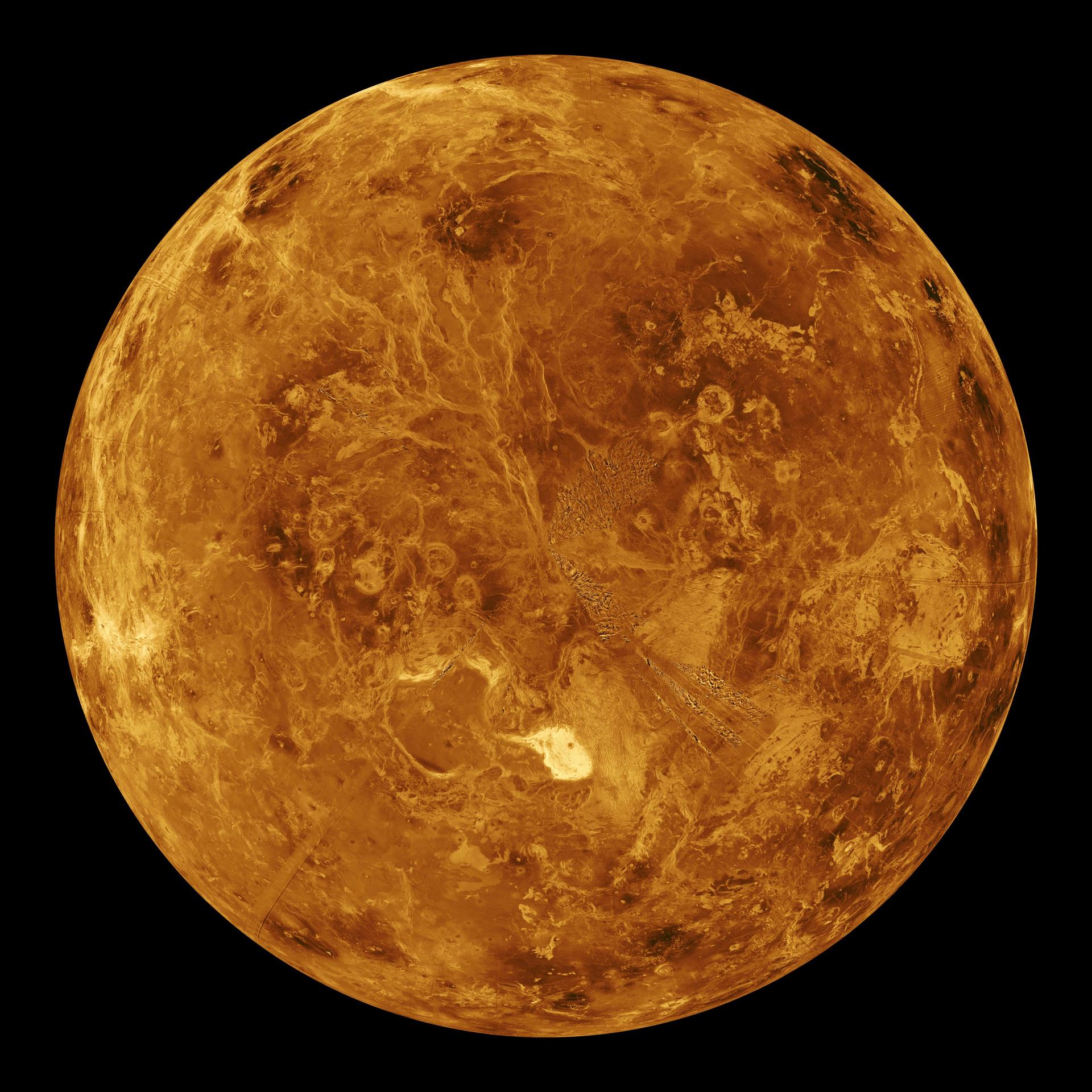
A Day on Venus Is Longer Than Its Year
Venus takes 243 Earth days to spin once — but only 225 to orbit the Sun. It also spins backwards. This is the story of the planet that does everything wrong.
A Clock That Makes No Sense
Here is a fact that sounds like a mistake: a day on Venus is longer than a year on Venus.
Venus takes 243 Earth days to rotate once on its axis. It takes 225 Earth days to complete an orbit around the Sun. The planet finishes its year before it finishes a single spin. If you could stand on Venus and watch the Sun cross the sky — assuming you could see through the permanent cloud cover, and assuming you survived the surface conditions for more than a few seconds — you would wait 116.75 Earth days between one sunrise and the next. That is the solar day: the time between noon and noon, as experienced by someone on the surface.
But the deeper number, the sidereal day — one full rotation relative to the distant stars — is 243.025 Earth days. Longer than the year. This is not a marginal difference. It is not a rounding artefact. The day is genuinely, substantially longer than the year.
No other planet in our solar system does this. And that is only the beginning of what is strange about Venus.
243 Days to Spin, 225 Days to Orbit
The paradox becomes vivid when you watch both clocks run side by side. Venus crawls through its rotation while its orbit completes and starts again. Earth, for comparison, spins 365 times in the time it takes to orbit once. Venus spins 0.93 times.
Watch it long enough and the dissonance becomes physical. Earth’s spin is fast and familiar — a reassuring metronome. Venus barely moves. Its orbit outpaces its spin so dramatically that the planet completes a full trip around the Sun while still facing mostly the same direction it started in.
Retrograde Rotation
Venus does not merely spin slowly. It spins in the wrong direction.
Every other planet in the solar system rotates counterclockwise when viewed from above the north pole — the same direction they orbit the Sun. (Uranus is tilted on its side, which complicates the comparison, but its rotation is broadly prograde.) Venus rotates clockwise. If you could hover above Venus’s north pole and watch, the planet would be turning the opposite way from its orbit, the opposite way from every other planet, the opposite way from the original spin of the protoplanetary disk that formed the solar system.
On Venus, the Sun rises in the west and sets in the east.
Why? There are two leading hypotheses, and neither is fully settled. The first: early in its history, Venus was struck by a massive impactor that flipped its rotation axis. The Moon-forming impact on Earth was large enough to eject a moon’s worth of material into orbit; an even larger or differently angled impact could, in principle, reverse a planet’s spin entirely. The second hypothesis is subtler and more unsettling: Venus’s thick atmosphere may have done it. Gravitational tidal interactions between the Sun and Venus’s dense atmosphere could have gradually slowed, stopped, and reversed the planet’s rotation over billions of years — a kind of atmospheric brake applied across geological time.
If the second hypothesis is correct, Venus did not start this way. It was turned backwards by its own air.
Surface Conditions
Venus is the hottest planet in the solar system. Not Mercury, which is closer to the Sun. Venus. The surface temperature is 465°C — hot enough to melt lead, hot enough to melt zinc, hot enough that the Venera landers the Soviet Union sent in the 1970s and 1980s survived for between 23 minutes and two hours before their electronics failed.
The reason is the atmosphere. Venus is wrapped in a blanket of carbon dioxide 96.5% thick, with clouds of sulfuric acid, and a surface pressure 92 times that of Earth. Ninety-two atmospheres. The pressure at the bottom of Venus’s sky is equivalent to being 900 metres underwater in Earth’s oceans. The CO₂ traps solar heat so efficiently that the temperature barely varies between day and night, between equator and pole, between noon and midnight on a planet where midnight lasts for weeks.
This is a runaway greenhouse effect. Not a metaphor. Not an analogy for what could happen on Earth. The actual physical process, carried to its thermodynamic conclusion. The greenhouse mechanism that makes Earth habitable — trapping enough heat to keep water liquid — went wrong on Venus. Or rather, it went right, in the physics sense. It did exactly what the equations predict. It just kept going.
Through the Atmosphere
Imagine descending through Venus’s atmosphere. At 250 kilometres, you are above the clouds in thin, cold haze. By 65 kilometres, you enter the sulfuric acid cloud deck — visibility drops to almost nothing. At 48 kilometres, the clouds clear and the temperature is already above 100°C. The light is dim and orange, filtered through kilometres of CO₂. As you fall further, the atmosphere thickens. By the time you reach the surface, the air is so dense it behaves almost like a fluid. Light refracts so severely that if you could see, the horizon would appear to curve upwards, as if you were standing inside a bowl.
The Venera programme sent ten landers to the surface between 1970 and 1985. Venera 7 was the first spacecraft to return data from the surface of another planet. Venera 13 survived 127 minutes — the record — and sent back the only colour photographs ever taken on the surface of Venus. They show a landscape of flat, fractured basalt under an orange sky. No erosion patterns from water. No softening. Just rock and heat and pressure, going on forever.
The Divergence
Venus is almost exactly the same size as Earth. Its diameter is 95% of Earth’s. Its mass is 82% of Earth’s. Its gravity is 90% of Earth’s. If you stood on Venus (momentarily, before dying), you would weigh almost the same as you do now. For decades, before radar and spacecraft revealed the surface, astronomers called Venus Earth’s twin and imagined it as a warm, humid world — possibly covered in oceans, possibly harbouring life.
They were not wrong about the oceans. They were wrong about the timing.
Recent climate models suggest that Venus may have had liquid water on its surface for two to three billion years. Not a brief episode. Billions of years of oceans, of water cycles, of a planet that looked, from the right distance, remarkably like Earth. The models are not speculative: they are based on general circulation models (GCMs) adapted from Earth climate science, constrained by Venus’s topography as mapped by Magellan in the 1990s and its current atmospheric isotope ratios.
The deuterium-to-hydrogen ratio in Venus’s atmosphere is roughly 150 times higher than Earth’s. Deuterium is heavier than hydrogen and escapes to space more slowly. A high D/H ratio is the chemical signature of a planet that once had far more water than it has now — the lighter hydrogen escaped, the heavier deuterium stayed behind. Venus is telling us, in its atmospheric chemistry, that it used to have water. Lots of it.
So what happened?
The Sun got brighter. Stars on the main sequence increase in luminosity over time, and the Sun is roughly 30% brighter today than it was four billion years ago. Venus, closer to the Sun than Earth, hit a threshold: the point at which increased solar energy evaporated enough surface water to push the atmosphere past a critical greenhouse limit. Water vapour is a powerful greenhouse gas. More heat meant more evaporation, which meant more greenhouse trapping, which meant more heat. The feedback loop ran away. The oceans boiled. The water vapour rose into the upper atmosphere, was broken apart by ultraviolet radiation, and the hydrogen escaped to space. The oxygen reacted with surface minerals and disappeared. What was left was a dry, thick, CO₂-dominated atmosphere sitting on a planet that remembers nothing of its oceans except a faint isotopic signature.
When Did Venus Diverge?
Four and a half billion years ago, Venus and Earth were almost indistinguishable. Same neighbourhood, same building materials, similar mass. They diverged not because of a single event, but because of a slow, inexorable difference in their distance from the Sun.
The timeline is a warning and a wonder. Two planets, born together, and one of them kept its oceans while the other lost everything. The difference was not dramatic. It was a few tens of millions of kilometres of orbital distance, compounded by physics over geological time.
Return to Venus
For thirty years, Venus was neglected. After Magellan finished its radar mapping in 1994, no dedicated mission went to Venus. Mars captured the planetary science budget and the public imagination. But three missions are now approved and in development, and they represent the most ambitious exploration of Venus since the Soviet Venera programme.
VERITAS (NASA) will orbit Venus with a synthetic-aperture radar far more capable than Magellan’s, mapping the surface at roughly 30-metre resolution and measuring topographic changes that could reveal active volcanism. If Venus has active volcanoes — and recent evidence from Magellan data reanalysis strongly suggests it does — VERITAS will confirm it.
DAVINCI+ (NASA) will drop a descent probe into Venus’s atmosphere, measuring its composition in detail as it falls. The probe will sample noble gases and their isotopes, which are the most reliable tracers of a planet’s volatile history. DAVINCI+ will answer the question of how much water Venus once had more precisely than any measurement before it. It will also take the first high-resolution images of Venus’s tessera terrain — ancient, heavily deformed highlands that may be the remnants of continental crust from Venus’s habitable era.
EnVision (ESA) will study Venus as a system — atmosphere, surface, interior, and how they interact. Its radar will image the surface at scales as small as a few metres, and its spectrometers will map surface composition for the first time from orbit.
Together, these three missions will answer a question that has been open since the Space Age began: was Venus once habitable, and if so, what exactly killed it?
What Venus Tells Us About Ourselves
Venus is not interesting because it is alien. It is interesting because it is familiar.
A planet the same size as ours. The same raw materials. Probably the same early conditions: liquid water, a nitrogen-rich atmosphere, moderate surface temperatures. For billions of years, Venus was arguably habitable. And then it wasn’t. The physics of greenhouse warming, given enough time and enough proximity to a brightening star, crossed a threshold that could not be uncrossed. The feedback loop ran to completion. The water is gone.
We study Venus not because it is far away, but because it is the closest example of what a planet looks like after the worst-case climate outcome. It is Earth with different initial conditions — not drastically different, just slightly different — compounded over four and a half billion years. A cautionary tale written in sulfuric acid clouds and crushed Soviet landers and an atmosphere so thick that the surface glows dull red in its own infrared radiation.
And it spins so slowly that its day is longer than its year. Even its clock is wrong.
Venus is a mirror. You do not have to like what it shows you. But you should probably look.
Frequently Asked Questions
How can a day be longer than a year?
A “day” in the astronomical sense (sidereal day) is one full rotation of the planet on its axis. A “year” is one full orbit around the Sun. Venus rotates extremely slowly (243 Earth days per rotation) while orbiting relatively quickly (225 Earth days per orbit). Since rotation is slower than revolution, the day exceeds the year. This is unique among solar system planets.
Why does Venus spin backwards?
Venus has retrograde rotation — it spins clockwise when viewed from above the north pole, opposite to all other planets. Two hypotheses compete: a massive impact early in its history flipped its spin axis, or gravitational tidal interactions between the Sun and Venus’s thick atmosphere gradually reversed its rotation over billions of years. Neither has been definitively confirmed.
Is Venus hotter than Mercury?
Yes. Despite being nearly twice as far from the Sun, Venus has a surface temperature of 465°C compared to Mercury’s dayside maximum of about 430°C. The difference is Venus’s extreme greenhouse effect: its thick CO₂ atmosphere traps heat so efficiently that the surface temperature barely varies between day and night or between equator and pole.
Did Venus once have oceans?
Probably. Climate models suggest Venus may have maintained liquid water for 2–3 billion years. The key evidence is Venus’s deuterium-to-hydrogen ratio, which is roughly 150 times Earth’s — a strong indicator that the planet once had far more water, which was lost to space after ultraviolet radiation broke apart water vapour molecules. The upcoming DAVINCI+ mission will measure this ratio with unprecedented precision.
What is a solar day versus a sidereal day?
A sidereal day is one full rotation relative to the distant stars (243 Earth days for Venus). A solar day is the time between one noon and the next as seen from the surface — the apparent motion of the Sun. Because Venus rotates retrograde and orbits the Sun simultaneously, its solar day is about 116.75 Earth days, much shorter than its sidereal day.