


There is a world 133 light-years from here that sits at the edge of a question astronomers have debated for decades. At 15 times Jupiter’s mass, 29 Cygni b could have formed one of two ways: the patient accumulation of rock and ice and gas in a disk around a young star, the same process that built our own solar system; or the sudden collapse of a gas cloud, top-down, the way a companion star forms. For years, objects this massive have been categorized mostly by their weight. Now, for the first time, we have their chemistry.
The James Webb Space Telescope has directly imaged 29 Cygni b and detected carbon dioxide and carbon monoxide in its atmosphere. What those molecules say about how this world came to exist is, in the words of the research team, unambiguous.
A planet caught in the act of being a planet
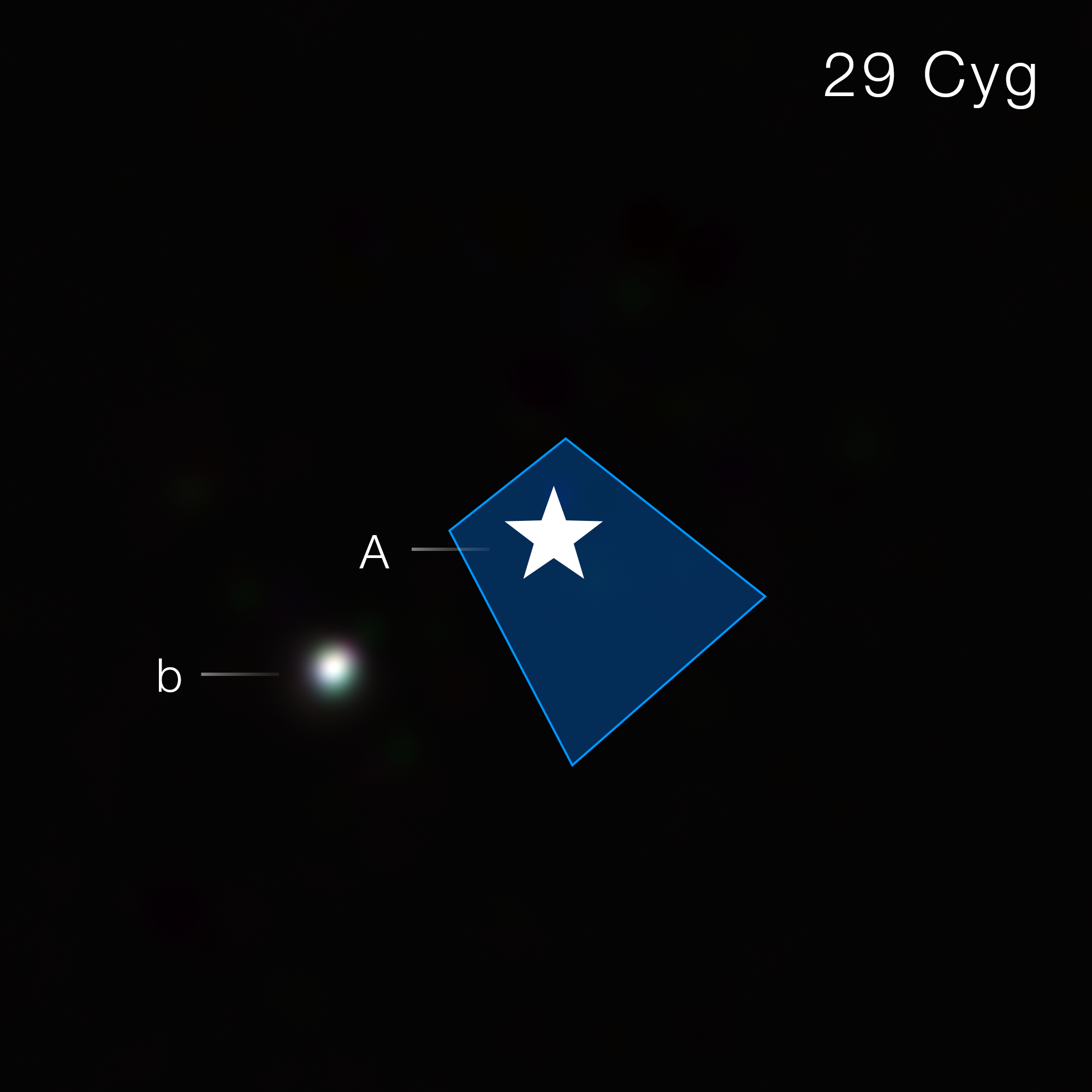
A team led by William Balmer at Johns Hopkins University and the Space Telescope Science Institute published results on April 14, 2026, in The Astrophysical Journal Letters. Using Webb’s NIRCam instrument in coronagraphic mode, which blocks the blinding glare of the host star to expose what orbits beside it, they captured light directly from 29 Cygni b.
The planet orbits its Sun-like host at roughly 1.5 billion miles (2.4 billion kilometers): about the distance Uranus keeps from our own Sun. Observed on September 1, 2025, through three infrared filters between 4 and 5 microns, each chosen to reveal where specific molecules absorb starlight, 29 Cygni b gave up its secrets. Carbon dioxide at 4.3 microns. Carbon monoxide at 4.6. Not faint hints: robust detections, and the first direct images of CO2 absorption in the atmosphere of a companion object straddling the boundary between planet and star.
The relative strength of those two signals carries the key. CO2 is more sensitive to heavy-element enrichment than CO; a high CO2-to-CO ratio is the signature of a metal-rich atmosphere. In 29 Cygni b, the team measured a metallicity roughly three times that of its host star. Given the planet’s mass, that translates to approximately 150 Earth masses of heavy elements locked inside a world that already weighs 15 Jupiters.
What carbon tells you about a world’s origin
That enrichment is not what you expect from an object that formed like a star. When a gas cloud collapses to produce a binary companion or brown dwarf, it generally inherits the chemistry of its parent cloud. Its metallicity mirrors the host, not exceeds it. The metal signature in 29 Cygni b, enhanced by a factor of three, is instead the signature of accretion: the bottom-up, pebble-by-pebble, planetesimal-by-planetesimal process that assembled the gas giants of our own solar system.
The team also measured the planet’s orbital tilt relative to its host star: only 12 degrees off-plane, consistent with having formed within the same rotating disk of gas and dust that gave rise to the star itself. Objects that form through fragmentation or gravitational capture rarely preserve that alignment.
Both lines of evidence converge. “29 Cygni b formed like a planet and not like a star,” the team concluded. That sentence carries real weight, because objects at 15 Jupiter masses have long occupied an uneasy classification: too heavy for most planetary catalogs, too light to ignite sustained fusion, occupying a zone where formation history has been nearly impossible to verify. Mass, it turns out, is a poor guide. Formation history, written in carbon, is better. Understanding why massive planets grow this large in disks connects to the deeper story of how stellar nurseries shape the full population of objects that emerge around young stars.
What comes next
Webb’s coronagraphic capability has now demonstrated it can resolve atmospheric chemistry in directly-imaged companions at solar-system scales, around stars more than a hundred light-years away. Balmer’s team plans to apply the same technique to other super-Jupiters and brown dwarf companions straddling the planetary-stellar boundary, building a chemistry catalog that could rewrite how the classification system works.
The question of what counts as a planet, as opposed to a failed star, has never had a clean answer. It may not be settled by weight alone. It may be settled by what something is made of, and by the slow, incremental process through which it assembled itself in a disk that has long since dispersed.
One hundred and fifty Earth masses of heavy elements, built grain by grain inside a protoplanetary disk that no longer exists, still waiting in the atmosphere of a gas world 133 light-years away.

