

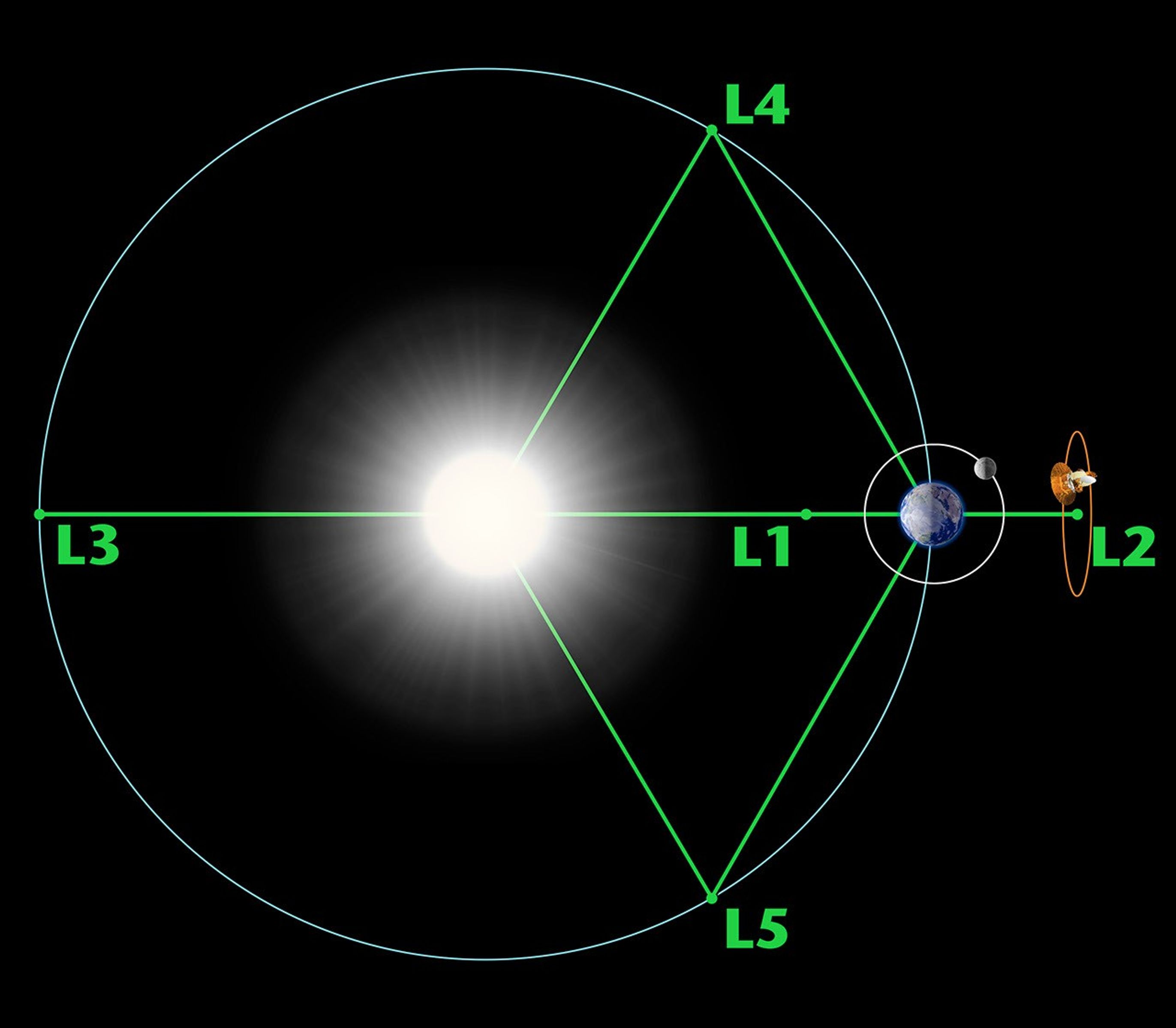
Imagine a place in space where you could stop your engines and never drift away. No fuel, no corrections, no slow spiral into the Sun or out toward the void. Just stillness, held in perfect equilibrium by the gravitational tug of two enormous bodies pulling on you from opposite sides. These places are real. There are exactly five of them in every two-body gravitational system, and they have quietly become some of the most valuable real estate in our solar system.
They are called Lagrange points, named after the Italian-French mathematician Joseph-Louis Lagrange, who proved their existence in 1772. At each of these five positions, the gravitational pull of two large masses (say, the Sun and Earth) combines with the centripetal force of orbital motion to create a kind of gravitational equilibrium. A small object placed at one of these points can, in theory, remain there indefinitely, orbiting the Sun in lockstep with Earth without expending any energy at all.
That elegant piece of orbital mechanics has transformed the way we explore space. Today, Lagrange points host some of our most important scientific instruments. Tomorrow, they may host something far more ambitious: permanent human settlements.
Here is how all five Lagrange points work, what we’ve placed at each one, and why two of them could become the foundation for humanity’s next great leap into the cosmos.
L1: The Solar Watchtower
The first Lagrange point sits along the line between the Sun and Earth, roughly 1.5 million kilometres from our planet in the sunward direction. At L1, a spacecraft orbits the Sun slightly faster than Earth would at that distance, because Earth’s gravity pulls it back just enough to keep pace with our planet’s year-long orbit.
This makes L1 the perfect vantage point for studying the Sun. The Solar and Heliospheric Observatory (SOHO), a joint NASA/ESA mission, has occupied a halo orbit around L1 since 1996, delivering three decades of continuous solar observation. From here, SOHO watches coronal mass ejections erupt from the Sun’s surface and sends early warnings back to Earth, giving us roughly 60 minutes of lead time before those charged particles slam into our magnetosphere.
SOHO is not alone at L1. DSCOVR (Deep Space Climate Observatory) has been monitoring solar wind and imaging the sunlit face of Earth from the same region since 2015, though the spacecraft is nearing the end of its operational life. In September 2025, NASA launched SWFO-L1 (Space Weather Follow-On), which arrived at L1 in January 2026 and was renamed SOLAR-1, ensuring continuity of our solar weather monitoring capabilities.
There is a catch, though. L1 is unstable. Think of it as balancing a ball on top of a hill: the equilibrium is real, but any small perturbation will send the ball rolling. Spacecraft at L1 require regular station-keeping manoeuvres, roughly every 23 days, to maintain their position.
L2: Home of the Most Powerful Telescope Ever Built
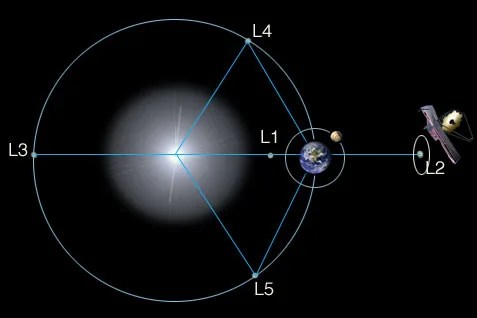
If L1 is the watchtower facing the Sun, L2 is the observatory facing the universe. It sits 1.5 million kilometres from Earth on the opposite side, directly away from the Sun. Here, a spacecraft’s orbital period naturally matches Earth’s, keeping it permanently in our planet’s shadow. That single fact makes L2 the most coveted address in space for telescopes.
The reason is thermal. Infrared telescopes need to be cold, desperately cold, to detect the faintest light from the earliest galaxies. At L2, a spacecraft can point a sunshield toward the Sun, Earth, and Moon all at once, shielding its instruments from all three sources of heat simultaneously. The result: operating temperatures below 50 Kelvin (minus 223 degrees Celsius) on the cold side.
This is where the James Webb Space Telescope lives. Launched on Christmas Day 2021, Webb reached its halo orbit around L2 in January 2022, settling into a path that carries it in a wide loop around the point every 168 days. The distance between Webb and L2 itself varies between 250,000 and 830,000 kilometres, a seemingly large range, but one that keeps the telescope in perpetual shadow while maintaining a clear line of communication with Earth.
From this perch, Webb has rewritten our understanding of the early universe. Its near-infrared camera, NIRCam, has captured light from galaxies that formed just 300 million years after the Big Bang, revealing structures that stretch our comprehension of cosmic distance to its very limits. Unlike the Hubble Space Telescope, which orbits Earth and passes in and out of our planet’s shadow every 90 minutes, Webb enjoys an uninterrupted view of deep space, enabling continuous science operations around the clock.
Webb is not the first telescope at L2. The Wilkinson Microwave Anisotropy Probe (WMAP) mapped the cosmic microwave background from L2 between 2001 and 2010. The Planck space observatory followed, and ESA’s extraordinary Gaia mission spent over a decade at L2 cataloguing the precise positions and motions of nearly two billion stars before being manoeuvred into a retirement orbit around the Sun on 27 March 2025.
Like L1, the L2 point is gravitationally unstable. Webb performs station-keeping burns roughly once every three weeks to maintain its orbit. These corrections are small (using just a few grams of fuel each time), but they are the reason Webb carries a finite fuel supply, one that currently limits the mission to a projected lifespan well beyond its original 10-year design goal.
L3: The Point Behind the Sun
The third Lagrange point lies on the far side of the Sun, directly opposite Earth in its orbit. It is, by any measure, the loneliest of the five. No spacecraft has ever been sent there, and none is currently planned.
The reason is partly practical. Communicating with a probe hidden behind the Sun would require a relay network, since there is no direct line of sight to Earth. More fundamentally, L3 shares the same instability as L1 and L2 but offers fewer scientific advantages. There is no unique observational benefit to being on the opposite side of the Sun that cannot be achieved more easily from elsewhere.
Where L3 truly shines is in the imagination. Science fiction writers have long adored the idea of a “Counter-Earth” lurking at L3, a hidden planet perfectly obscured by the Sun. The notion dates back to the Pythagorean philosopher Philolaus in the fifth century BCE, and it resurfaced in countless novels and television episodes through the twentieth century. Sadly for fiction (and happily for orbital mechanics), L3’s instability means nothing can hide there for long. Any object at L3 would gradually drift away within decades without active station-keeping.
L4 and L5: Where Gravity Parks Things for Billions of Years
The final two Lagrange points are something else entirely. While L1, L2, and L3 are all unstable (perched on gravitational “hilltops,” in the language of potential energy), L4 and L5 are genuinely stable. They are gravitational valleys where objects, once captured, can remain for billions of years without any course corrections at all.
L4 sits 60 degrees ahead of Earth in its orbit around the Sun. L5 sits 60 degrees behind. Together with the Sun and Earth, each point forms a perfect equilateral triangle. This geometry is not a coincidence; it is a mathematical consequence of the three-body gravitational interaction, stabilised by the Coriolis effect, the same force that shapes hurricanes on Earth.
The stability of L4 and L5 holds as long as the mass ratio between the two large bodies exceeds approximately 24.96. For the Sun and Earth (mass ratio of roughly 333,000 to 1), that condition is met by a vast margin. For the Sun and Jupiter, it is met even more emphatically.
And Jupiter’s Lagrange points prove the principle magnificently. Over 12,000 Trojan asteroids (named after heroes of the Trojan War) cluster at Jupiter’s L4 and L5 points, trapped there for billions of years by the same gravitational geometry. NASA’s Lucy mission, launched in October 2021, is currently on a 12-year journey to visit several of these ancient Trojans, studying rocks that have been parked in Jupiter’s gravitational sweet spots since the earliest days of the solar system.
Earth has its own Trojans, though far fewer. The first confirmed Earth Trojan, (706765) 2010 TK7, was discovered in 2011 orbiting our L4 point. It measures roughly 300 metres across. In 2022, astronomers confirmed a second: (614689) 2020 XL5, a considerably larger body at about 1.2 kilometres in diameter. This second Trojan, discovered by the Pan-STARRS survey in Hawaii and confirmed through follow-up observations at the Lowell Discovery Telescope, will remain at L4 for approximately 4,000 years before gravitational perturbations pull it free.
The Future at L4 and L5: From Parking Spots to Cities
In 1976, Princeton physicist Gerard K. O’Neill published The High Frontier, a book that reimagined L4 and L5 not as scientific observation posts but as the natural location for permanent human habitation in space. His reasoning was simple and, decades later, still compelling.
At L4 or L5, you get gravitational stability for free. No fuel budget for station-keeping, no risk of orbital decay. You also get access to raw materials: Trojan asteroids at these points could supply metals, water, and carbon compounds without the punishing cost of hauling them up from a planetary gravity well. And you get distance from Earth, enough that a colony could function independently, but close enough (about the same distance as Earth is wide in its orbit around the Sun) to maintain communication and trade.
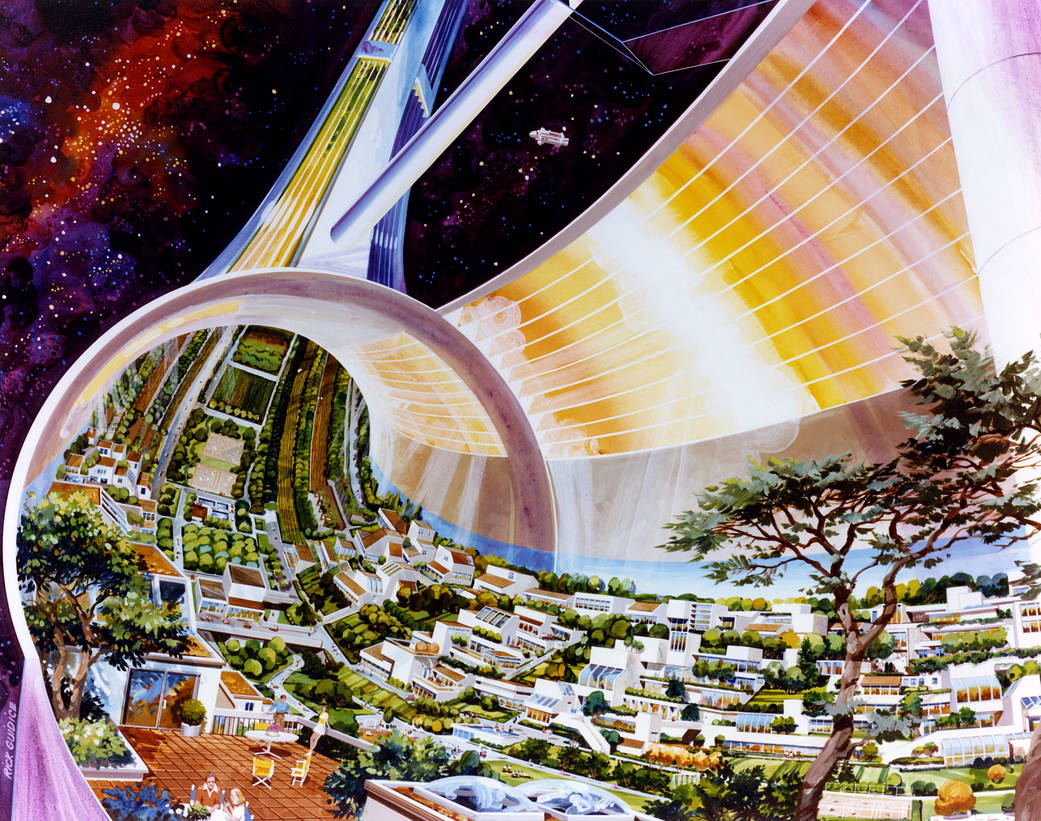
O’Neill envisioned colossal rotating cylinders, each 32 kilometres long and 6.4 kilometres in diameter, spinning to generate artificial gravity on their inner surfaces. Three land panels would alternate with three window panels, and adjustable mirrors would simulate a day-night cycle. Inside: rivers, farms, forests, and communities of tens of thousands of people, living in an engineered landscape bathed in real sunlight reflected from space.
The enthusiasm was real. In 1975, NASA Ames Research Center hosted a ten-week summer study that produced detailed engineering analyses of these habitats, along with stunning concept art by Rick Guidice and Don Davis that captured the public imagination. A grassroots organisation called the L5 Society formed shortly after, dedicated to the goal of building a colony at the fifth Lagrange point within the members’ lifetimes. The society eventually merged with the National Space Institute to form the National Space Society, which continues to advocate for space settlement today.
The engineering challenges are enormous, of course. Building a structure of that scale would require a civilisation with energy production capabilities far beyond what we possess today, something that might place the effort somewhere on the early rungs of the Kardashev Scale. The materials science alone would push the boundaries of what we understand about structural engineering under rotation and radiation exposure. And the question of building something like a Dyson sphere to power such a civilisation remains firmly in the realm of the theoretical.
But the orbital mechanics? Those are already solved. The parking spots exist. They have existed for 4.6 billion years, patiently collecting asteroids, waiting for someone to arrive with a blueprint and a reason to stay.
Why Lagrange Points Matter Now
The five Lagrange points are more than mathematical curiosities. They are infrastructure. L1 guards us from solar storms. L2 gives us eyes on the oldest light in the universe. L4 and L5 offer something rarer still: permanent addresses in a solar system where almost everything else is in constant, restless motion.
As of early 2026, we have active spacecraft at both L1 and L2 in the Sun-Earth system, with missions planned for years to come. NASA’s Nancy Grace Roman Space Telescope, which completed construction in late 2025, is expected to launch as early as autumn 2026 and will join Webb at L2, surveying billions of galaxies and hunting for exoplanets using gravitational microlensing.
Meanwhile, Lagrange-point thinking has spread to other gravitational systems entirely. NASA’s Artemis programme originally planned to place its Lunar Gateway station in a near-rectilinear halo orbit associated with the Earth-Moon L2 point, a different Lagrange system (Earth-Moon rather than Sun-Earth) but built on the same mathematics Lagrange described 250 years ago. Though the Gateway’s design was restructured in early 2026 to prioritise a lunar surface base, the orbital mechanics that made it feasible remain unchanged, waiting for the next mission that needs them.
Every new mission at a Lagrange point extends a quiet pattern that has been building for decades. We are not just visiting these gravitational oases; we are settling them, one instrument at a time.
Five points of perfect balance in a universe of relentless motion. We found them with mathematics centuries before we could reach them with rockets. And now, with telescopes already parked in their stillness and colonies drafted for their stability, these invisible waypoints are becoming the fixed stars of a civilisation learning to navigate its own solar system.

