

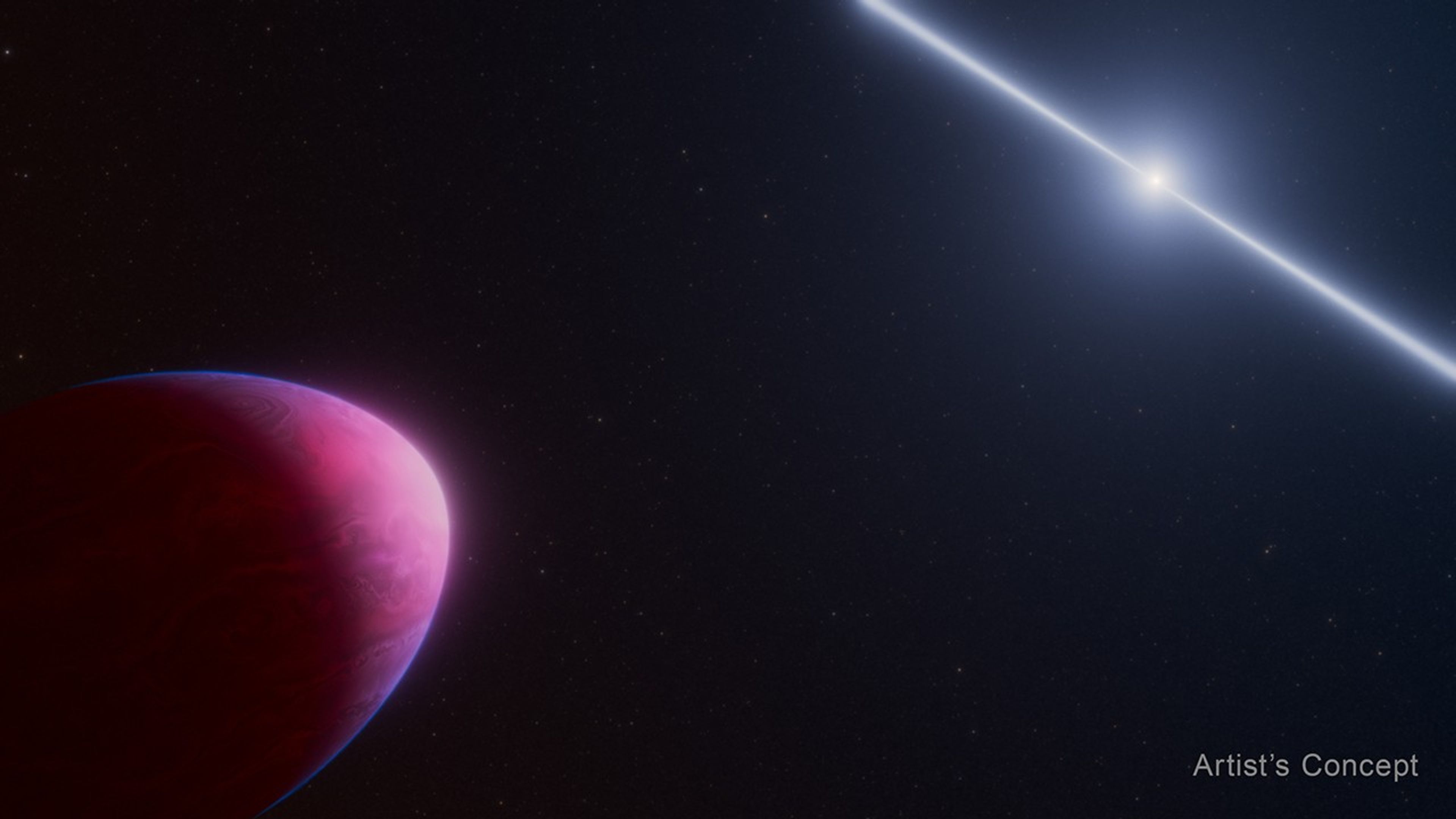
Picture a world the mass of Jupiter, squeezed into the shape of a lemon by the gravity of a dead star spinning hundreds of times per second. Its skies are thick with soot. Deep in its atmosphere, that carbon may be condensing into diamonds. And nothing about how it got there makes any sense.
This is PSR J2322-2650 b: a planet 750 light-years away in the constellation Sculptor, orbiting so close to a millisecond pulsar that its entire year lasts just 7.8 hours. When the James Webb Space Telescope turned its instruments toward this world in 2025, what it found was an atmosphere unlike anything astronomers had ever seen before, on any planet, anywhere.
An Atmosphere That Shouldn’t Exist
Of the roughly 150 exoplanet atmospheres studied to date, every single one has contained familiar molecules: water vapour, methane, carbon dioxide, the chemical signatures of worlds built from the same cosmic recipe as our own. PSR J2322-2650 b broke that pattern entirely.
Using Webb’s mid-infrared instrument, a team led by Michael Zhang at the University of Chicago found an atmosphere dominated by helium and molecular carbon, specifically the molecules C2 and C3. No water. No methane. No carbon dioxide. And, most puzzling of all, no nitrogen or oxygen, two elements that are abundant across the universe and present in virtually every planetary atmosphere we have ever examined.
“Instead of finding the normal molecules we expect to see on an exoplanet, like water, methane, and carbon dioxide, we saw molecular carbon,” Zhang said. The results were published in The Astrophysical Journal Letters on 16 December 2025.
Shaped by a Dead Star’s Grip
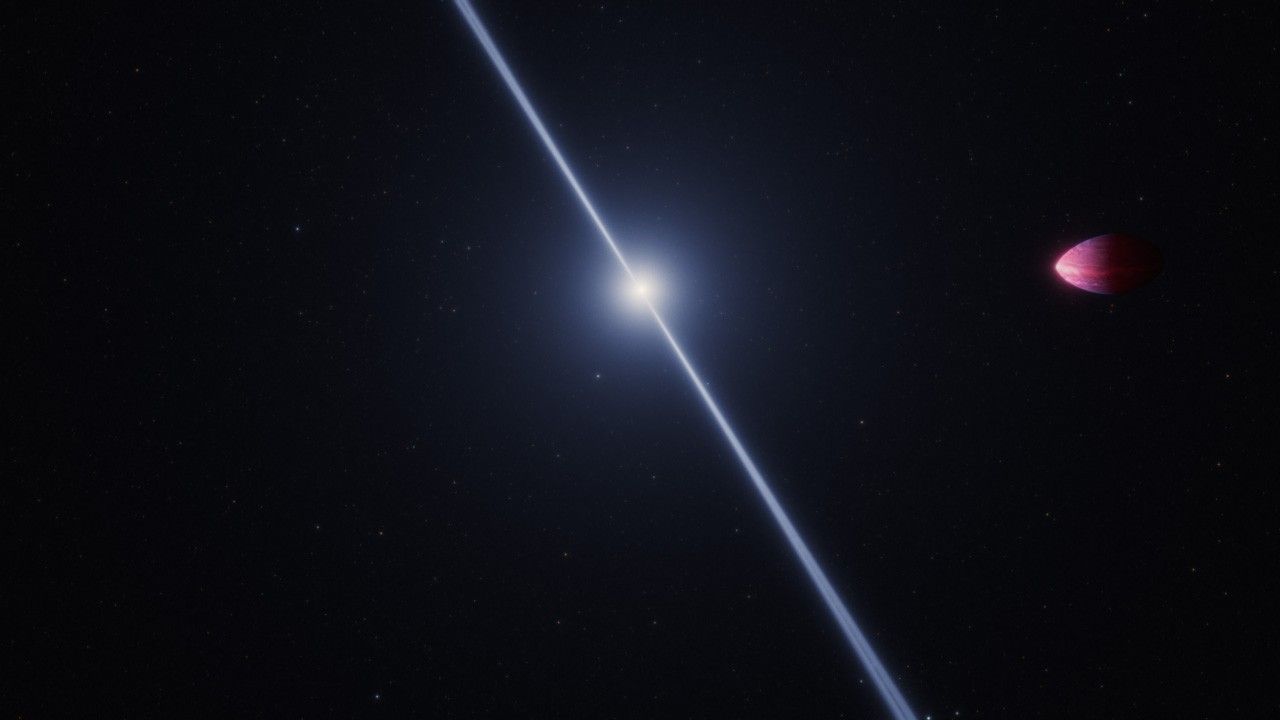
To understand why this planet looks the way it does, you need to understand its host star. PSR J2322-2650 is a pulsar: the collapsed core of a massive star that ended its life in a supernova, leaving behind a neutron star just a few kilometres across but containing more mass than our Sun. It spins on its axis once every 3.5 milliseconds, sweeping beams of radio waves across space like a lighthouse, which is how it was first detected in 2017.
Pulsars are the universe’s most extreme compact objects short of black holes themselves, and their gravity is ferocious. PSR J2322-2650 b orbits just 1.6 million kilometres away (roughly 1% of the Earth-Sun distance), close enough that the pulsar’s tidal forces have stretched the planet’s equator roughly 38% wider than its poles, giving it its distinctive lemon shape.
The planet is also tidally locked: one face permanently bakes under the pulsar’s radiation at about 2,040°C, while the far side, forever turned away, sits at a comparatively mild 650°C. Clouds of carbon soot likely drift through the atmosphere, and at the pressures found deeper within the planet, that carbon may crystallise into diamond. “May” is the operative word; Webb observed the atmosphere, not the interior, so the diamond hypothesis remains an informed inference from the chemistry, not a direct detection.
A Formation Puzzle
The deeper mystery is not what the planet is made of, but how it came to be made of it. Peter Gao of the Carnegie Earth and Planets Laboratory, a co-author on the study, noted that the planet’s composition “seems to rule out every known formation mechanism.”
One leading hypothesis is that PSR J2322-2650 b is not a planet in the traditional sense at all. It may be the remnant core of a companion star, a white dwarf that once orbited the pulsar in a tight binary system. Over millions of years, the pulsar would have stripped away the outer layers of its companion through gravitational and radiative ablation, leaving behind an ultra-low-mass carbon-rich remnant, something planet-sized but stellar in origin.
This scenario has precedent. PSR J1719-1438 b, discovered in 2011, is thought to be a similarly stripped companion, a crystallised carbon body with a density far exceeding diamond. But PSR J2322-2650 b is the first such object where Webb has been able to study the atmosphere directly, and the results have only deepened the puzzle. If this was once a white dwarf, where did all the oxygen go? Carbon-oxygen white dwarfs are the most common type in the galaxy, and stripping away the outer layers should have left both elements behind, not just one.
“What the heck is this?” is how Maya Beleznay, a PhD candidate at Stanford and co-author on the paper, summarised the team’s reaction.
What Comes Next
The discovery opens a new category in exoplanet science. PSR J2322-2650 b is the only known gas-giant-like world orbiting a pulsar whose atmosphere has been characterised, and its composition challenges every model astronomers currently use to explain how planets form and evolve in extreme environments.
Further Webb observations could probe the planet’s atmosphere at different wavelengths, searching for trace elements that might reveal more about its history. The team is also interested in whether other pulsar companions, several of which are known but unstudied, share the same baffling carbon-dominated chemistry.
For now, PSR J2322-2650 b sits alone in its category: a world that looks like no other, orbiting a star that died long ago, quietly building diamonds from soot in an atmosphere that no one predicted could exist.
Sometimes the universe takes a dead star, a stolen companion, and four billion years of patience, and quietly assembles something impossible. We just happened to point the right telescope at it.

