

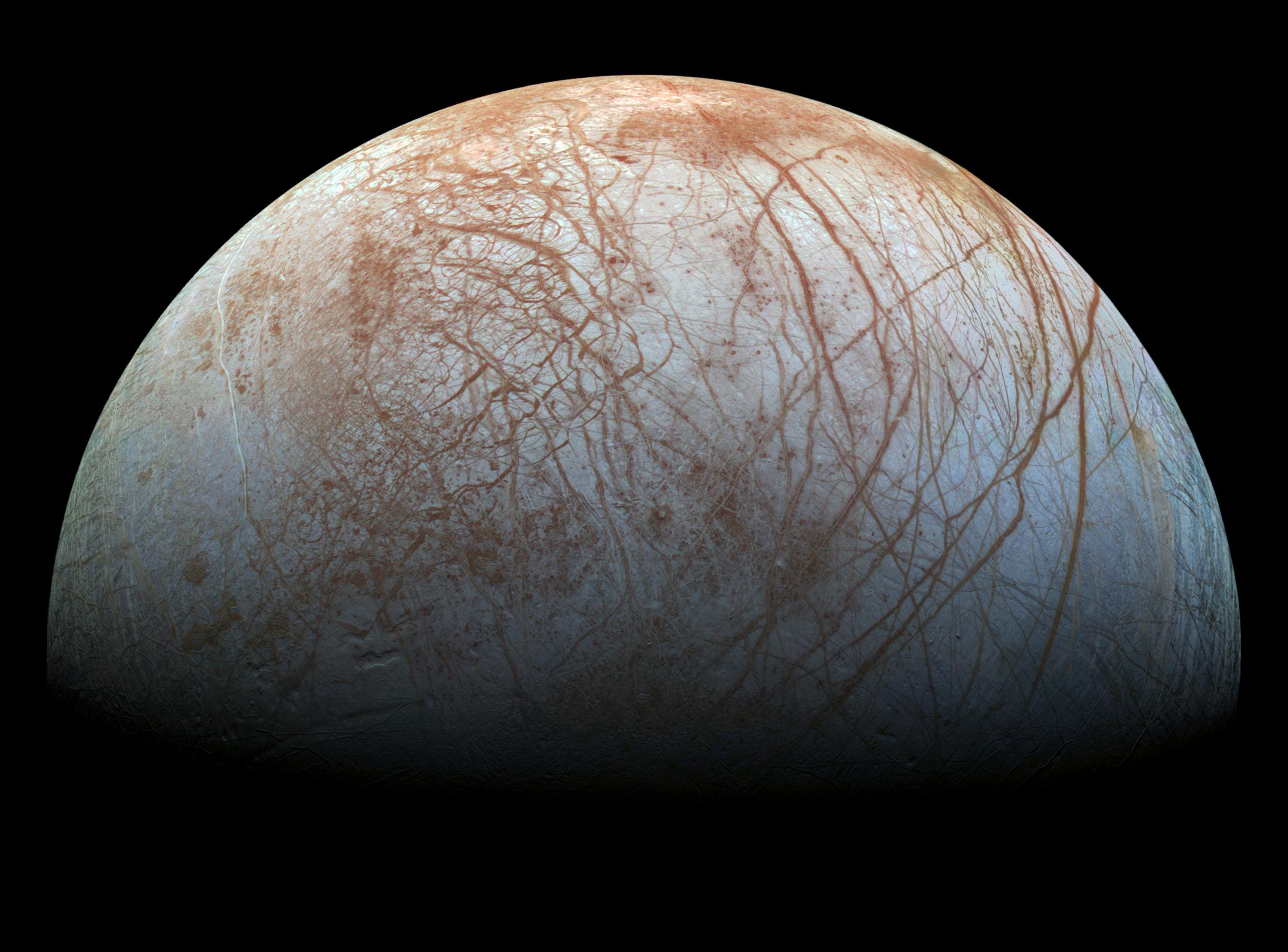
Somewhere beneath a shell of ice roughly the height of Mount Everest, there is an ocean. Not a frozen trace. Not a fossil puddle. A liquid, moving, globe-spanning body of water that may hold twice the volume of every ocean on Earth combined. It has been there, in total darkness, for four and a half billion years.
You have never heard it. Nobody has. No instrument has ever touched it. But we know it is there, because the ice above it bends, cracks, and rearranges itself in patterns that only make sense if something liquid is pulling and pushing from below. Jupiter’s moon Europa is roughly the size of our Moon. It is one of the most likely places in the solar system to harbour life. And in 2030, a spacecraft already in flight will arrive to find out whether something is alive down there.
An Ocean Written in the Ice
The first hint came in 1979, when Voyager 2 flew past Jupiter and sent back images of Europa that puzzled everyone. Where scientists expected a cratered surface like our Moon’s, they found smooth plains crossed by long, dark ridges. The surface looked young, which in geological terms means it is being renewed from below. Something beneath the ice was erasing the craters, filling them in, rewriting the surface like a page that will not stay still.
The confirmation came nearly two decades later. On December 19, 1996, the Galileo spacecraft passed within 692 kilometres of Europa and measured something extraordinary: an induced magnetic field. Jupiter’s powerful magnetosphere sweeps past Europa as the moon orbits, and if Europa were solid ice and rock, the field would pass through unchanged. Instead, Galileo’s magnetometer detected a response, a secondary field generated by electrical currents flowing within the moon. The physicist Margaret Kivelson and her team at UCLA published the finding: the most probable explanation was a layer of electrically conductive fluid beneath the surface. Salt water. A global ocean.
Subsequent Galileo flybys strengthened the case. By 2000, Kivelson’s team reported in Science that the data made “a stronger case for a subsurface ocean at Europa.” The induced magnetic field flipped direction in a way that only a conducting layer could produce. The Europa subsurface ocean was no longer a hypothesis. It was the simplest explanation the physics allowed.
Current models suggest Europa’s ice shell is between 10 and 30 kilometres thick. Below it: a saltwater ocean perhaps 100 kilometres deep, kept liquid by tidal heating. As Europa orbits Jupiter every 3.5 days, the giant planet’s gravity flexes the moon’s interior, generating friction inside its rocky core and ice shell. That friction produces heat, enough heat to keep an entire ocean from freezing for billions of years.
The surface tells its own story. The reddish-brown lines that cross Europa like veins (called lineae) are fractures in the ice where warmer material has welled up from below. The jumbled, shattered regions known as chaos terrain appear to be places where the ice has broken apart, shifted, and refrozen. In some of these areas, researchers have detected sodium chloride, ordinary table salt, likely originating from the ocean itself. You are looking at a world whose skin is slowly being rewritten by the water beneath it.
In January 2026, researchers showed that salty, nutrient-rich surface ice can become dense enough to sink through Europa’s shell, delivering chemicals from the radiation-bombarded surface to the ocean below in as little as 30,000 years. The ice shell is not a sealed lid. It is a slow, leaking membrane, ferrying ingredients downward into the dark.
What an Ocean Closer to Home Taught Us
In 1977, the same year the Voyager probes launched, a team of marine geologists descended to the floor of the Pacific Ocean near the Galápagos Islands in the submersible Alvin. What they found changed biology. Around volcanic vents in the seafloor, where superheated water billowed through cracks in the rock, entire ecosystems were thriving: tube worms, clams, shrimp, bacteria. None of them depended on sunlight. They were living on chemical energy, feeding on hydrogen sulphide and other molecules produced by the interaction of hot water and rock. Life, born in the same stellar forges that produced the elements in Europa’s ocean, does not require a star to sustain it. It requires liquid water, a source of chemical energy, and a rocky surface for reactions to occur.
Europa has all three: an ocean in contact with a rocky seafloor, heated from within by tidal forces. The parallel is not speculative. It is the reason astrobiologists rank Europa among the most promising ocean worlds in the solar system.
Saturn’s moon Enceladus has made the case stronger still. In 2015, NASA’s Cassini spacecraft flew through active plumes of water vapour erupting from Enceladus’s south pole and detected molecular hydrogen, a chemical signature of hydrothermal reactions between water and rock. Cassini also found complex organic molecules, silica nanoparticles (a calling card of hot water passing through rock), and phosphates. Five of the six elements essential for life as we know it (carbon, hydrogen, nitrogen, oxygen, phosphorus) have now been detected in material from Enceladus’s ocean. Europa’s ocean is far larger, and it has been in contact with rock for far longer.
Not everyone is convinced the analogy holds. In January 2026, a team led by Paul Byrne at Washington University in St. Louis published a study in Nature Communications arguing that Europa’s seafloor may be geologically quiet today. By modelling the moon’s internal structure and the gravitational stresses from Jupiter, they found little evidence for active faulting, volcanic vents, or tectonic movement on the ocean floor. “Geologically, there’s not a lot happening down there,” Byrne said. “Everything would be quiet.”
The study does not rule out life entirely. Even a geologically quiet seafloor has been in contact with rock for billions of years, and slow, low-temperature chemical reactions could still provide energy. But it narrows the window. If Europa’s ocean is a cold, still body of salt water above an inert floor, the analogy to Earth’s hydrothermal vents weakens. This is exactly what makes the next mission so critical. We need measurements, not models.
Europa Clipper Is Already on Its Way

The Europa Clipper mission launched on October 14, 2024, from Kennedy Space Center aboard a SpaceX Falcon Heavy. It is the largest spacecraft NASA has ever built for a planetary mission, with solar arrays spanning roughly 30 metres. The spacecraft completed a gravity assist from Mars on March 1, 2025, and is now heading back toward Earth for a second gravity assist on December 3, 2026. It will arrive at Jupiter in April 2030, having travelled 2.9 billion kilometres to get there.
Once in the Jupiter system, Europa Clipper will not orbit Europa directly. The radiation environment so close to Jupiter is too intense for prolonged exposure. Instead, it will orbit Jupiter and conduct 49 close flybys of Europa, some at altitudes as low as 25 kilometres above the ice. Each pass will be a sprint through the radiation belt, collecting data before retreating to safer ground to transmit it home.
The instrument suite reads like a checklist for ocean hunting. REASON, an ice-penetrating radar, will map the internal structure of the ice shell and search for pockets of liquid water within it. MASPEX, a mass spectrometer sensitive enough to identify individual molecules, will sample Europa’s thin atmosphere and any ejected material for organic compounds, salts, and gases that originated in the ocean. E-THEMIS, a thermal camera, will map surface temperatures and hunt for warm spots, potential evidence of active venting or thin ice.
The Hubble Space Telescope has detected what may be water vapour plumes above Europa’s surface, observed in 2012, 2013, and 2016. The evidence remains contested; out of 10 Hubble observations, only three showed possible plume signatures, and scientists have been careful to call these “evidence of plumes” rather than proof. But if the plumes are real, and if they are still active when Europa Clipper arrives, the spacecraft can fly directly through them. That would mean sampling the ocean without landing, without drilling, without touching the ice at all.
We have been looking at Europa’s ice from above for nearly five decades. In four years, we begin to look through it. The search for life beyond Earth is no longer theoretical. It has a spacecraft, a trajectory, and a date.
If Europa Clipper finds chemical signatures consistent with biology, it will not be a civilisation. It will not be something visible to the eye. It will likely be a pattern in the chemistry: amino acids arranged in ways only biology produces, or isotope ratios that no known geology can explain. Microbial life, chemosynthetic, feeding on hydrogen and sulphur in an ocean that has never known a single photon of sunlight.
And yet. If it exists, it may be the most consequential discovery in human history. Not because of what it is, but because of what it proves. Life on Europa would mean life arose independently, twice, in the same solar system. And if it happened twice here, in one unremarkable corner of one unremarkable galaxy, in a universe of hundreds of billions of galaxies each containing hundreds of billions of stars with their own worlds, the implication is overwhelming. It would mean the universe is not empty. It would mean life is not an accident. It would mean we are not alone, in the deepest and most statistical sense of the word.
The quietest, most consequential countdown in science is already running. Somewhere beneath that ice, an ocean four and a half billion years old is keeping whatever secret it has kept since before there were eyes to wonder about it.

