

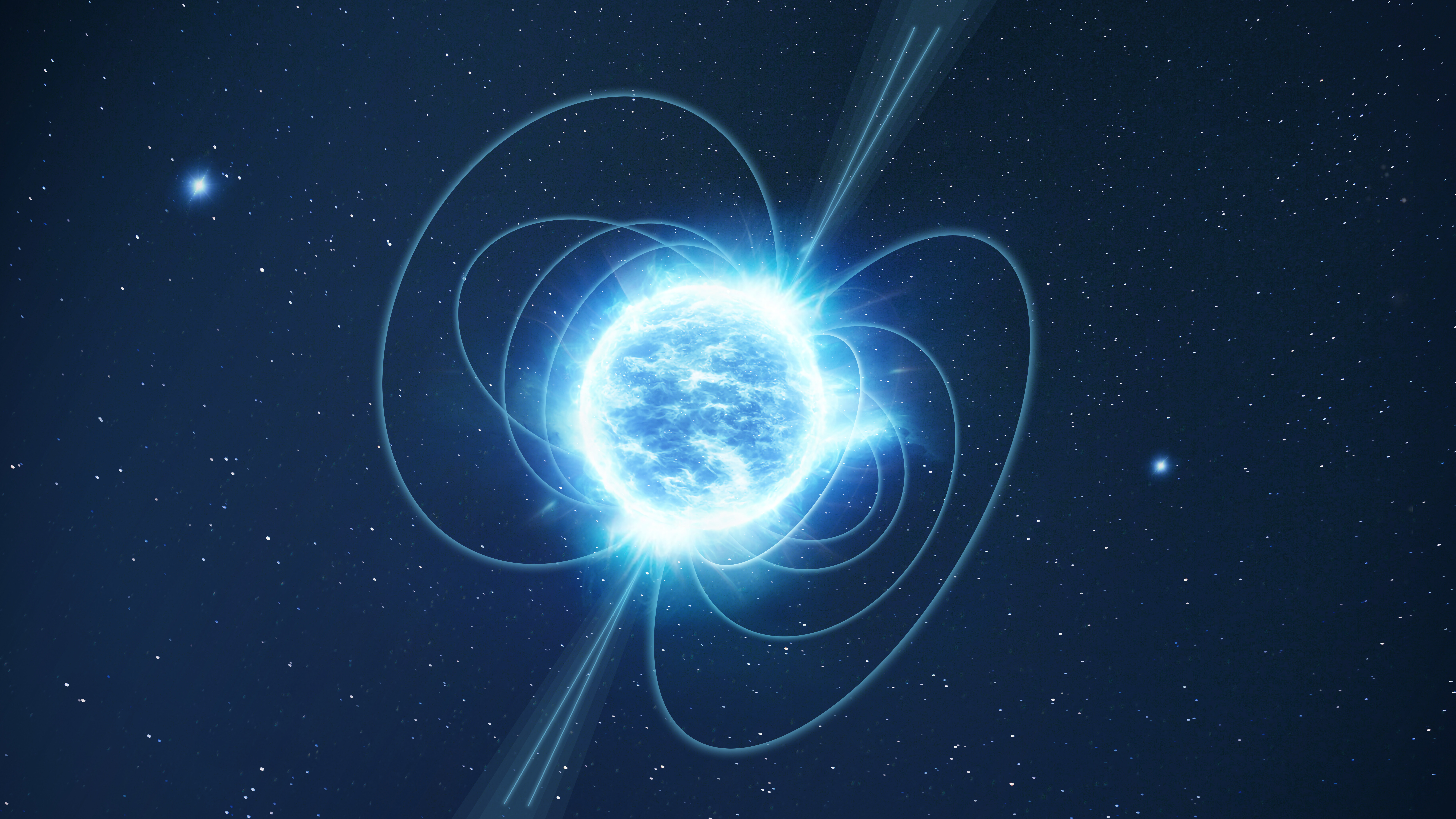
In December 2004, a dead star on the far side of our galaxy released more energy in a fifth of a second than the Sun produces in 150,000 years. The blast was so powerful it physically compressed Earth’s magnetic field, partially ionized our upper atmosphere, and overwhelmed the detectors on satellites that weren’t even pointing at it. No human felt a thing. But the instruments noticed.
That dead star was SGR 1806–20, a magnetar sitting roughly 50,000 light-years away in the constellation Sagittarius. And its brief, violent outburst remains one of the most extraordinary events ever recorded in our galaxy: a reminder that the universe contains objects so extreme they can reach across tens of thousands of light-years and rattle the planet you’re standing on.
What Is a Magnetar?
So what is a magnetar? At its simplest, a magnetar is a neutron star with an almost incomprehensibly powerful magnetic field. Neutron stars themselves are already remarkable: the collapsed cores of massive stars, squeezed into spheres roughly 20 kilometres across yet containing about 1.4 times the mass of our Sun. A teaspoon of neutron star material would weigh around a billion tonnes on Earth.
But magnetars take the extraordinary and push it further. While a typical neutron star has a magnetic field billions of times stronger than Earth’s, a magnetar’s field reaches a quadrillion times the strength of our planet’s magnetosphere, on the order of 1015 Gauss. To put that in perspective: Earth’s magnetic field measures about one Gauss. A hospital MRI scanner produces around 10,000 Gauss. A magnetar produces roughly a million billion. They are, by a wide margin, the most magnetic objects in the known universe.
The difference between a magnetar and a standard neutron star comes down to that magnetic field. All magnetars are neutron stars, but not all neutron stars are magnetars. Think of it as a spectrum: ordinary pulsars sit at one end, spinning steadily and emitting radio beams, while magnetars occupy the extreme other end, where the magnetic field itself becomes the dominant force, driving violent outbursts of X-rays and gamma rays as it slowly decays.
That decay is what makes magnetars so volatile. As the magnetic field dissipates over thousands of years, it twists and stresses the star’s ultradense crust (a crystalline lattice of neutrons and iron nuclei just a kilometre or so thick) until it fractures. These starquakes release colossal bursts of energy, and the magnetic field lines, momentarily unanchored, snap and reconnect in events that rival the most powerful explosions in the galaxy. Magnetars are, in a real sense, objects tearing themselves apart from the inside out.
The December 2004 Superflare
On December 27, 2004, SGR 1806–20 produced what astronomers call a giant flare: a sudden, catastrophic release of magnetic energy from the star’s surface. The total energy of the SGR 1806–20 magnetar flare measured approximately 2 × 1046 ergs. In more human terms, the blast briefly outshone every other object in the Milky Way, releasing the equivalent of ten trillion times the Sun’s total energy output in just one-fifth of a second.
NASA’s Swift satellite, which had launched barely a month earlier, had its gamma-ray detectors completely saturated by the blast, even though it wasn’t pointed anywhere near the source. The spacecraft detected a long tail of energy that persisted for more than five minutes. Down on Earth, the ionosphere (the electrically charged layer of atmosphere extending roughly 600 kilometres above the surface) was measurably compressed. At an altitude of about 60 kilometres, ionic density spiked by six orders of magnitude: a millionfold increase, caused by a star most people have never heard of, located halfway across the galaxy.
The event has been compared to a magnitude 32 earthquake, some 32 sextillion times more powerful than any tremor ever recorded on our planet. The comparison is imperfect (a “starquake” is not a tectonic event), but it captures the scale. SGR 1806–20 rotates once every 7.56 seconds: a city-sized ball of matter denser than an atomic nucleus, spinning in the dark, crackling with the strongest magnetic field nature has produced.

How Magnetars Are Born
Magnetars form in the same crucible that produces all neutron stars: the core-collapse supernova of a massive star, typically one weighing between 10 and 25 times the mass of our Sun. When such a star exhausts its nuclear fuel, its core implodes in a fraction of a second, and the outer layers are blown away in one of the most energetic events in the cosmos. What remains is a neutron star, born spinning and searingly hot.
But something different happens in about one in every ten supernovae. If the newborn neutron star is rotating fast enough (between 100 and 1,000 revolutions per second in those first chaotic moments), a magnetohydrodynamic dynamo process can amplify pre-existing magnetic fields to extraordinary levels. The turbulent, superdense conducting fluid inside the star acts like a cosmic generator, converting rotational energy into magnetic energy before the star settles into equilibrium. The result is a magnetar: a neutron star wrapped in a magnetic field so strong it distorts the very structure of the vacuum around it.
The existence of magnetars was first proposed in 1992 by astrophysicists Robert Duncan and Christopher Thompson, who needed to explain a strange class of objects called soft gamma repeaters (SGRs): sources that periodically belched bursts of gamma rays in patterns that didn’t match any known phenomenon. Their theoretical prediction was spectacularly confirmed when SGR 1806–20 erupted twelve years later, validating the magnetar model in the most dramatic way imaginable.
Magnetars are, in a sense, the violent endpoints of the stellar life cycle: born in the same stellar nurseries where new stars ignite, but forged into something far stranger by the physics of collapse. They are also fleeting, at least by cosmic standards. A magnetar’s extreme magnetic field decays over roughly 10,000 years, and as the field weakens, the starquakes and gamma-ray outbursts gradually subside. After that, the magnetar fades into an ordinary, quieter neutron star. The roughly 30 magnetars we know of represent only those young and violent enough for us to detect; many more likely exist as burnt-out remnants, invisible and silent.
What Would Happen If a Magnetar Were Near Earth
The SGR 1806–20 flare affected our planet from 50,000 light-years away. So what would happen if a magnetar were closer?
The numbers are sobering. At a distance of roughly half the distance from Earth to the Moon (about 190,000 kilometres), a magnetar’s field would be strong enough to wipe the magnetic stripes from every credit card on the planet. That might sound trivial, but consider what it implies: a single object, smaller than Manhattan, exerting measurable force on the electrons in a plastic card from further away than most satellites orbit.
Move closer, within about 1,000 kilometres, and the field becomes lethal in ways that sound like science fiction: strong enough to distort the electron clouds around atoms in your body, disrupting the molecular bonds that hold your tissues together. In a magnetar’s embrace, organic matter doesn’t burn or freeze. It dissolves. The iron in your blood would be pulled from your cells atom by atom. Water molecules would stretch and deform. The chemistry that sustains life simply stops working in a field that strong.
Even without direct proximity, a magnetar’s superflare poses risks at interstellar distances. Astrophysicists estimate that a giant flare occurring within about six light-years of Earth could seriously damage the atmosphere, stripping away the ozone layer and exposing the surface to lethal ultraviolet radiation. Within ten light-years, the effects would be catastrophic enough to trigger a mass extinction event.
The good news: the nearest known magnetar, XTE J1810–197, sits approximately 8,100 light-years away (its distance directly measured for the first time using parallax observations from the Very Long Baseline Array). Of the roughly 30 confirmed magnetars discovered so far, none are remotely close enough to threaten us. The universe, it turns out, keeps its most dangerous magnets at a comfortable distance.
What Magnetars Are Teaching Us Now
Two decades after the SGR 1806–20 superflare, magnetars continue to surprise. In January 2025, researchers published evidence in a preprint on arXiv that the aftermath of that famous 2004 flare contained signatures of r-process nucleosynthesis: the rapid capture of neutrons by atomic nuclei that forges the heaviest elements in the periodic table, including gold, platinum, and uranium. The flare, it appears, didn’t just release energy. It ejected neutron-rich crustal material at enormous velocity, creating the extreme conditions needed to synthesize heavy elements.
This finding, if confirmed, would establish magnetar giant flares as a previously unrecognized source of the universe’s heavy elements, contributing an estimated 1 to 10 percent of the Milky Way’s total r-process element budget. Until now, that role was attributed primarily to neutron star mergers and certain supernovae. A single magnetar tantrum may scatter gold atoms across light-years of space.
And then, in March 2026, came the biggest milestone yet. A team led by UC Berkeley published results in Nature describing the first observed birth of a magnetar. A superluminous supernova called SN 2024afav, located about a billion light-years away, produced a strange “chirp” in its light curve: a signal that sped up over time in a pattern that could only be explained by Lense-Thirring precession, a consequence of general relativity. For the first time, astronomers were watching a magnetar being forged in real time inside a collapsing star, confirming the formation theory Duncan and Thompson had proposed over three decades earlier.
Meanwhile, NASA’s Hubble Space Telescope reported in April 2025 the discovery of a “roaming magnetar” called SGR 0501+4516, which appears not to have been born in a supernova explosion at all, challenging the standard formation model in a different way. And observations of XTE J1810–197, the closest known magnetar, have revealed radio emissions with rapidly changing circular polarization unlike anything previously seen from these objects.
Magnetars also increasingly intersect with our understanding of black holes. The magnetar SGR 1745–2900 orbits just a fraction of a light-year from Sagittarius A*, the supermassive black hole at the centre of our galaxy, offering researchers a unique probe of the extreme environment surrounding it. Its radio signals, warped and scattered by the hot plasma near the black hole, give astronomers a way to map conditions in a region that is otherwise almost impossible to observe directly. Each new observation peels back another layer of physics that we barely understand, and the Vera C. Rubin Observatory, expected to begin its comprehensive sky survey soon, may uncover dozens more of these extraordinary objects hiding in plain sight.
Somewhere in the dark, a sphere no wider than a city is spinning with a magnetic field strong enough to reshape matter itself. It has been doing this for thousands of years. It will keep doing it long after we stop watching. And every now and then, it reminds us that the most powerful forces in the universe don’t announce themselves to human senses; they whisper to our instruments, and the instruments scream.

