
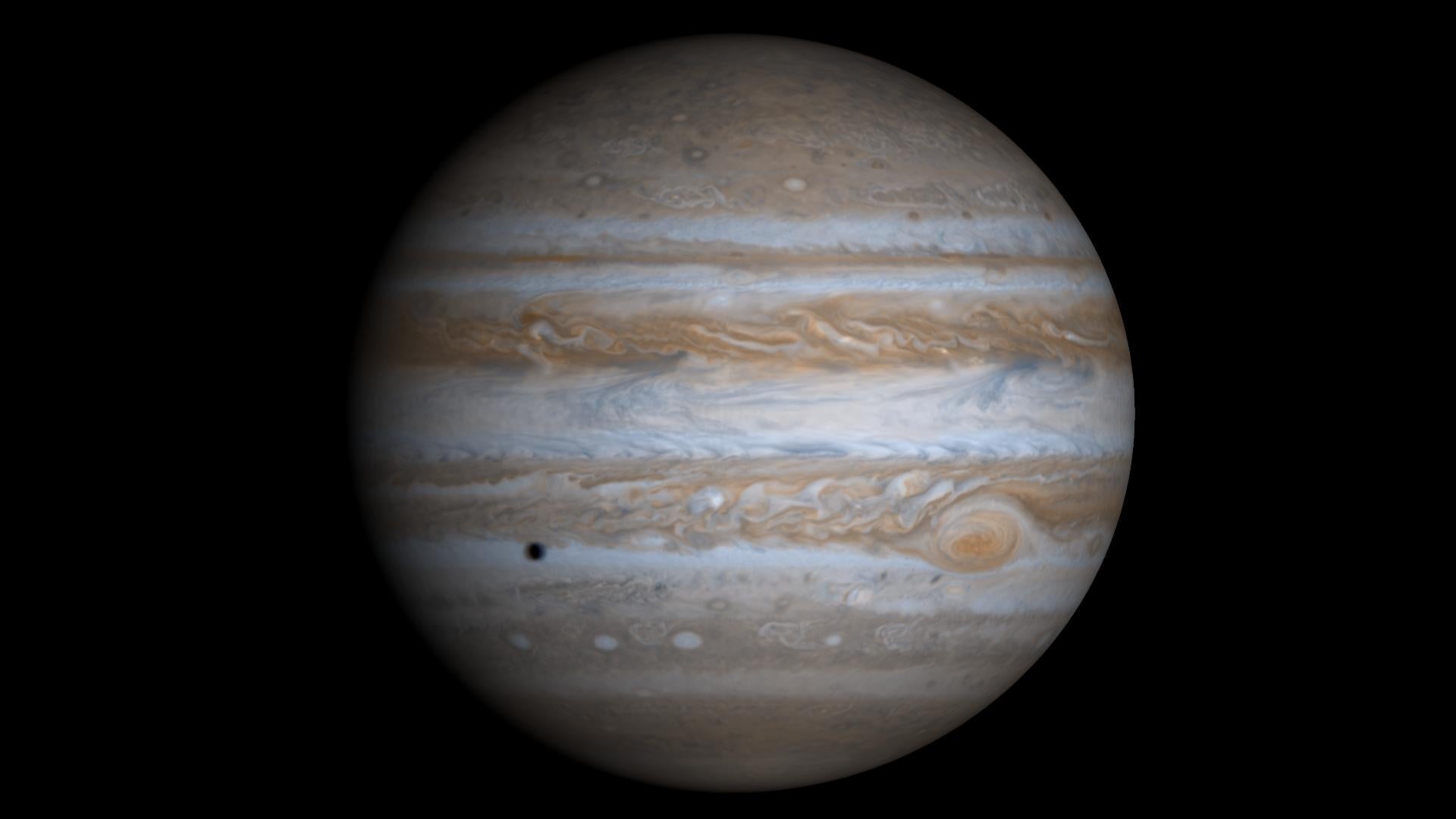
Jupiter’s Great Red Spot Isn’t the Storm We Thought It Was
The storm Cassini saw in 1665 is gone. The one we see now was born two centuries later — and it is slowly dying.
How Old Is Jupiter’s Great Red Spot?
In 1665, Giovanni Domenico Cassini pointed a telescope at Jupiter and saw something that shouldn’t have been there: a dark oval, wider than any feature he’d recorded before, sitting in the planet’s southern hemisphere like a bruise that wouldn’t heal. He called it the Permanent Spot.
For 48 years, astronomers tracked it. Then, sometime after 1713, it vanished. No record of its disappearance survives. One year it was there; within a generation, it wasn’t. Jupiter turned, and the spot was gone.
A century passed. Then, in 1831, a new oval appeared — at the same latitude, in the same atmospheric band, spinning in the same direction. It has been observed continuously ever since. For 350 years, most astronomers assumed they were looking at the same storm. A single, unbroken tempest, older than the steam engine, older than electricity, older than the United States.
They were wrong.
“The current Great Red Spot is not the Permanent Spot of Cassini. It is a different storm — born, most likely, around 1831.”
— Sánchez-Lavega et al., Geophysical Research Letters, 2024
In June 2024, a team led by Agustín Sánchez-Lavega published the evidence. By comparing historical size records, drift rates, and latitude data, they showed that the two storms don’t match. Cassini’s Permanent Spot was likely wider than today’s Great Red Spot at its peak, occupied a slightly different latitude, and disappeared in a way that doesn’t align with gradual shrinkage. The simpler explanation: the original storm died, and a new one — the one we call the Great Red Spot — formed independently, perhaps a century later.
The storm is not 350 years old. It is closer to 195. Still older than every living human, every government on Earth, every piece of technology you have ever touched. But not the ancient, unbroken phenomenon we imagined.
That distinction matters. Because if the Great Red Spot was born, it can die. And the data says it’s dying now.
A Storm the Size of Earth — And Shrinking
When continuous observations began in 1879, the Great Red Spot measured roughly 40,000 kilometres across its longest axis. Three Earths could have sat inside it, side by side, with room to spare.
Today, it is barely wider than Earth itself.
Use the slider to scrub through time. Earth stays the same size. Watch the storm shrink around it.
Winds Twice as Fast as a Category 5 Hurricane
A Category 5 hurricane is the most violent weather event on Earth. Winds above 252 kilometres per hour. Roofs torn from buildings, trees uprooted, landscapes rearranged. The strongest ever recorded — Hurricane Patricia, 2015 — peaked at 345 km/h.
The Great Red Spot’s outer ring screams at 430 to 680 kilometres per hour. Twice as fast. And it has been doing this, without a surface to slow it down, for nearly two centuries.
Below, two particle simulations run at the same scale. Left: a Category 5 hurricane. Right: the Great Red Spot. Watch the difference.
In 2021, Hubble data revealed that the GRS’s outermost winds have been accelerating — increasing by roughly 8% between 2009 and 2020. The storm is shrinking, but its edges are spinning faster. Like a figure skater pulling in her arms.
But what lies beneath those clouds?
300 Kilometres Deep: What Juno Found Beneath the Clouds
In July 2017, NASA’s Juno spacecraft passed directly over the Great Red Spot for the first time, skimming just 9,000 kilometres above the cloud tops. Its microwave radiometer peered through the ammonia ice and into the storm’s interior.
What it found: the Great Red Spot is not a surface feature. It extends 200 to 350 kilometres below the visible clouds — 50 to 100 times deeper than Earth’s deepest ocean. The pressure at its base reaches 100 bar, roughly 100 times the atmospheric pressure at sea level on Earth.
If you could see the storm from the side, it would look like a tiered wedding cake: high ammonia-ice clouds at the centre, cascading down to its outer layers. The base is warmer than the top. The structure is an anticyclone — a high-pressure system rotating counterclockwise in Jupiter’s southern hemisphere, rolling inside a channel formed by two opposing jet streams.
The Great Red Spot’s roots go 50 to 100 times deeper than Earth’s oceans. We are not looking at weather. We are looking at a column of atmosphere taller than most countries are wide.
No One Knows Why It’s Red
The most recognisable colour in planetary science — and we still don’t know what causes it.
The Great Red Spot’s distinctive ochre-red hue has been debated for decades. The ammonia ice that forms its cloud tops is white. Something is turning it red. Three theories compete:
The answer may be a combination of all three. Or something we haven’t considered. The colour of the Great Red Spot remains one of planetary science’s most visible unsolved mysteries — hiding in plain sight for four centuries.
A Storm That Eats Storms to Stay Alive
The Great Red Spot is an anticyclone — a high-pressure vortex spinning counterclockwise. On Earth, anticyclones dissipate within weeks. On Jupiter, where there is no solid surface to create friction, a sufficiently large vortex can persist for centuries. But it cannot do it alone.
Like a fire that needs fuel, the GRS sustains itself by absorbing smaller storms. Smaller anticyclones, born in Jupiter’s turbulent atmosphere, drift into the GRS’s high-speed peripheral ring. They circle the red oval, get pulled in, and merge. Each merger adds angular momentum. Each one tops up the energy that friction and radiation are slowly draining.
In 2024, a study by Caleb Keaveney at Yale proposed a simple explanation for the shrinkage: the GRS is starving. Fewer small storms are forming nearby to feed it. Without fresh fuel, the vortex dissipates energy faster than it can replace it. The storm is not being destroyed. It is running out of food.
If the supply of small anticyclones continues to decline, the Great Red Spot faces two possible futures: it reaches a new, smaller stable size — or it dissipates entirely.
Will the Great Red Spot Disappear?
In 1879: 40,000 kilometres. In 2004: roughly 20,000. Today: around 14,000. The Great Red Spot has lost more than half its length in a century and a half. Since 2012, the rate has accelerated — the storm is shrinking by about 930 kilometres per year and becoming more circular.
Then, in late 2024, Hubble revealed something no one expected. Over a 90-day observation window, the spot was oscillating — its size, shape, brightness, and rotation speed pulsing on a regular cycle. The Great Red Spot was wobbling. This behaviour had never been identified before.
No one can say with certainty what this means. The oscillation may be a sign of internal reorganisation — the storm adjusting to its new, smaller geometry. Or it may be the erratic breathing of a system approaching instability.
What we do know: every measurement since the late 19th century points in the same direction. Smaller. More circular. Faster winds at the edge, but less total area. The trend is clear even if the endpoint is not.
We may be the last generation to see the Great Red Spot. Or it may outlive us all. The storm has no obligation to satisfy our narrative arc.
But consider this: Cassini’s Permanent Spot survived 48 years of recorded observation, then vanished. The current Great Red Spot has survived 195. If Jupiter has taught us anything, it is that even the most permanent-looking features of the universe are temporary. Stars die. Storms end. The question is never whether, only when.
The storm is still there. For now. Look up on a clear night — if you have a decent telescope, you can still see it. A faint ochre oval in the banded clouds of Jupiter. A hurricane older than every nation on Earth, slowly winding down in the cold dark, 630 million kilometres from anyone who has ever named it.
Frequently Asked Questions
How old is Jupiter’s Great Red Spot?
The current Great Red Spot has been continuously observed since 1831, making it approximately 195 years old. A 2024 study by Sánchez-Lavega et al. showed that it is not the same storm as the “Permanent Spot” observed by Cassini from 1665 to 1713 — that earlier storm likely dissipated, and the modern GRS formed independently around 1831.
Is the Great Red Spot shrinking?
Yes. In 1879, the GRS measured roughly 40,000 km across — three times Earth’s diameter. Today it measures approximately 14,000 km, barely wider than Earth. The rate of shrinkage accelerated after 2012 to about 930 km per year, and the storm’s shape is becoming more circular.
How big is the Great Red Spot compared to Earth?
At its historical peak in the late 1800s, the Great Red Spot was about three times the diameter of Earth (40,000 km vs Earth’s 12,742 km). Today, it is approximately 1.1 times Earth’s diameter — still enormous, but dramatically smaller than it once was.
How deep is the Great Red Spot?
NASA’s Juno spacecraft found that the Great Red Spot extends 200 to 350 kilometres below the visible cloud tops, reaching pressures of about 100 bar. This is 50 to 100 times deeper than Earth’s deepest ocean trench (the Mariana Trench at ~11 km).