
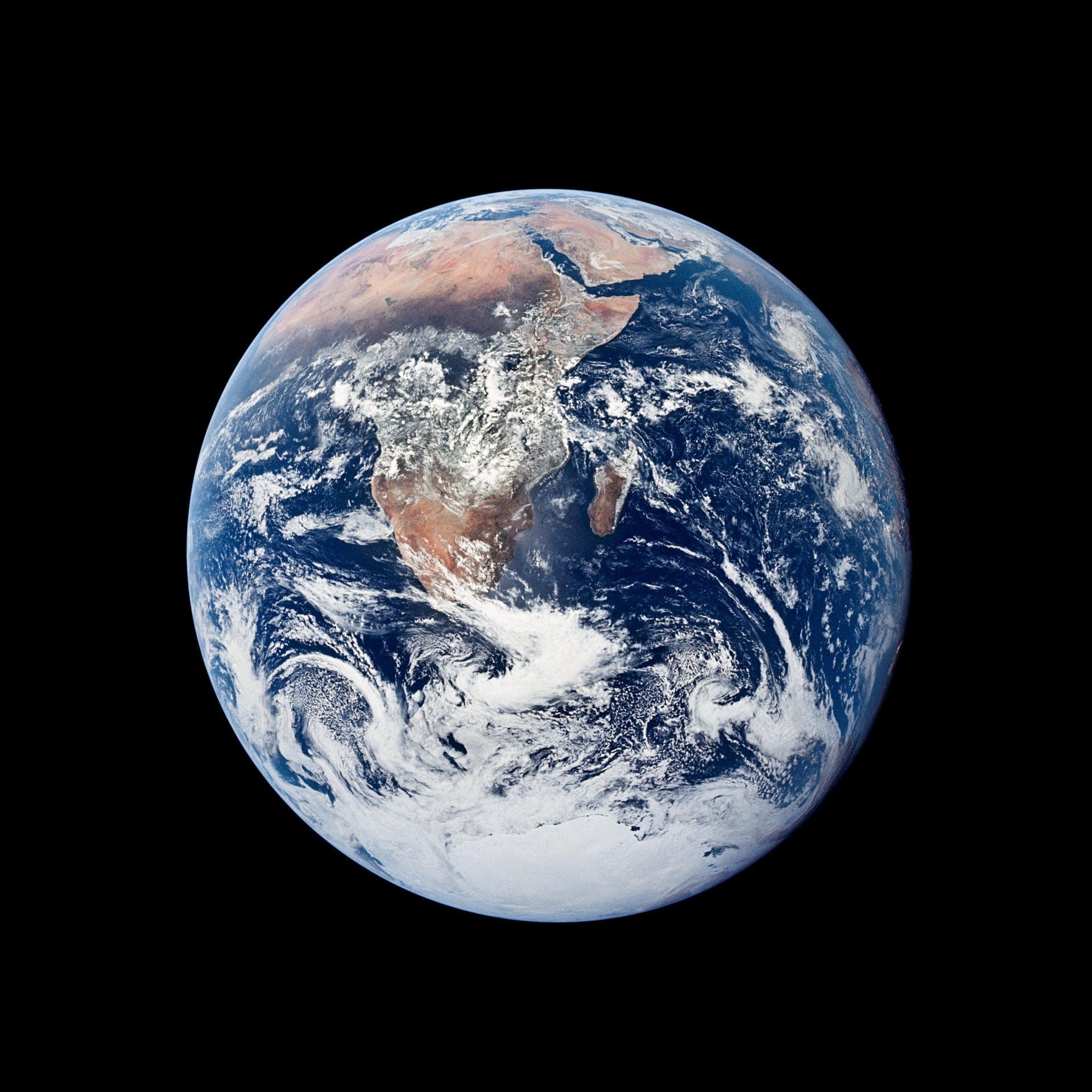
The Overview Effect
What changes when you see Earth from far enough away — and why almost no one who has seen it can explain what happened next.
The Shift
In 1987, a researcher named Frank White gave it a name. He called it the Overview Effect — the cognitive shift that occurs when you see Earth from space. Not a metaphor. Not a philosophy. A shift — a physical rewiring of perspective that nearly every astronaut reports and none of them can fully explain.
White had spent years interviewing astronauts, expecting to confirm a hypothesis. What he found instead was a pattern so consistent it felt like a law of nature: put a human being far enough above the Earth, and something fundamental changes in how they see everything below.
“You develop an instant global consciousness, a people orientation, an intense dissatisfaction with the state of the world, and a compulsion to do something about it.”
— Edgar Mitchell, Apollo 14
The Overview Effect is not about facts. Every astronaut already knew the Earth was round, already knew the atmosphere was thin, already understood that borders were human inventions. What changed was that they experienced it — and the difference between knowing something and experiencing it turned out to be the difference between reading about fire and putting your hand in the flame.
The Witnesses
Since Yuri Gagarin became the first human to orbit the Earth in 1961, roughly 655 people have crossed the boundary of space — out of more than eight billion alive today. That is 0.000008% of humanity. Fewer people than will read this sentence today. Of those, a striking majority describe some version of the same shift.
What they saw depends on where they were:
They don’t all say the same thing. But they circle the same center.
“When we look down at the earth from space, we see this amazing, indescribably beautiful planet. It looks like a living, breathing organism. But it also, at the same time, looks extremely fragile.”
— Ron Garan, ISS Expedition 27
“The Earth was small, light blue, and so touchingly alone, our home that must be defended like a holy relic.”
— Aleksei Leonov, Voskhod 2
And then there is the account that distills it most simply. Alan Shepard, one of the original Mercury Seven, a man selected for his composure, his steadiness, his ability to not be overwhelmed:
“When I first looked back at the Earth, standing on the Moon, I cried.”
— Alan Shepard, Apollo 14
The pattern is unmistakable. Military test pilots, scientists, engineers — people trained to be precise and unemotional. And yet, almost universally, they describe something that training does not prepare you for.
The Line
Every astronaut mentions it. Not the continents, not the oceans, not the cities glowing at night. The thing that breaks them open is the atmosphere. That impossibly thin membrane of gas between everything alive and everything dead.
Here is what they see:
If the Earth were the size of a basketball, the atmosphere would be thinner than a coat of paint. Every weather system, every breath of wind, every cloud and sunrise exists in a layer so thin that from orbit, it looks like it could be wiped away with a cloth.
“You see the thin blue line of the atmosphere, and you realize every single person that you know is sustained inside of that line. Everything else outside of it is completely inhospitable.”
— Jessica Watkins, ISS Expedition 67
The Orbit
The International Space Station orbits Earth at 408 kilometers, traveling at 7.66 kilometers per second. It circles the planet every 93 minutes. The crew sees sixteen sunrises and sixteen sunsets every day. Far beyond, the Moon traces its own orbit at a leisurely 3,679 km/h — zoom out to see the contrast.
“Florida had just become this special part of home, which is Earth. We’re all earthlings.”
— Nicole Stott, ISS Expedition 20
This is the shift. Not a rejection of home, but an expansion of what home means. The planet is not diminished by being seen whole. It is enlarged.
The Return
The Overview Effect is not just what happens in orbit. It’s what happens after.
Victor Glover describes it as a choice. You come back to sea level, and then you decide: will you live differently?
The Overview Effect is not locked behind a rocket. Frank White himself first felt a version of it while flying in an airplane. Researchers have found that immersive virtual reality can induce components of the same cognitive shift. Contemplative traditions describe states of awareness that astronauts immediately recognize as kindred to what they felt in orbit.
The perspective is not about altitude. It is about attention. About choosing to see the whole when everything around you insists on the parts.
You do not have to go to space to look back at the Earth. You just have to decide to look.
Where humanity could be — is often exactly where we already are. We just need to see it from far enough away.
Frequently Asked Questions
What is the Overview Effect in space?
The Overview Effect is a cognitive and emotional shift reported by many astronauts when they see Earth from space for the first time. From orbit or lunar distance, national borders disappear. The planet appears small, fragile, and surrounded by an overwhelming darkness. Many astronauts describe a sudden and visceral awareness of our planet’s vulnerability, a dissolution of the divisions they had always taken for granted, and a lasting change in perspective they carry home with them.
Have all astronauts experienced the Overview Effect?
Not every astronaut uses the phrase, and descriptions vary. But the shift in perspective has been documented consistently across nationalities, eras, and space agencies. Apollo astronaut Edgar Mitchell described it as an “explosion of awareness.” More recently, astronauts aboard the ISS describe the emotional weight of watching weather systems, wildfires, and flooding from 400 kilometres above. The shared pattern is striking enough that psychologists and cognitive scientists now study it as a distinct, recurring phenomenon.
Can you experience the Overview Effect on Earth?
Researchers are exploring this. Immersive simulations, high-resolution imagery of Earth from space, and planetarium presentations can produce partial versions of what astronauts describe. Psychologically, the underlying mechanism appears to be a shift in self-transcendence: the boundary between self and environment loosens. Some meditation and awe-inducing experiences produce similar neurological signatures. None replicate the visceral reality of looking back at Earth from orbit, but the research suggests the Overview Effect may be partly accessible to those who have never left the ground.