

Somewhere around five billion years from now, the Sun will run out of hydrogen fuel in its core and begin to die. But here is the part that rarely makes the headline: Earth will be gone long before that. The oceans will have boiled away, the atmosphere stripped to nothing, the surface baked sterile, all while the Sun still looks more or less the same in the sky. What will happen to the Sun is not a single event. It is a slow, billion-year process, and the most unsettling chapter comes first.
The story of our star’s death is, in a sense, already being written. The Sun is 4.6 billion years old, roughly halfway through its time on the main sequence, the stable phase of hydrogen fusion that has kept it burning steadily since before life existed on Earth. Its core, a furnace of 15 million degrees Kelvin, converts 600 million tonnes of hydrogen into helium every second. It has been doing this for longer than complex life has existed, and it will continue for billions of years more. But “stable” is not the same as “unchanging.” The Sun is getting brighter. Slowly, relentlessly, about 10 percent every 1.1 billion years. And that slow brightening is what kills us first.
The Slow Evaporation: Now to One Billion Years
Right now, in April 2026, the Sun sits comfortably in middle age. It is in the peak of Solar Cycle 25, which reached solar maximum in late 2024. Sunspots and flares are frequent; in May 2024, a barrage of coronal mass ejections triggered the strongest geomagnetic storm in two decades and painted auroras across latitudes that hadn’t seen them in centuries. But these are surface hiccups. The deeper story is thermodynamic.
Every billion years, as helium ash accumulates in the core, the Sun must burn hotter to sustain equilibrium. The luminosity creeps upward. A billion years from now, the Sun will be roughly 10 percent brighter than it is today. That does not sound dramatic. It is catastrophic.
A 10 percent increase in solar luminosity will push Earth out of the habitable zone, the narrow orbital band where liquid water can exist on a planet’s surface. The atmosphere will enter what climate scientists call a moist greenhouse state: water vapour saturates the upper atmosphere, ultraviolet radiation splits the molecules apart through photodissociation, and the freed hydrogen escapes into space. The oceans do not boil overnight. They evaporate, molecule by molecule, over hundreds of millions of years. A 2013 study from the Institut Pierre Simon Laplace modelled the process in three dimensions for the first time, confirming that liquid water will vanish from Earth’s surface within roughly one to 1.5 billion years. But the result is the same. Earth becomes Venus: hot, dry, dead.
This is the timeline that rarely gets told. You have heard that the Sun will die in five billion years. What you may not have heard is that Earth has closer to one billion years of habitability left. The difference is not a rounding error. It is four billion years of a star burning on, illuminating a world that can no longer bear its light.
Sun Life Cycle Stages: From Red Giant to White Dwarf
Let us walk the full timeline forward from where we are now, stage by stage. Think of it as a biography of the Sun’s remaining years, told at the scale of a human life.
1.5 to 2 billion years from now: the moist greenhouse is in full effect. Average surface temperatures have climbed past 47°C (117°F) and are still rising. Whatever multicellular life survived the initial warming has retreated to polar refuges or deep caves, then vanished. Single-celled extremophiles may persist for a few hundred million years longer, but the trajectory is irreversible. The Sun does not care. It is simply following the physics of a slowly contracting core.
3.5 billion years from now: the Sun is 40 percent brighter. Whatever remained of Earth’s water is long gone. The ice caps, the deep ocean trenches, the groundwater, all of it lost to space. Plate tectonics has ceased without water to lubricate subduction zones. The carbon cycle, which regulated Earth’s climate for four billion years, has ended. Our planet is a dry, scorched husk orbiting a star that still has 1.5 billion years of fuel left.
5 billion years from now: the hydrogen in the Sun’s core is finally exhausted. With no outward radiation pressure to counterbalance gravity, the inert helium core begins to collapse under its own weight. The core heats up. Hydrogen fusion continues in a shell around the core, and the outer layers of the Sun begin to expand. The Sun leaves the main sequence. It will never return.
5.4 billion years from now: the Sun enters the subgiant phase, a transitional period that lasts a few hundred million years. The star swells, cools at the surface, and reddens. Its luminosity increases even as its surface temperature drops. From any surviving planet in the outer solar system, the Sun would look noticeably different: larger, dimmer, tinged a deep orange. The Hertzsprung gap, the brief corridor between the main sequence and the red giant branch, is crossed in less than a million years, a blink in stellar terms.
6 to 7 billion years from now: the Sun climbs the red giant branch. This is when the transformation becomes violent. Over roughly 600 million years, the Sun expands to more than 200 times its current diameter. Its outer edge reaches past the orbit of Mercury, swallows Venus, and almost certainly engulfs Earth. Even if our planet’s orbit drifts outward (as some models predict, since the Sun will have lost up to 28 percent of its mass by then), the tidal forces and intense radiation will strip away whatever remains of the atmosphere and surface. The Sun, in its death, reclaims the world it once made habitable.
This is the stage people picture when they hear “the Sun will destroy Earth.” It is real. But by this point, Earth has been lifeless for five billion years.
The helium flash: deep inside the red giant, the core reaches 100 million degrees Kelvin. Helium, compressed into a degenerate state (so dense that quantum mechanics, not thermal pressure, holds it up), ignites explosively. This is the helium flash: a thermonuclear detonation lasting only minutes, releasing more energy than the entire Milky Way produces in that instant. Yet you would see nothing from outside. The flash is absorbed by the overlying layers. The Sun contracts slightly, stabilises, and begins fusing helium into carbon and oxygen in its core. This quieter phase lasts about 100 million years.
The asymptotic giant branch: when the core helium is spent, the Sun enters its final, most dramatic expansion. It climbs the asymptotic giant branch (AGB), swelling again, this time to luminosities 3,000 times its current output. Unstable helium shell flashes, called thermal pulses, ripple through the star roughly every 100,000 years. Each pulse drives fierce stellar winds that strip away the outer layers. Over a few hundred thousand years, the Sun sheds nearly half its remaining mass into space.
The planetary nebula: what the Sun leaves behind is haunting. The expelled gas forms a glowing shell, illuminated by the exposed core: a planetary nebula. This is what you see in the image above, the Ring Nebula (NGC 6720), captured by the James Webb Space Telescope’s NIRCam instrument. This nebula, roughly 2,500 light-years away, was created by a Sun-like star at the end of its life. It is a preview of our Sun’s future. The nebula will persist for perhaps 10,000 years before dispersing into the interstellar medium, seeding the galaxy with carbon, oxygen, and nitrogen, the raw materials for the next generation of stars and planets. The Sun was born in a stellar nursery much like the ones these elements will eventually feed.
The white dwarf: at the centre of the dissipating nebula sits the Sun’s final form. A white dwarf: roughly half the mass of the original Sun, compressed into a sphere the size of Earth. A single teaspoon of its material would weigh about five tonnes. No fusion. No fuel. Just a crystal of carbon and oxygen, glowing white-hot at first (surface temperatures exceeding 100,000 Kelvin), then cooling, imperceptibly, over trillions of years.
The outer solar system, meanwhile, survives. Jupiter, Saturn, and their moons endure the Sun’s red giant phase largely intact, their orbits widened by the star’s mass loss. In the white dwarf era, Europa’s subsurface ocean (if it ever had one) will finally freeze solid. Saturn’s rings may persist as a faint halo around a gas giant orbiting a cooling cinder. The solar system does not vanish. It simply becomes very, very quiet. The white dwarf Sun will outlast the current age of the universe many times over before it fades to black.
What the Timeline Means
When people ask “how long does the Sun have left,” the answer depends on what you mean by “left.” As a star, about five billion years. As a source of warmth for this particular planet, closer to one billion. As a recognisable object in the sky, perhaps seven billion. As a slowly cooling ember, trillions.
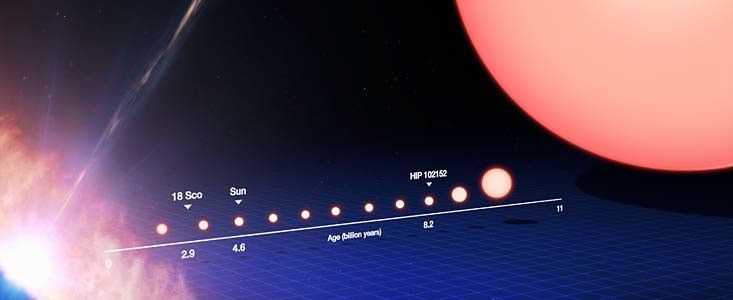
The Sun will become a red giant. That is not a prediction; it is a consequence of physics, as certain as gravity. Every Sun-like star that has ever been observed follows the same path. We can see them frozen at every stage: main sequence stars like our own, subgiants just starting to swell, red giants engulfing their inner planets, planetary nebulae glowing in the aftermath, white dwarfs cooling in the dark. The ESO study that produced the hero image above tracked “solar twins” at different ages, including HIP 102152, an 8.2-billion-year-old star that shows us what the Sun will look like three and a half billion years from now. The universe is full of our Sun’s future selves.
What changes, knowing this? Perhaps nothing practical. A billion years is beyond planning. But there is something clarifying about understanding the full arc. The Sun is not eternal. It was born in a collapsing cloud of gas and dust roughly 4.6 billion years ago, forged its own light through nuclear fusion, and has been spending itself ever since. Every photon that reaches your face is a tiny withdrawal from a finite account. The balance is large, but it is not infinite.
And yet, the Sun’s death is also a beginning. The carbon in your bones, the oxygen in your lungs, the iron in your blood: all of it was made inside a star that died before our Sun was born. When the Sun finally sheds its outer layers and seeds the galaxy with its processed elements, it will be returning the favour. Some of that material, billions of years later, may find its way into another collapsing cloud, another protostar, another planet where something looks up and wonders how long its own star has left.
That is the deepest lesson of stellar evolution. Stars do not simply die. They participate in something larger. The Sun’s death, whenever and however it comes, is not an ending. It is a contribution to a process that has been running for 13.8 billion years and shows no sign of stopping. Every stellar nursery in the galaxy is proof that the death of one star is the precondition for the birth of another.
Five billion years from now, someone else’s sky may glow with the light of elements that once belonged to us.

