


Two teams of physicists have spent more than a decade measuring the same number. They are using the best instruments ever built, the most refined techniques ever developed, and the deepest observations of the cosmos ever taken. They are both almost certainly right. And their answers do not agree.
The number is the Hubble constant, usually written as H0. It tells you how fast the universe is expanding right now, named after Edwin Hubble, who first demonstrated in 1929 that galaxies are moving away from us at speeds proportional to their distance. In principle, measuring it should be straightforward: observe how quickly distant galaxies are receding, calibrate the distances carefully, and you have your answer. One number. One universe. One rate of expansion.
Except there are two answers. And the gap between them has not closed as measurements improved. It has widened. Physicists call this the Hubble tension, and it may be the most important unresolved problem in cosmology.
Two Methods, Two Answers
The first method looks at the oldest light in existence: the cosmic microwave background, or CMB. This faint glow permeates all of space, a relic of the moment, roughly 380,000 years after the Big Bang, when the universe cooled enough for light to travel freely. ESA’s Planck satellite mapped this light with extraordinary precision, measuring temperature fluctuations as small as a few millionths of a degree. From those fluctuations, physicists can reconstruct the conditions of the early universe and calculate what the expansion rate should be today.
Planck’s answer: 67.4 ± 0.5 km/s/Mpc. That means for every megaparsec of distance (about 3.26 million light-years), a galaxy recedes 67.4 kilometres per second faster. The margin of error is less than 1%. This is a measurement of remarkable confidence, rooted in a model of physics that has been tested against millions of data points across the observable universe. It is not a rough estimate. It is one of the most precisely determined numbers in all of cosmology.
The second method works from the other end of time. Instead of rewinding the physics of the early universe, it measures distances and velocities directly, using objects we can see in the present-day cosmos. This is the cosmic distance ladder, a chain of calibrated steps that reaches further and further into space.

The first rung uses parallax, the apparent shift of nearby stars as Earth orbits the Sun, to fix distances within our galaxy. The second rung uses Cepheid variable stars, pulsating giants whose brightness oscillates at a rate tied directly to their true luminosity. Observe how fast a Cepheid pulses, and you know how bright it truly is; compare that to how bright it appears, and you know how far away it is. The third rung uses Type Ia supernovae, thermonuclear explosions of white dwarf stars that detonate with nearly identical energy. Because they are so luminous, visible across billions of light-years, they extend the distance ladder into the deep universe.
The SH0ES team (Supernova H0 for the Equation of State of Dark Energy), led by Nobel laureate Adam Riess at Johns Hopkins University, has spent over 20 years refining this ladder. Their answer: 73.0 ± 1.0 km/s/Mpc.
The two values disagree by about 8 to 9%. In everyday life, that might sound small. In precision cosmology, it is enormous. The statistical significance of the discrepancy exceeds five sigma, the threshold physicists use to distinguish a real effect from a fluke. The odds that this gap is due to chance alone are roughly one in 3.5 million.
For years, sceptics hoped the distance ladder was simply miscalibrated. Cepheid variable stars are often found in crowded stellar fields. When you observe one through Hubble’s optics, the light of surrounding stars can bleed into your measurement, potentially biasing the result. If the Cepheids were a little less bright than Riess’s team calculated, the local expansion rate would come down, and the tension might dissolve.
Then the James Webb Space Telescope looked at the same Cepheids.
Webb’s infrared instruments cut through the crowding problem entirely. Its mirror is larger, its resolution sharper, and it observes in wavelengths where dust and neighbouring stars interfere far less. In 2024, the SH0ES team published results from Webb observations of Cepheids in the spiral galaxy NGC 5584, 72 million light-years away. Webb’s value for the same set of galaxies was 72.6 km/s/Mpc. Hubble’s was 72.8. The numbers were nearly identical.
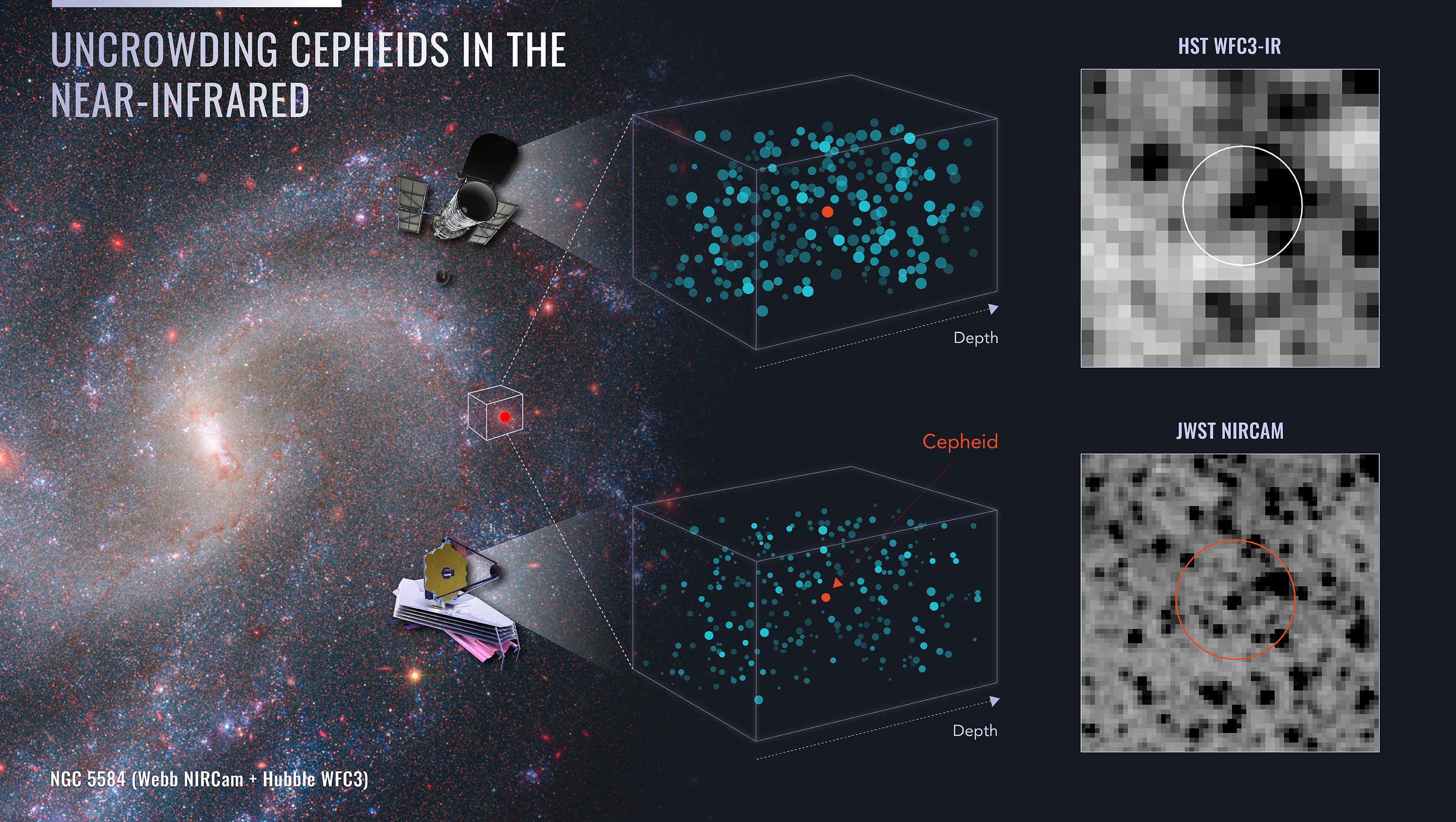
The most powerful space telescope ever built had confirmed, not corrected, the distance ladder. Crowding was not the problem. Dust was not the problem. The Hubble tension was real, and it had just gotten deeper. In late 2024, the SH0ES team published its largest JWST study yet, observing Cepheids across multiple supernova host galaxies. The conclusion held: the local expansion rate remains stubbornly near 73 km/s/Mpc, no matter how sharply you look at the stars.
Not everyone agrees the tension is as stark as five sigma. Wendy Freedman, an astronomer at the University of Chicago who pioneered the use of Cepheids for cosmology in the 1990s, has been building an independent distance ladder using different standard candles. Her Chicago-Carnegie Hubble Program (CCHP) uses two alternative stellar markers: tip of the red giant branch (TRGB) stars and J-region asymptotic giant branch (JAGB) stars. Both provide distance measurements that do not depend on Cepheids.
Freedman’s team, using JWST data, found values of 68.8 km/s/Mpc (TRGB) and 67.8 km/s/Mpc (JAGB). These sit closer to Planck’s early-universe number, not Riess’s local one. Her conclusion: the tension might be smaller than we think, possibly the result of subtle differences in how different teams calibrate their distance ladders, not a sign of new physics.
The debate between Riess and Freedman is one of the most closely watched disputes in modern astrophysics. Both are rigorous. Both have decades of expertise. Both use JWST data. They reach different conclusions. The difference lies not in the telescope but in the choice of stellar standard candle and the calibration assumptions that go with it. Resolving which approach is more reliable may take years of additional data.
Meanwhile, the TDCOSMO collaboration has introduced an entirely independent measurement method. Instead of stars, they use gravitationally lensed quasars: distant, blindingly luminous galactic cores whose light is bent and split by the gravity of an intervening galaxy. When a quasar’s brightness flickers, the different light paths deliver the flicker at slightly different times. That time delay, combined with a model of the lensing galaxy’s mass, yields a distance, and from distance, an expansion rate.
In December 2025, TDCOSMO published results from eight lensed quasars, incorporating new data from JWST, the Keck Telescopes, and the Very Large Telescope. Their result: approximately 71.6 km/s/Mpc, with 4.6% precision. It falls between Planck and SH0ES, but closer to the high end. Another data point; still no resolution.
Every New Telescope Deepens the Mystery
If the dark energy that drives cosmic acceleration is not a fixed cosmological constant but something that changes over time, could that explain the discrepancy?
The Dark Energy Spectroscopic Instrument (DESI), a ground-based survey mapping millions of galaxies to trace the universe’s expansion history, released its second data set in 2025. The results contained a provocative hint: the equation of state of dark energy may not be constant. In the early universe, dark energy appeared to behave like a “phantom” (expanding faster than a cosmological constant would predict). In the recent universe, it resembles “quintessence” (expanding more slowly). Dark energy, in other words, might be evolving.
This would be a revolution. But it does not solve the Hubble tension. When DESI’s data is combined with Planck’s CMB measurements, the inferred Hubble constant actually drops to 63.7 km/s/Mpc, further from the local value, not closer. The tension does not ease. It deepens.
The relationship between dark energy and the expansion rate is not straightforward. Understanding how quickly the universe expands today depends on the entire history of its acceleration. If dark energy has been changing, every assumption built into the standard model of cosmology (known as ΛCDM) needs to be re-examined. The Hubble tension might be a symptom of something much larger.
Theorists have not been idle. Dozens of proposals have been put forward to reconcile the two measurements. Most fall into two broad categories.
The first alters the early universe. Early dark energy models propose that a brief, intense burst of dark energy existed before the CMB was released, shrinking the sound horizon, the characteristic scale imprinted in the CMB’s patterns. A smaller sound horizon would shift Planck’s inferred expansion rate upward, toward the local value. Some models combine early dark energy with additional neutrino species (sterile neutrinos), adding extra radiation that could further adjust the early universe’s expansion dynamics. These “neutrino-assisted early dark energy” models can reduce the tension to roughly two sigma, though none eliminates it entirely.
The second category modifies the late universe. Perhaps gravity behaves differently on cosmological scales than general relativity predicts. Perhaps there are interactions between dark matter and dark energy that subtly alter the expansion history. Perhaps the universe is not as homogeneous as the standard model assumes, and local variations in matter density create a “Hubble bubble” around our cosmic neighbourhood that biases our distance measurements. A framework published in early 2026 explored the possibility that evolving dark energy could be directly linked to the tension, though the authors noted the model requires further observational constraints before it can compete with ΛCDM.
None of these proposals has gained consensus. The standard ΛCDM model, despite the tension, still fits the overwhelming majority of cosmological data better than any alternative. Replacing it requires extraordinary evidence, not just a disagreement between two numbers, however statistically significant.
What Happens Next
The next few years will be decisive. ESA’s Euclid space telescope, launched in July 2023, is mapping the three-dimensional structure of the universe across 10 billion years of cosmic history. It has already catalogued 26 million galaxies, and its first cosmology data release is expected in late 2026. That analysis will provide an independent measurement of the expansion rate that depends on neither the CMB nor the traditional distance ladder. If Euclid confirms the tension, the case for new physics becomes very difficult to dismiss.
More JWST observations of Cepheids, TRGB stars, and gravitationally lensed systems will continue to sharpen the measurements. DESI will release further data constraining the behaviour of dark energy across cosmic time. The Vera C. Rubin Observatory in Chile has begun its ten-year Legacy Survey of Space and Time, expected to discover thousands of Type Ia supernovae per year, building a statistical sample orders of magnitude larger than anything available today. And the Nancy Grace Roman Space Telescope, NASA’s next flagship, will combine a Hubble-class mirror with a field of view 100 times larger, enabling unprecedented surveys of both Cepheids and supernovae across vast swathes of the sky.
The answer, when it comes, will reshape our understanding of the scale of the universe itself. If the tension is real, if neither measurement is wrong, then something fundamental about the way we model the cosmos is incomplete. We may need new particles, new forces, or new physics that nobody has yet imagined.
The universe is under no obligation to make sense on the first try. Two numbers sit on the table, stubbornly apart, and the space between them may be the most important discovery in modern cosmology.

