

The telegraph operator watched his paper catch fire. His machine was disconnected from its battery.
It was the night of September 1, 1859, and something impossible was happening to the sky. Across the western United States, the darkness had turned a deep, pulsing crimson. Gold miners in the Rocky Mountains stumbled out of their tents at one in the morning, brewed coffee, fried bacon, and went looking for the sunrise that wasn’t there. In the northeastern states, people read their evening newspapers by the glow pouring down from above, without a single lamp. The light was an aurora, driven to latitudes where no living person had seen one, pushed there by the largest geomagnetic storm in recorded history. If you’re wondering what would happen if the Carrington Event happened today, the answer involves every satellite in orbit, every power grid on the planet, and a cost that begins at $600 billion.
September 1, 1859
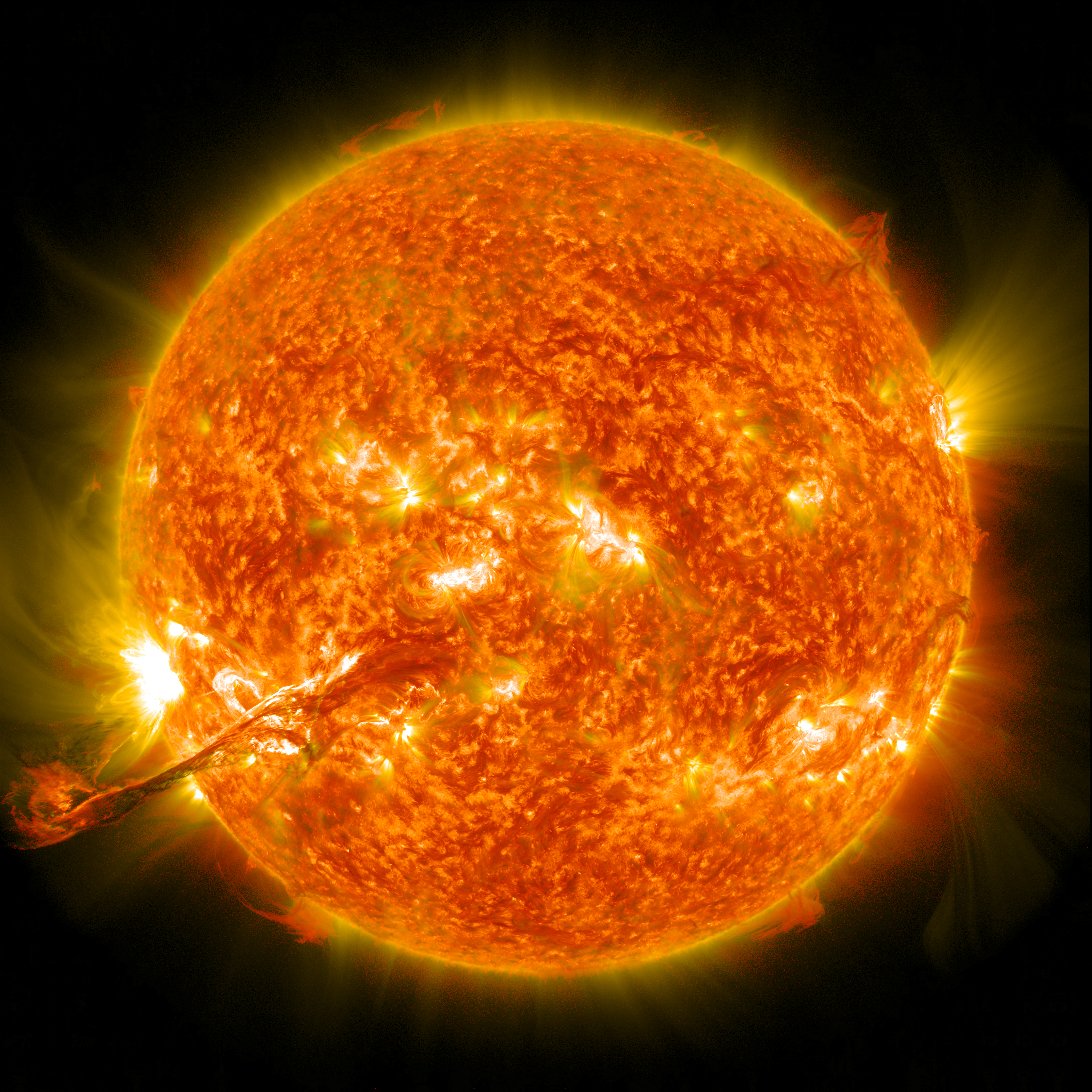
At 11:18 a.m. on that Thursday morning, a 33-year-old English astronomer named Richard Carrington was sketching sunspots at his private observatory in Redhill, Surrey. He had been tracking an unusually large group of dark spots for days, carefully recording their drift across the solar disc. Then, as he watched, two patches of intensely white light erupted from the surface of the Sun. They were so bright they overwhelmed the surrounding sunspot group entirely. Carrington had never seen anything like it. Neither had anyone else. He was witnessing the first solar flare ever recorded by a human being.
Elsewhere in England, another astronomer, Richard Hodgson, was independently observing the same event through his own telescope. The two men would later present their drawings side by side at a meeting of the Royal Astronomical Society in November 1859, confirming that the flash was real, not an instrument error or a trick of the eye. What made the observation remarkable, beyond the coincidence, was the medium: Carrington saw the flare in ordinary white light, something so rare that most astronomers of the era considered it theoretically impossible.
What Carrington could not see was the invisible consequence of that flash. The flare had been accompanied by a coronal mass ejection: a wave of magnetized plasma, billions of tons of charged particles, launched from the Sun’s corona at extraordinary speed. A typical CME takes three to four days to cross the 93 million miles between the Sun and Earth. This one arrived in roughly 17.6 hours. Scientists now believe a prior CME, launched from the same active region days earlier, had swept the interplanetary medium clear of resistance, creating a corridor of low-density solar wind. The second blast, unimpeded, accelerated through that corridor like a train on an empty track.
When it struck, Earth’s magnetic field buckled. The geomagnetic storm that followed, peaking from September 1 to 2, remains the most powerful ever measured. Its effects on the only long-distance electrical network of the era, the telegraph system, were immediate and violent.
In Pittsburgh, a telegraph manager reported that the currents flowing through the lines were so powerful that platinum contacts were in danger of melting and what he described as “streams of fire” poured from the circuits. In Washington, D.C., a telegraph operator named Frederick Royce leaned too close to his equipment and watched an arc of fire jump from a ground wire to his forehead. Across Europe and North America, sparks showered from machines, operators received electric shocks, and telegraph paper caught fire from the surges coursing through hundreds of miles of copper wire.
But the strangest detail was this: at stations in Boston and Portland, Maine, operators disconnected their batteries entirely and found they could still send and receive messages at 30- to 90-second intervals. The electrical current generated by the storm itself, flowing through the wire, was strong enough to power the equipment. The aurora had become the battery.
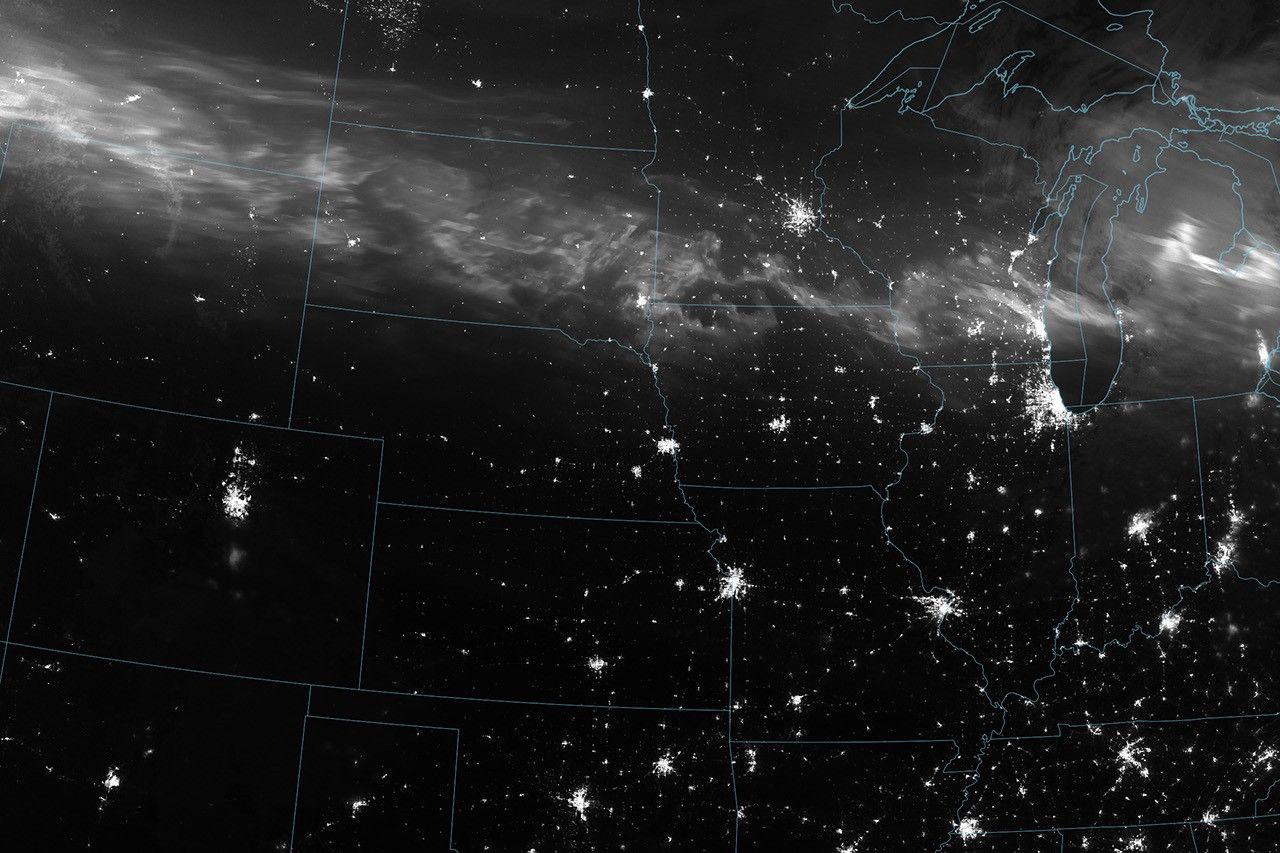
And the aurora itself was something no living person had witnessed. It blazed across latitudes where it does not belong: Cuba, Hawaii, Jamaica, Colombia, southern Japan, and parts of China. Ships’ logs in the tropics recorded skies so bright with red and green light that crew members believed distant cities were burning. In the eastern United States, the aurora was so vivid that people woke their neighbors to watch it. Newspapers the following week carried breathless accounts of blood-red skies and curtains of green fire that moved like living things. The storm had turned Earth’s atmosphere into a canvas visible across nearly the entire planet, a display so spectacular that some witnesses believed it was a sign of the apocalypse.
What Would Happen If It Struck Today
The world of 1859 ran on steam, horse, and a handful of telegraph wires strung between cities. The world of 2026 runs on satellites, fiber optics, semiconductor chips, and a power grid that spans continents. A Carrington-class geomagnetic storm today would hit a civilization whose entire nervous system is electrical.
The most immediate danger is the power grid itself. Geomagnetically induced currents (GICs), the same phenomenon that set telegraph paper on fire in 1859, would flow through high-voltage transmission lines and into the transformers that form the backbone of modern electrical infrastructure. These transformers are not designed to handle direct current. GICs saturate their magnetic cores, causing them to overheat and, in severe cases, suffer irreversible damage. A single extra-high-voltage transformer can weigh over 400 tons, cost millions of dollars, and take 12 to 18 months to manufacture and install. There are no large stockpiles of spares. A 2013 joint study by Lloyd’s of London and Atmospheric and Environmental Research estimated that a Carrington-scale event could leave 20 to 40 million people in the United States without power for periods ranging from several weeks to one to two years. The economic cost for the US alone was projected at $0.6 to $2.6 trillion.
Satellites would be next. A storm of this magnitude would bombard low-Earth orbit with energetic particles, degrading solar panels, corrupting onboard electronics, and accelerating orbital decay by expanding the upper atmosphere. During the May 2024 G5 geomagnetic storm, the strongest in over two decades, roughly half of the approximately 10,000 low-Earth orbit satellites performed coordinated evasive maneuvers: the largest satellite migration in history. And that storm, while historic by modern standards, was still well below Carrington scale. Research published in January 2026 calculated that a Carrington-level superstorm could disrupt satellite control within just 2.8 days, potentially triggering a cascading chain of orbital debris that would threaten humanity’s access to low-Earth orbit for years. GPS accuracy would degrade or fail. Communications satellites could go dark. The precise timing signals that synchronize financial markets and cellular networks would vanish.
Then there is the internet. While the fiber optic cables that carry data across ocean floors are not themselves vulnerable to induced currents, the copper power lines that run alongside them are. Those power lines feed electrical repeaters spaced along the cable every 60 to 100 kilometres. If enough repeaters fail, an entire transoceanic cable goes dark. Undersea cables are grounded only at their endpoints, hundreds or thousands of kilometres apart, leaving the repeaters between them exposed. A 2022 study published on arXiv found a strong correlation between geomagnetic activity and voltage fluctuations in transoceanic cable power systems, suggesting that a Carrington-scale event could knock out significant segments of the global internet backbone.
The cascading failures extend further than most people would expect. Without reliable power, water treatment plants go offline. Hospital backup generators carry fuel for days, not months. Financial systems that depend on sub-millisecond synchronization freeze. Supply chains managed by software running on servers cooled by electricity grind to a halt. The Lloyd’s study identified chains of failure reaching into agriculture, fuel distribution, and emergency services: sectors most people would never immediately connect to a solar storm.
We have already had a close call. On July 23, 2012, a CME of Carrington-class intensity erupted from the Sun and tore through the exact orbital position Earth had occupied just days earlier. The blast was detected by NASA’s STEREO-A spacecraft, which happened to be sitting in its path. Had the eruption occurred about a week sooner, when the Sun’s rotation had that active region pointed directly at our planet, it would have struck Earth head-on. Daniel Baker of the University of Colorado later estimated the damage would have been comparable to the original Carrington Event. “If it had hit, we would still be picking up the pieces,” Baker said in 2014. Most of the world never learned how close it came.
The Quiet Vigil at L1
Between the Sun and the Earth, roughly one million miles from our planet, there is a gravitational balance point called the L1 Lagrange point. It is where humanity has stationed its early-warning system for exactly this kind of threat.
For a decade, NOAA’s Deep Space Climate Observatory (DSCOVR) orbited L1, monitoring the solar wind in real time. When a CME passed the spacecraft, DSCOVR measured its speed, density, and magnetic orientation, then transmitted that data to the Space Weather Prediction Center in Boulder, Colorado. The warning time was typically 15 to 60 minutes: enough, in theory, for grid operators to reduce transformer loads and for satellite controllers to put spacecraft into safe mode. Fifteen minutes is not generous. But it is the difference between a controlled power reduction and a cascading blackout.
DSCOVR went offline in mid-2025 after a software anomaly, but its successor was already on the way. NOAA’s Space Weather Follow-On mission, SWFO-L1, launched on September 24, 2025, and reached its final orbital position at L1 in January 2026. Now renamed SOLAR-1, the observatory is completing instrument checkout and is expected to begin full operational service this spring. The handoff reflects a broader recognition across space agencies that solar monitoring is not optional. It is critical infrastructure, as essential as weather radar before a hurricane.
The May 2024 G5 storm served as a live rehearsal for the system. NOAA issued accurate advance warnings. Grid operators across North America and Europe implemented protective measures. Satellite operators executed contingency plans. The storm produced auroras visible from Florida to Jamaica, briefly created two additional radiation belts sandwiched between the existing Van Allen Belts, and accelerated at least one Starlink satellite’s reentry by 11 days. But the lights stayed on. The internet kept running. The damage was manageable because the warning system worked, and because the storm, while severe, was not Carrington-scale.
The Sun is a middle-aged star, roughly 4.6 billion years into a 10-billion-year life, born in a stellar nursery like the ones the James Webb Space Telescope photographs in distant nebulae today. Its roughly 11-year solar cycle brings peaks of magnetic activity and relative quiet. Solar Cycle 25 reached its official maximum in October 2024, with a smoothed sunspot number of 160.8, significantly higher than the original forecast of 115. As recently as February 2026, a sunspot region roughly half the size of the one that caused the Carrington Event appeared suddenly and erupted with more than 20 flares in 24 hours, including four X-class bursts. None of those were aimed squarely at Earth. Next time, they might be.
As the current solar cycle gradually declines over the next several years, the probability of extreme events diminishes, but never reaches zero. Carrington-class storms do not follow schedules. Evidence in ice cores, tree rings, and geological records suggests they occur roughly once or twice per millennium. That is a statistical average, not a promise of even spacing.
Somewhere tonight, SOLAR-1 is watching the Sun from a million miles away, measuring every ripple in the solar wind, sending numbers back to a quiet room in Colorado. The next Carrington Event is not a question of if. It is a question of whether, when the Sun flares white again, we will see it coming in time.

