

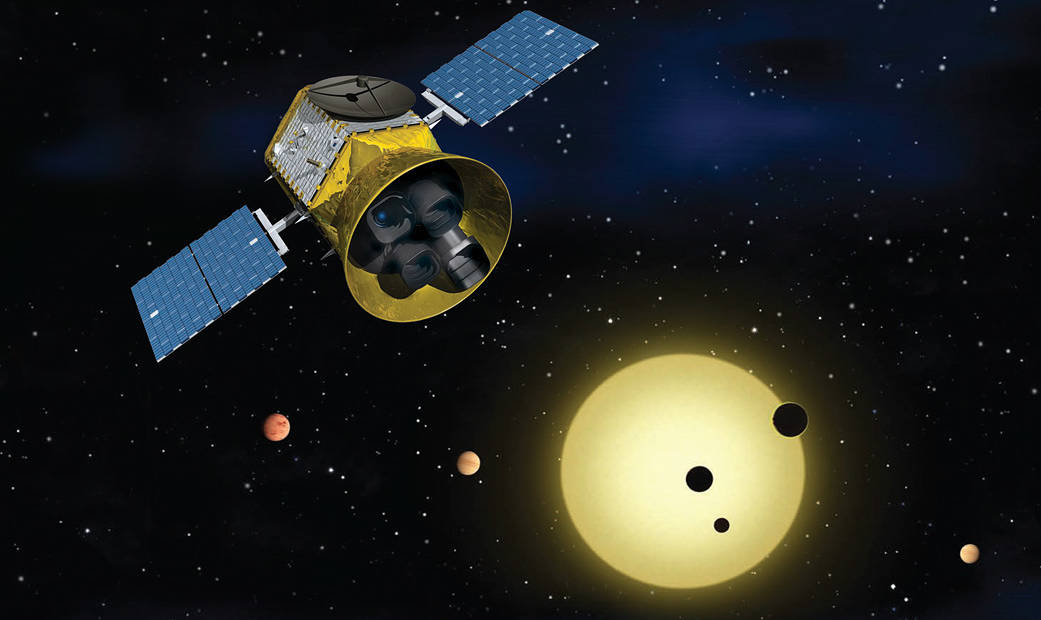
Orbital mechanics is supposed to be the steadiest thing in the universe. Planets settle into their paths over millions of years and hold there, tracing the same arcs through the dark for eons. Our own solar system has been doing this for four and a half billion years. But 372 light-years away, in the southern constellation Pictor, there is a planetary system whose orbits are actively coming undone.
Three worlds circle the star TOI-201. Their paths are tilted relative to one another, and the most massive of them pulls so hard on its companions that their orbital geometry is shifting. Not over geological time. On human timescales. Within 200 years, one of those worlds will stop transiting its star from our line of sight entirely.
An Unlikely Observatory
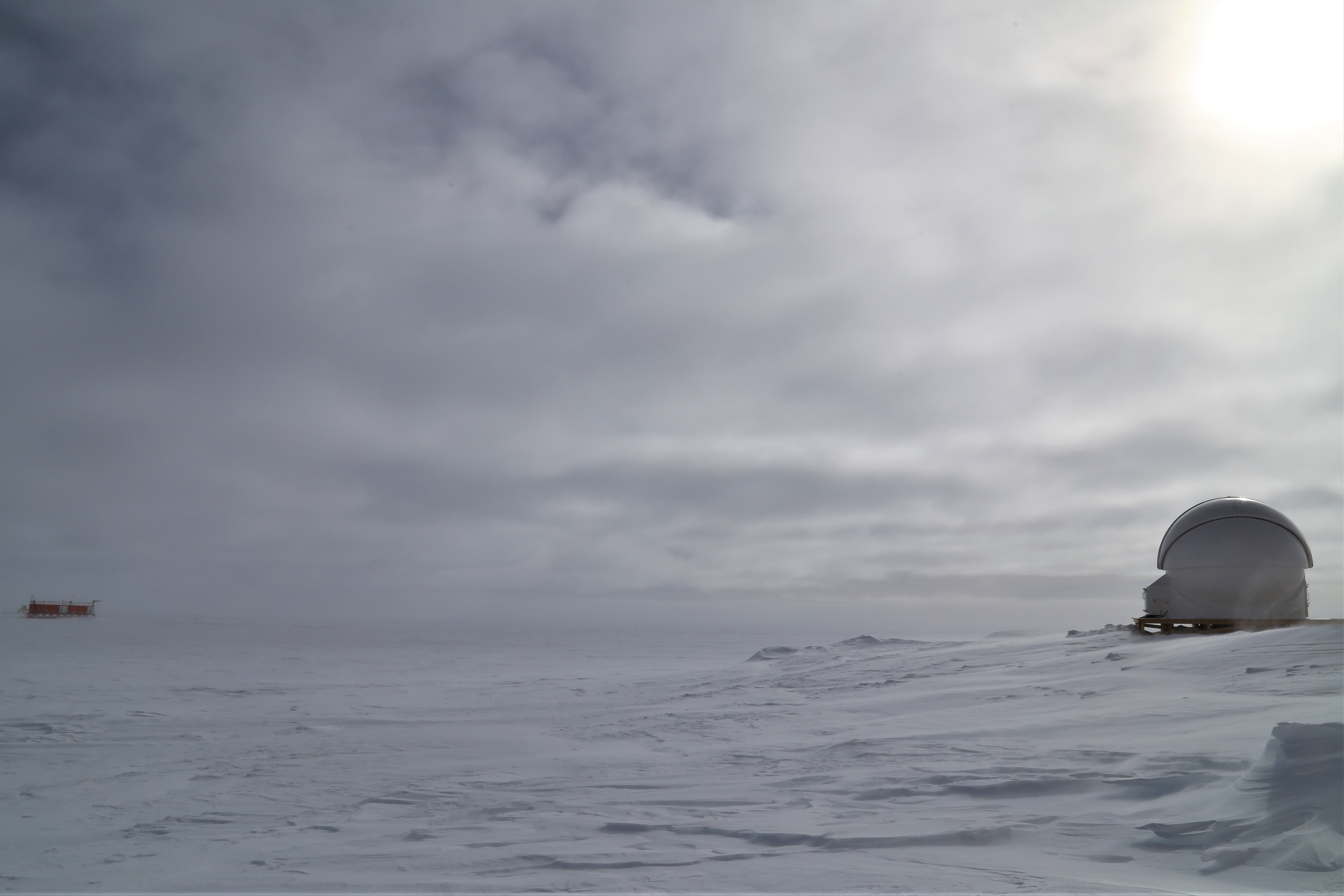
The discovery was announced on April 15, 2026, in Science Advances. An international team led by Ismael Mireles, a Ph.D. candidate at the University of New Mexico, combined data from NASA’s TESS spacecraft with observations from ASTEP, the Antarctic Search for Transiting ExoPlanets. ASTEP sits at the Concordia Station on the Antarctic Plateau, 1,200 kilometers from the coast and 3.2 kilometers above sea level. The months-long polar night gives astronomers an uninterrupted window on the same patch of sky, month after month, ideal for catching the slow, rare transits of long-period objects. The team also drew on data from the LCOGT telescope network, ESA’s Gaia satellite, and observations from the Instituto de Astrofísica de Canarias.
TOI-201 itself is an F-type star: 32% larger and more massive than our Sun, and only about 870 million years old. By comparison, the Sun is 4.6 billion years old. The system is young, which partly explains its volatility.
Three bodies share its gravity. TOI-201 d is a rocky super-Earth, six times our planet’s mass, that scorches around the star every 5.8 days. TOI-201 b is a warm Jupiter, half the mass of our solar system’s largest planet, completing a 53-day orbit. And TOI-201 c is a brown dwarf: too massive to be a planet (about 16 times Jupiter’s mass), too small to fuse hydrogen like a star. It traces a wide, highly elliptical path every 7.9 years. That last object carries a distinction of its own: it is now the longest-period transiting object ever discovered.
The System in Motion
In most planetary systems, worlds form within the same flat disk of gas and dust, and they tend to remain in that plane for billions of years. TOI-201’s three bodies orbit at misaligned angles, and the brown dwarf’s stretched, eccentric path means it sweeps gravitationally close to the inner planets on each pass. Those tugs accumulate. The orbits slowly tip and shift. “The planets’ orbits are tilted relative to each other,” lead author Mireles said, “and because of that, they’re slowly pulling each other into new orientations.”
This is the three-body problem rendered at planetary scale. Most orbital evolution unfolds across timescales that no civilization could observe in a single lifetime. Here, the changes are measurable across a span of years. TOI-201 is, as Mireles described it, “one of only a handful of systems where planetary orbits can be watched actively changing on human timescales.”
The consequences are playing out in visible increments. Within about 200 years, TOI-201 d will stop crossing its star’s face as seen from Earth, its orbital plane having precessed out of alignment with our line of sight. TOI-201 b will follow a few centuries later. All three bodies will eventually resume transiting, but the cycles play out over millennia. We happen to be observing during a window when all three are still visible from our vantage point.
What Comes Next
The next transit of TOI-201 c is predicted for March 26, 2031. Given the brown dwarf’s extended orbit, it will be a rare and extended event. Telescope networks worldwide are already planning coordinated observations.
The system also offers a working laboratory for orbital dynamics. Because the geometry is changing on measurable timescales, astronomers can compare model predictions against real data year by year, testing and refining their understanding of how gravitational interactions sculpt young planetary systems before they settle into something stable.
The planets of TOI-201 do not know they are being watched. They are simply doing what gravity requires: pulling at one another, slowly and without pause, until the system finds a new shape that holds.

