
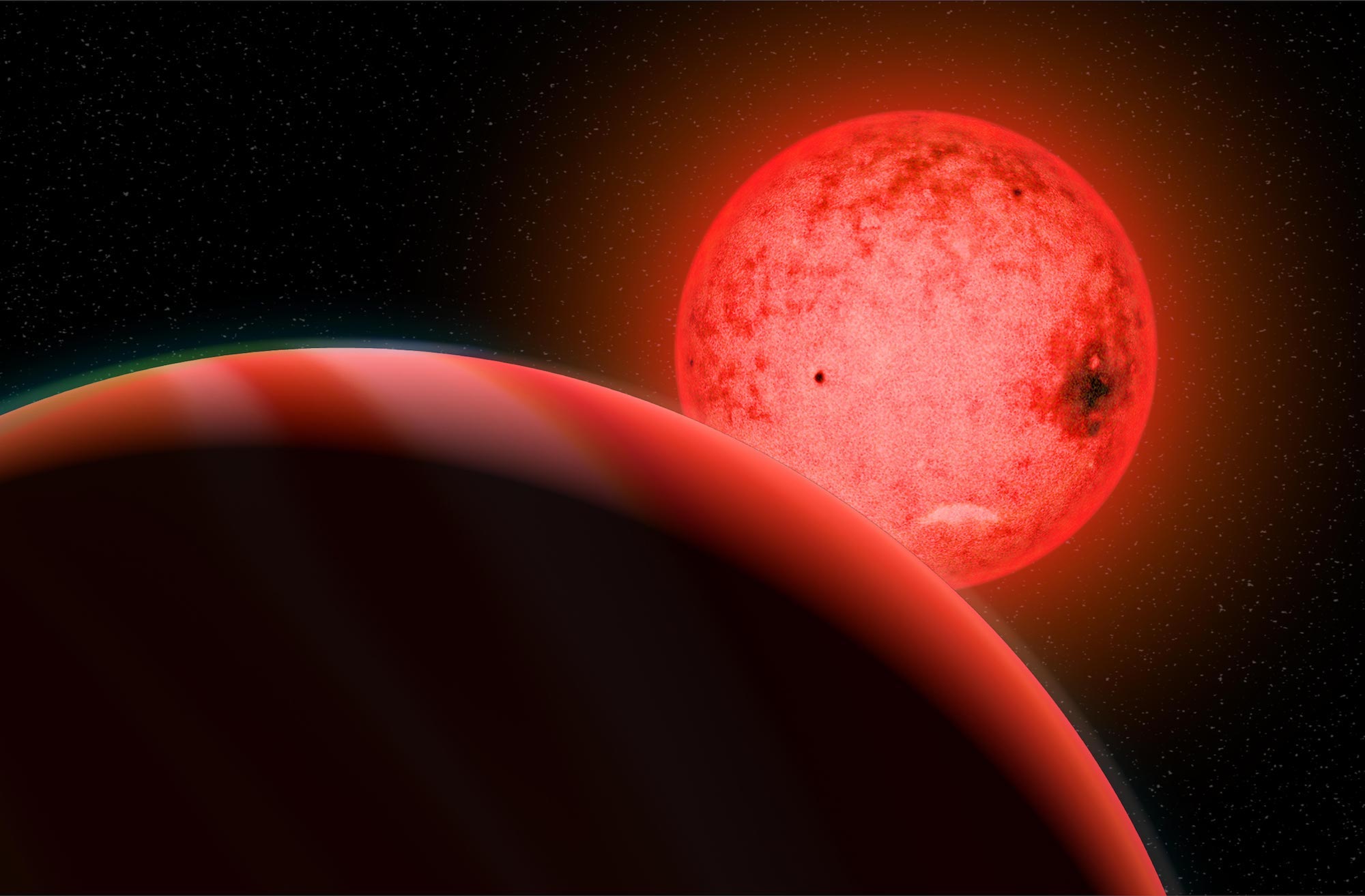
Picture the system to scale. The host star, TOI-5205, has a radius just 39 percent of the Sun’s: small, red, cool enough to simmer for hundreds of billions of years. The planet orbiting it every 1.63 days is almost exactly Jupiter’s size, with 1.08 times its mass. A gas giant is supposed to orbit something vastly larger than itself. In this system, 283 light-years away in the constellation Vulpecula, that gap has nearly closed.
When TOI-5205 b crosses in front of its star, it blocks roughly six percent of the starlight. That is an exceptionally deep transit signal for any exoplanet, not because the planet is unusually large, but because the star is so small. The planet isn’t the anomaly. The relationship is. And now, after three sessions with the James Webb Space Telescope, scientists have discovered that even the planet’s own atmosphere contradicts what its interior appears to be made of.
There is no model that fully explains any of this.
Why TOI-5205 b Shouldn’t Exist
Two competing theories describe how giant planets form. The first, and most widely accepted, is core accretion: a solid core of roughly ten Earth masses assembles over millions of years from the rocky dust and pebbles drifting through a young protoplanetary disk. The process begins in regions dense enough to condense, deep within molecular clouds where gas and dust collapse under their own gravity. Once that core is massive enough, its gravity pulls in surrounding gas rapidly, building a Jupiter-class world before the disk dissipates. The second theory, disk instability, skips the core entirely. Under the right conditions, gravitational instabilities in a massive disk can cause it to fragment directly into clumps, which collapse quickly into gas giants.
Both models struggle with TOI-5205 b. Around a low-mass M-dwarf like TOI-5205, the protoplanetary disk is expected to be proportionally thin and low in solid material. Core accretion needs a sufficiently massive disk to build the initial rocky foundation. Disks around small stars also disperse faster, narrowing the window for gas accretion. That should make a Jupiter-mass planet effectively impossible. The lifecycle of a star shapes everything that can form around it, and a star with 40 percent of the Sun’s mass is simply not expected to produce the conditions that build giants.
Disk instability faces its own constraints. It requires a disk massive enough to become gravitationally unstable, a condition more commonly associated with heavier, more luminous stars. The disk around a star like TOI-5205 is generally considered too low-mass for this pathway to work.
This kind of contradiction has appeared before. In 2019, astronomers confirmed GJ 3512 b, a planet nearly half Jupiter’s mass orbiting a star just one-eighth the mass of our Sun. Researchers concluded that only disk instability could explain it, though the model required conditions that stretched existing theory. TOI-5205 b is a different problem: its star is less extreme, but the planet’s atmosphere now adds a layer of contradiction that neither formation model anticipated. As the original discovery team wrote in 2023: “Based on our nominal current understanding of planet formation, TOI-5205 b should not exist.”
What JWST Found in the Atmosphere
The new results, published April 7, 2026 in The Astronomical Journal (Cañas et al., 171(4):260), come from an international team led by Caleb Cañas of NASA’s Goddard Space Flight Center, alongside co-investigators Shubham Kanodia of Carnegie Science and Jessica Libby-Roberts of the University of Tampa. Their work is part of the GEMS program (Giant Exoplanets around M-dwarf Stars), operating under JWST’s largest Cycle 2 exoplanet survey: “Red Dwarfs and the Seven Giants.” Among the thousands of confirmed worlds now catalogued, planets like TOI-5205 b remain in a category of their own: too large for where they sit, too close to stars that shouldn’t host them.
The team used Webb’s Near Infrared Spectrograph (NIRSpec) to observe three separate transits of TOI-5205 b, spanning wavelengths from 0.6 to 5.3 micrometers. At those wavelengths, molecules in the planet’s upper atmosphere absorb starlight at characteristic fingerprints, leaving dips in the transmission spectrum that reveal the atmosphere’s composition. The technique is known as transmission spectroscopy, and for a planet blocking six percent of its star’s light on every pass, the signal is unusually strong.
Among the detections: methane (CH4) and hydrogen sulfide (H2S), present between 3.0 and 5.0 micrometers. Those molecules are consistent with a cool gas giant. What the atmosphere is missing, or more precisely, what it has far too little of, is the real discovery.
A Contradiction Written in Layers
Every gas giant we understand well, Jupiter and Saturn included, has an atmosphere enriched in heavy elements relative to its host star. As a forming planet sweeps up material from the disk surrounding a young star, it accumulates metals, silicates, and carbon compounds. This enrichment, called metallicity, is effectively a fingerprint of how a world was built. The more heavy elements present, the more turbulent and material-rich the formation process was.
TOI-5205 b’s atmospheric metallicity falls below Jupiter’s. Below Saturn’s. Below its own host star’s, the very material from which it should have formed. “The metallicity is much lower than our models predicted,” said Kanodia. The planet’s carbon-to-oxygen ratio exceeds solar values significantly: carbon-rich, oxygen-poor, and chemically unlike any gas giant previously measured.
Interior structure models, built from the planet’s known mass and radius by Simon Müller and Ravit Helled of the University of Zurich, predict bulk heavy-element fractions of 10 to 20 percent. That number stands in stark contrast to what the atmosphere shows. Somehow, the planet’s outer envelope and its deep interior appear to be decoupled: two layers of the same world, carrying different records of where it came from, or what happened after it formed. Interior and surface composition can diverge radically when extreme conditions prevent mixing between layers, and gas giants under certain pressure-temperature regimes may behave similarly, trapping early enrichment deep while the atmosphere evolves separately.
Adding to the complexity: TOI-5205 is heavily spotted. Starspots and faculae, regions of magnetic activity on the stellar surface, contaminate the very light used to read the planet’s atmospheric signature. Below 3.0 micrometers, stellar contamination dominates the transmission spectrum entirely. Separating the planet’s fingerprint from the star’s required careful Bayesian retrieval techniques across all three transit observations. The team’s approach sets a methodological precedent for future M-dwarf atmosphere studies: any planet orbiting an active red dwarf will face this same interference, and correcting for it is not yet a routine procedure.
The GEMS Survey: Red Dwarfs and the Seven Giants
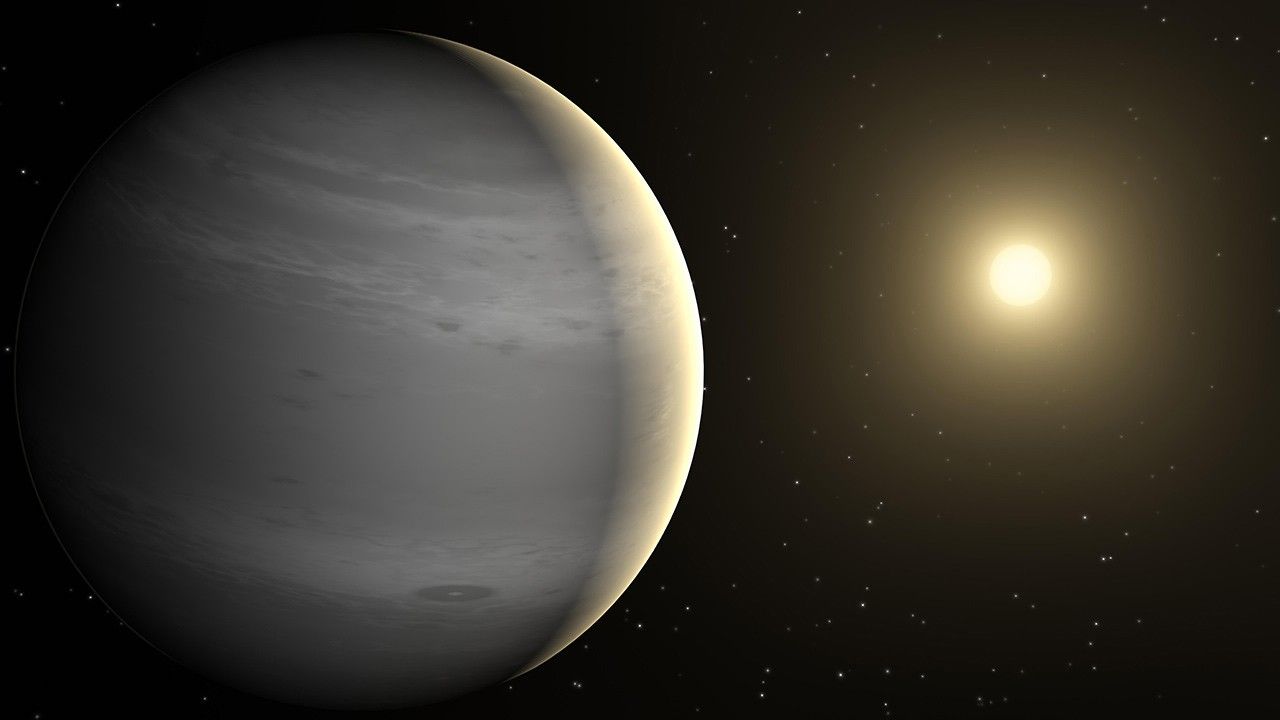
TOI-5205 b is one of seven giant planets selected for the GEMS survey, the largest Cycle 2 exoplanet program on JWST. The survey’s premise is straightforward and unsettling: if even one Jupiter-sized world can orbit a star like TOI-5205, there may be more of them, and their existence demands an explanation that existing theory cannot currently provide.
The choice of M-dwarf hosts reflects both scientific opportunity and growing theoretical discomfort. M-dwarfs make up roughly 70 percent of all stars in the Milky Way. If Jupiter-class planets around them are truly rare, then formation theory is broadly correct. If even a small fraction of M-dwarfs host giants, the implications for disk physics and the conditions required for planet formation ripple outward to virtually every stellar population we study. A handful of confirmed atmospheric detections from seven carefully chosen targets could begin to answer which of these worlds is correct.
The GEMS targets were not selected at random. They represent the anomalies: the worlds formation models said were impossible, assembled into a single survey to find out whether they are genuine exceptions or evidence of something the models have been consistently missing. TOI-5205 b is the first to have its atmosphere characterized. The other six are waiting.
There is also a practical reason M-dwarfs dominate the survey roster. Because these stars are small, transiting gas giants block a much larger fraction of their light than they would around a Sun-like star. TOI-5205 b’s six-percent transit depth is nearly six times what the same planet would produce around the Sun. That deep signal makes atmospheric characterization faster and more precise, which is exactly why JWST’s most ambitious exoplanet program is focused here, at the edge of what theory says should exist.
What Comes Next
Müller and Helled’s interior modeling work is ongoing. The central question, why the atmosphere and interior tell such different stories, may require new frameworks to answer: not refinements to existing models, but a more fundamental rethinking of how enrichment moves (or fails to move) between a gas giant’s layers over billions of years. Do atmospheres like this form metal-poor to begin with, or does some mechanism strip enrichment over time? The data does not yet say.
Better stellar models for active M-dwarfs will be essential before any of these results can be considered final. Without cleanly separating stellar contamination from planetary signal at shorter wavelengths, the atmospheric picture remains incomplete. Future JWST observations of TOI-5205 b, with different instrument configurations or at different orbital phases, could help disentangle the two signals. That work is likely already being planned.
The remaining six GEMS targets will tell the broader story. If several of them show similarly low atmospheric metallicities, TOI-5205 b becomes part of a pattern rather than an outlier. If it stands alone, the question shifts from “what went wrong with the models” to “what went wrong with this particular planet.” Either answer rewrites something.
TOI-5205 b has been orbiting its star since long before our solar system existed, its interior and atmosphere quietly disagreeing about what kind of planet it is. We are only beginning to ask the question.

