


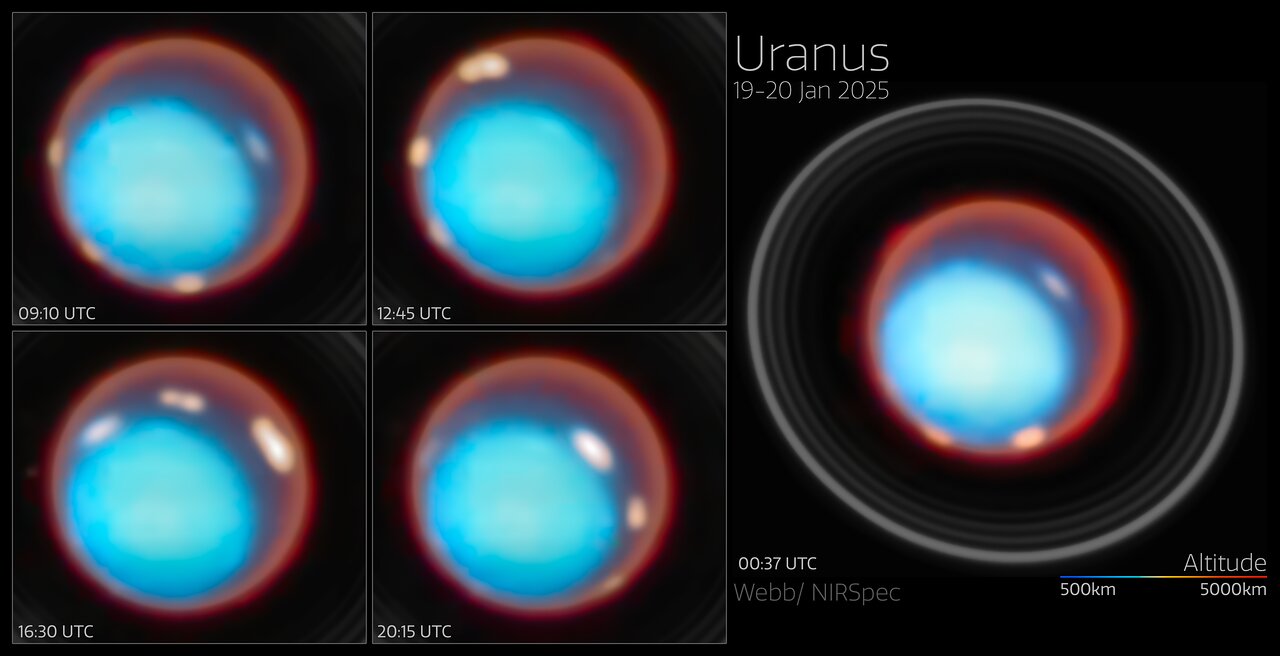
For forty years, everything humanity knew about Uranus up close came from a single afternoon. On January 24, 1986, Voyager 2 swept past the seventh planet, captured over 7,000 photographs, and kept flying. No spacecraft has returned since. In that long silence, Uranus became the solar system’s quiet afterthought: a pale blue-green circle in textbooks, featureless and forgettable. Then, last year, the James Webb Space Telescope turned its infrared gaze toward that overlooked world and found something no instrument had ever seen there: auroras, faint and rosy, shimmering thousands of kilometres above the ice-blue clouds.
This is the first time we have watched auroras on Uranus. Not inferred them from magnetic field models. Not guessed at them from distant ultraviolet hints. Seen them, mapped them in three dimensions, and measured the charged particles that produce them.
What Webb Found
On January 19, 2025, a team of astronomers pointed JWST’s Near-Infrared Spectrograph (NIRSpec) at Uranus and watched for 15 continuous hours, nearly one full rotation of the planet. The instrument’s Integral Field Unit split incoming light into thousands of individual spectra, building a spatial and spectral portrait of the upper atmosphere with a precision no telescope has achieved before. The observations were part of JWST General Observer programme 5073, led by Dr. Henrik Melin of Northumbria University in the UK.
The results, published in Geophysical Research Letters on February 19, 2026, reveal the first three-dimensional map of Uranus’s ionosphere, the outermost shell of atmosphere where gas becomes electrically charged and interacts directly with the planet’s magnetic field. Lead author Paola Tiranti, a PhD student at Northumbria, and her colleagues traced the abundance of H3+ (trihydrogen cation, an ion made of three hydrogen nuclei) across the planet’s face and upward through layers of atmosphere reaching 5,000 kilometres above the cloud tops.
Two bright auroral bands emerged in the data, glowing near the planet’s magnetic poles. Between them, the team found a distinct zone of depleted emission and lower ion density, a feature likely shaped by transitions in the magnetic field lines threading through that region. The average temperature of the ionosphere came in at 426 kelvins (roughly 150 °C), with temperatures peaking between 3,000 and 4,000 kilometres altitude and ion densities peaking closer to 1,000 kilometres. Notably, the measured ion densities were significantly weaker than existing models had predicted.
“This is the first time we’ve been able to see Uranus’s upper atmosphere in three dimensions,” Tiranti said.
The Strangest Magnetosphere in the Solar System
To understand why these auroras matter, you need to understand how deeply strange Uranus is. The planet rotates on its side, its axis tilted roughly 98 degrees from the vertical. And its magnetic field, rather than aligning with that rotation (as Earth’s roughly does), is tilted a further 59 degrees from the spin axis and offset from the planet’s centre by a full third of its radius. The result is a magnetosphere that tumbles and wobbles as Uranus orbits the Sun, sweeping auroras across the atmosphere in complex, shifting patterns unlike anything seen on Jupiter, Saturn, or Earth.
There’s an added twist. Recent analysis of the original Voyager 2 data has revealed that the probe arrived at Uranus just after a rare, intense solar wind event that dramatically compressed the planet’s magnetosphere. For decades, scientists built their models of Uranus on observations taken during an anomaly. The JWST data now provide a baseline captured under more typical conditions, offering the first clean look at how this magnetic field actually behaves day to day.
Webb’s data also confirm that Uranus’s upper atmosphere has been steadily cooling since the early 1990s. Why a planet nearly 2.9 billion kilometres from the Sun is losing heat from its ionosphere remains an open question, one that touches fundamental physics about how ice giants redistribute energy in their upper layers.
Why Ice Giants Matter Now
This is not just about one planet. Among the thousands of exoplanets discovered beyond our solar system, the most common size class is not gas giants like Jupiter or rocky worlds like Earth. It is planets roughly the size of Uranus and Neptune. We have two ice giants in our own backyard, and until this study, we had never mapped the upper atmosphere of either in three dimensions. Every insight Webb extracts from Uranus becomes a template for understanding worlds we can only see as points of light orbiting distant stars.
NASA’s 2023–2032 Planetary Science Decadal Survey ranked a Uranus Orbiter and Probe as its highest-priority flagship mission. Current planning targets a launch in the mid-to-late 2030s, with a transit time of roughly thirteen years. If that mission flies, the JWST observations being published now will serve as the roadmap for where to look and what to measure once a spacecraft is finally in orbit.
What Comes Next
Programme 5073 is not finished. The team plans further JWST observations to track how Uranus’s auroras shift with changing solar wind conditions and the planet’s long seasons (each lasting 21 Earth years). Meanwhile, a companion paper by Dr. Melin, published earlier in 2025 in the same journal, laid the groundwork by characterising the ionosphere’s bulk properties. Tiranti’s study builds on that foundation with the vertical and spatial detail needed to test magnetospheric models against real data for the first time.
Forty years of silence, and then this: a planet we thought we understood, glowing quietly in wavelengths our eyes will never see, reminding us that the most extraordinary things in our solar system are sometimes the ones we stopped looking at.

