

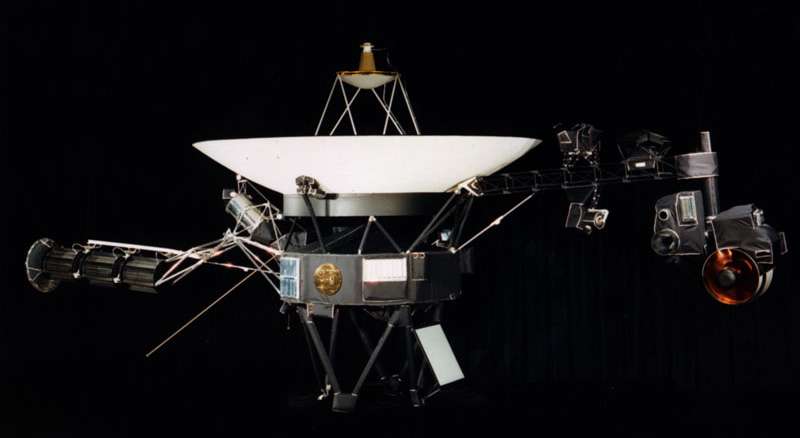
Right now, somewhere past the edge of everything the Sun can reach, a spacecraft the size of a small car is hurtling through the dark at 17 kilometres per second. It is roughly 25.8 billion kilometres from home. If you called out to it at the speed of light, your voice would take more than 22 hours to arrive. In November, it will take a full 24.
Voyager 1 was built to last five years. It has been flying for 48. And it is still, right now, sending data home to a small team at NASA’s Jet Propulsion Laboratory who have not stopped listening.
This is the story of how two spacecraft, launched in the last years of the 1970s, flew past every outer planet, crossed into interstellar space, and became the farthest things humanity has ever made. One of them is carrying a love letter, encoded in brainwaves, across the emptiest stretch of the universe we have ever touched.
The Grand Tour
In the summer of 1964, a graduate student named Gary Flandro sat at a desk at the Jet Propulsion Laboratory in Pasadena with a seemingly routine assignment: calculate possible trajectories for a mission to the outer planets. What he found was extraordinary. Jupiter, Saturn, Uranus, and Neptune were drifting into an alignment that occurs only once every 175 years. A spacecraft launched in the late 1970s could use each planet’s gravity to sling itself toward the next, reducing what would otherwise be a 40-year voyage to less than a decade.
Flandro published his findings in 1966. NASA considered a full Grand Tour of four spacecraft visiting all the giant worlds, but budgets were tight and ambitions had to be trimmed. What was eventually approved was a leaner mission: two probes, two trajectories, launched weeks apart. They would be called Voyager.
Voyager 2 lifted off on August 20, 1977, aboard a Titan III-E Centaur rocket. Voyager 1 followed sixteen days later, on September 5. Despite leaving second, Voyager 1 travelled a faster, more direct trajectory and reached Jupiter first, in March 1979. The encounters that followed rewrote our understanding of the outer solar system. Voyager 1 discovered active volcanoes on Io, the first found beyond Earth. It revealed the intricate braided structure of Saturn’s rings and provided the first detailed look at Titan’s thick orange atmosphere, a world with weather, wind, and hydrocarbon rain.
Voyager 2 took the longer road. After its own flybys of Jupiter in July 1979 and Saturn in August 1981, it continued outward into territory no spacecraft had visited. It reached Uranus in January 1986, finding a planet tilted almost completely on its side, with a magnetic field bizarrely offset from its rotational axis in ways no model had predicted. In August 1989, it arrived at Neptune, measuring winds exceeding 2,000 kilometres per hour (the fastest recorded on any planet) and photographing geysers of nitrogen erupting from the frozen surface of Neptune’s moon Triton.
Voyager 2 remains the only spacecraft to have visited Uranus or Neptune. Everything we know about those worlds from direct observation comes from a handful of days of data, captured nearly four decades ago, by a single machine passing through at roughly 20 kilometres per second. The next planned mission to either planet has not yet been approved.
The planetary mission was supposed to end there. It did not.
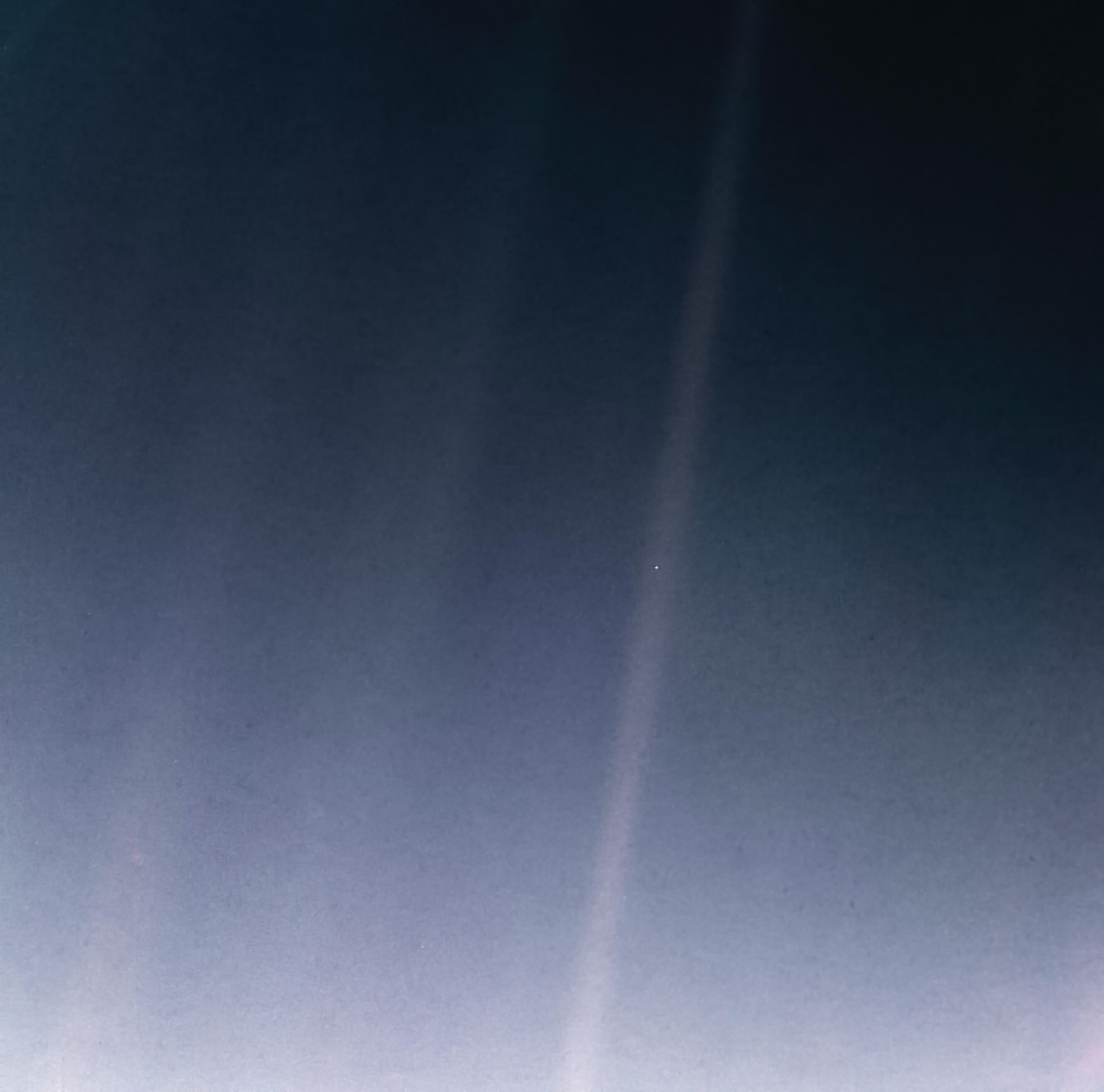
On February 14, 1990, with the planets behind it and the Sun a distant star, Voyager 1 turned its camera around. This was not part of the original mission plan. It happened because Carl Sagan, the astronomer who had championed the Voyager programme from its earliest days, had spent nearly a decade lobbying NASA for one final photograph: before you shut the cameras off for good, point them home.
From 6 billion kilometres away (roughly 40 astronomical units), Earth appeared as a pale speck, less than 0.12 of a pixel wide, caught in a scattered ray of sunlight. It is one of the most reproduced photographs in the history of science. NASA released a reprocessed version in 2020 using modern techniques, but the essential image is unchanged: a mote of light, barely there, in an ocean of nothing.
Sagan’s reflection, published four years later in his book Pale Blue Dot, remains some of the most quoted writing in science: “Look again at that dot. That’s here. That’s home. That’s us. On it everyone you love, everyone you know, everyone you ever heard of, every human being who ever was, lived out their lives… on a mote of dust suspended in a sunbeam.”
The cameras were switched off shortly afterward. Voyager 1 had no more need for eyes. What lay ahead was beyond seeing.
But Voyager still carries something meant to be found.
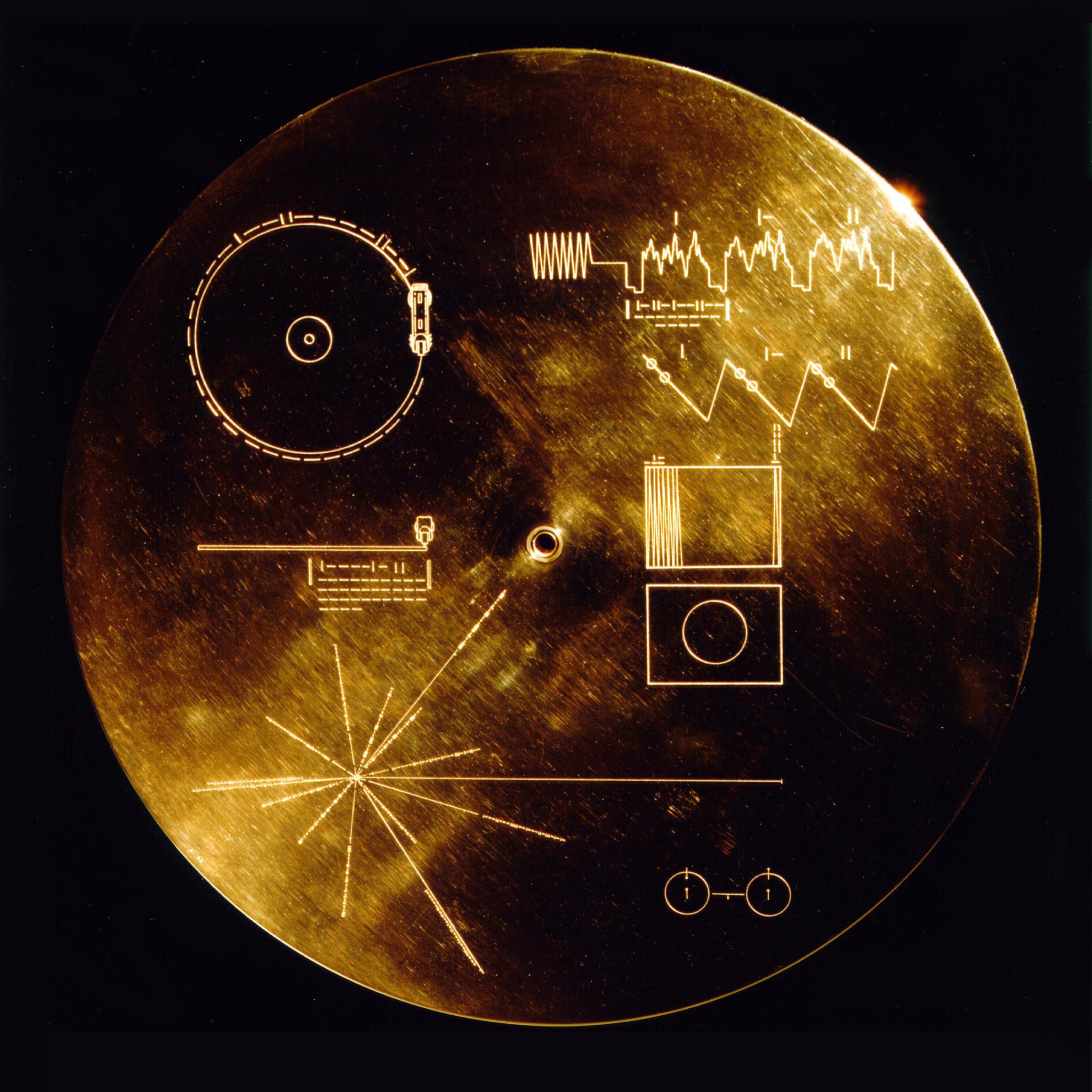
Bolted to the side of each spacecraft is a Golden Record: a 12-inch gold-plated copper disc enclosed in an aluminium case. Etched on the cover are diagrams showing how to play the record and a pulsar map that pinpoints the location of Earth relative to 14 known pulsars. Inside, encoded in analogue grooves, is a message assembled by a committee chaired by Carl Sagan.
The record contains spoken greetings in 55 languages, from Sumerian to Wu Chinese to Rajasthani. It carries the sound of surf breaking on a shore, the rumble of thunder, the song of humpback whales, and a human heartbeat. It holds 116 images: a nursing mother, a diagram of vertebrate evolution, the Great Wall of China, a violin with a musical score, a sunset with birds. There are musical selections from Bach to Blind Willie Johnson, from a Peruvian wedding song to Chuck Berry’s “Johnny B. Goode.”
Ann Druyan served as creative director of the project. During the weeks of work in the spring and summer of 1977, she and Sagan fell in love. Before the record was finalised, Druyan had her brainwaves recorded by an EEG and compressed into a minute of sound, which was placed on the disc alongside Beethoven’s string quartets and Navajo night chants. She has said that during the recording she thought about the history of Earth, the predicament of civilisation, and what it felt like to have just fallen in love.
That recording is now roughly 25 billion kilometres from the place where it was made, and still moving outward, at 17 kilometres every second.
Into the Dark Between the Stars
On August 25, 2012, Voyager 1 crossed the heliopause: the boundary where the outward pressure of the solar wind finally yields to the inward pressure of the interstellar medium. For the first time in history, a human-made object had left the Sun’s domain and entered the space between the stars. NASA confirmed the crossing in September 2013, after analysing plasma oscillation data that showed a sharp increase in electron density consistent with the denser plasma of interstellar space.
Voyager 2 followed on November 5, 2018, crossing the heliopause at a different location, a different angle, and a different phase of the solar cycle. Its plasma science instrument (since switched off) was still operational at the time, providing the first direct measurement of plasma density and temperature at the boundary itself. Together, the two crossings revealed that the heliopause is not a clean line but a complex, asymmetric transition zone: a region of shifting magnetic fields, turbulent pressures, and particles that behave differently from what models had predicted.
The data from interstellar space is irreplaceable. No other operational or planned mission will reach the heliopause for decades. These two probes, originally designed to photograph planets, have become our only instruments in a region measured in light-hours, sending back readings from a place no sensor had ever reached.
But the power to keep sending is running out.
Both spacecraft are fuelled by radioisotope thermoelectric generators (RTGs), which convert heat from the decay of plutonium-238 into electricity. The plutonium has a half-life of 87.7 years, and each generator loses roughly four watts of output per year. In 1977, the RTGs produced about 470 watts each. By 2026, that figure has fallen below half, and it keeps dropping. Engineers at JPL have been making increasingly difficult decisions about what to keep running.
In September 2024, Voyager 2’s plasma science instrument was shut down. In February 2025, Voyager 1’s cosmic ray subsystem was retired. In March 2025, Voyager 2’s low-energy charged particle detector followed. Further shutdowns are planned for this year: Voyager 1’s low-energy charged particle instrument and Voyager 2’s cosmic ray subsystem. When those go, each probe will be down to its final two science instruments: a magnetometer and a plasma wave detector.
In November 2023, the mission faced a more alarming crisis. A memory chip in Voyager 1’s flight data system failed, corrupting 3% of its onboard software. For five months, the spacecraft sent nothing intelligible. Engineers at JPL, working across a round-trip communication delay of more than 44 hours, devised a remarkable fix: they split the corrupted code into fragments, relocated each fragment to a working section of memory, and patched the software to run from its scattered new addresses. On April 20, 2024, Voyager 1 began talking again. By June, all four of its then-operational instruments were returning science data from 24 billion kilometres away.
The signal Voyager 1 transmits is about 23 watts at the antenna, roughly the power of a refrigerator light bulb. By the time it reaches the Deep Space Network on Earth, it has spread across billions of kilometres and arrives as a whisper measured in fractions of a billionth of a billionth of a watt. The team that receives it is small. Most of the original mission engineers have retired or died. The ones who remain know that every instrument they switch off brings the mission one step closer to silence.
In November 2026, Voyager 1 will cross a milestone that no one in 1977 imagined it would live to see. It will reach a distance of one full light-day from Earth: approximately 25.9 billion kilometres. A signal sent at the speed of light will take 24 hours to arrive. No human-made object has ever been that far.
JPL engineers believe at least one instrument on each probe can remain operational into the 2030s. After that, the power will no longer sustain even the heaters that keep the remaining systems from freezing. The transmitters will go quiet. And then there will be nothing left but the drift.
What Remains
After contact is lost, both Voyagers will continue through interstellar space. They will not slow down. There is nothing to slow them.
In approximately 40,000 years, Voyager 1 will pass within 1.6 light-years of a dim star called Gliese 445 (also catalogued as AC+79 3888), in the constellation Camelopardalis. Voyager 2 will drift within 1.7 light-years of Ross 248, a red dwarf in the constellation Andromeda. Neither encounter will be close by any standard. Neither star has known planets. The spacecraft will pass through empty space and keep going.
The Golden Records will survive far longer than the electronics that carried them. Gold does not corrode. In the vacuum of interstellar space, with no atmosphere, no weather, and no erosion, the discs will remain legible for hundreds of millions of years, possibly billions. Cosmic ray bombardment will slowly degrade the aluminium casing, but the gold will endure.
The records will outlast the oceans. They will outlast the continents. They may outlast the Sun itself, which will exhaust its hydrogen fuel and expand into a red giant in roughly five billion years, swallowing the inner solar system. By then, the Voyagers will be unimaginably far from where they started, still drifting, still carrying surf and thunder and whale song and greetings in 55 languages no one speaks anymore, and a minute of compressed brainwaves from a woman who had just fallen in love.
The chance that anything will ever find them is vanishingly small. The spaces between the stars are, as we are slowly learning from the signals that reach us across the cosmos, almost incomprehensibly vast. The Golden Record is a message in a bottle thrown into an ocean so large that the bottle may drift for aeons without touching a shore.
But we threw it anyway. That may be the most human thing we have ever done.
Somewhere out there, past the last whisper of the solar wind, a gold disc turns in the silence between the stars, carrying the sound of waves on a shore that may one day cease to exist, and the thoughts of a woman falling in love with a man who wanted to photograph Earth from six billion kilometres away, just to remind us how small we are.

