

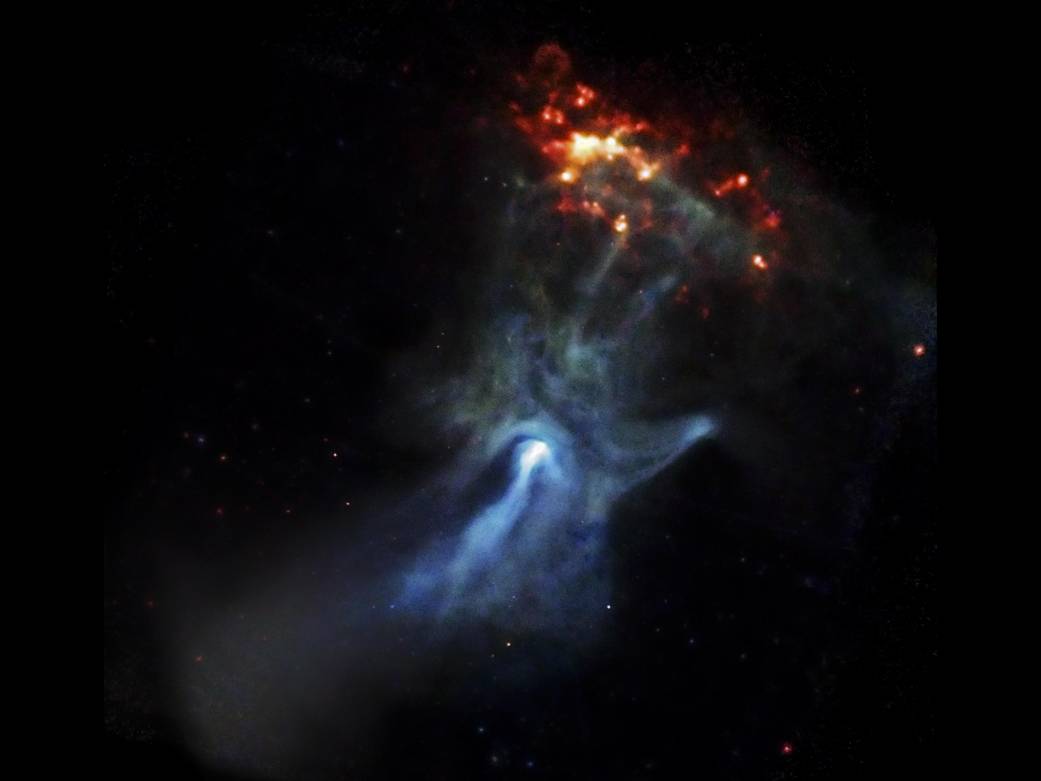
Somewhere in the northern sky, a collapsed star the size of a city is spinning on its axis once every 1.337 seconds. It has been doing so, with clockwork regularity, for millions of years. In 1967, when a 24-year-old graduate student first picked up its signal on a strip of chart-recorder paper at a radio observatory outside Cambridge, she had no idea what she was listening to. Neither did anyone else. For a few extraordinary weeks, the most rational explanation anyone could offer was: aliens.
It wasn’t aliens. What Jocelyn Bell had found was far stranger and far more beautiful: a rapidly spinning dead star, broadcasting into the void with the precision of a Swiss clock. She had discovered what we now call a pulsar, and in doing so, she opened an entirely new window on the universe.
A Bit of Scruff on the Chart Paper
In the summer of 1967, Jocelyn Bell was a PhD student at the University of Cambridge, working under the radio astronomer Antony Hewish. She had spent the previous two years helping to build the Interplanetary Scintillation Array at the Mullard Radio Astronomy Observatory: 4.5 acres of wire, posts, and cable, hammered and soldered into the English countryside by hand. The telescope was designed to study quasars by detecting the way their radio signals scintillated (twinkled) as they passed through the solar wind. Bell’s job was to operate the instrument and analyze the data, which arrived as ink traces on rolls of chart-recorder paper. Some nights she reviewed as much as 96 feet of it.
That August, she noticed something unusual: a small, recurrent mark that kept appearing in her recordings. She called it a “bit of scruff.” It didn’t look like scintillation from a quasar. It didn’t look like terrestrial interference, either. The signal appeared at the same sidereal time each day, meaning it tracked with the stars rather than with any human-made source on the ground. That detail alone suggested it was genuinely coming from deep space. It took three months of painstaking analysis to resolve. On November 28, 1967, using a higher-speed chart recording, Bell confirmed the nature of the signal: it was pulsing with astonishing regularity, once every 1.337 seconds, from a point in the constellation Vulpecula.
Hewish was skeptical. Natural radio sources did not produce signals with that kind of metronomic precision. Such regularity suggested something engineered: electrical interference, a malfunctioning instrument, or (if you let your imagination run) a deliberate beacon. The team half-seriously nicknamed the source LGM-1, for “Little Green Men.” Bell herself later recalled: “We did not really believe that we had picked up signals from another civilization, but obviously the idea had crossed our minds and we had no proof that it was an entirely natural radio emission.”
What settled the question was Bell finding a second pulsing source in a completely different part of the sky. Then a third. Then a fourth. Multiple alien civilizations, all broadcasting at radio frequencies from unrelated directions? Far less plausible than a new natural phenomenon. The team published their findings in Nature in February 1968, describing four pulsating radio sources. The theoretical physicist Thomas Gold quickly identified the signals as the hallmark of rapidly rotating neutron stars: objects that had been predicted on paper in the 1930s but never observed. A new word entered astronomy: pulsar.
Bell’s discovery cracked open an entirely new field of astrophysics. Within a few years, hundreds of pulsars had been identified. The Crab Nebula, the expanding wreckage of a supernova observed by Chinese and Japanese astronomers in 1054 AD, was found to harbour a pulsar at its heart, spinning 30 times per second. The existence of neutron stars, first proposed by Walter Baade and Fritz Zwicky in 1934, was finally confirmed by observation. All of it traced back to a PhD student, a homemade telescope, and a bit of scruff on the chart paper.
The discovery earned the 1974 Nobel Prize in Physics. It was awarded to Hewish and the radio astronomer Martin Ryle. Bell, the person who built the telescope, spotted the anomaly, and persisted against her supervisor’s initial skepticism, was not included. The omission has since become one of the most widely cited examples of gender bias in the history of science, placing Bell alongside other famously overlooked women in astronomy such as Vera Rubin, whose pioneering dark-matter observations were similarly passed over. Bell has addressed the snub with characteristic equanimity: “I feel I’ve done very well out of not getting a Nobel Prize,” she told The Guardian. “If you get a Nobel Prize you have this fantastic week and then nobody gives you anything else. If you don’t get a Nobel Prize you get everything that moves.”
In 2018, she received the Special Breakthrough Prize in Fundamental Physics, worth $3 million, for her “fundamental contributions to the discovery of pulsars, and a lifetime of inspiring leadership in the scientific community.” She donated the entire sum to establish a fund, administered by the Institute of Physics, for women, underrepresented minorities, and refugees pursuing careers in physics research.
The Anatomy of a Pulsar
So what is a pulsar, exactly? The answer begins with the death of a massive star.
When a star significantly larger than our Sun exhausts its nuclear fuel, its core collapses under its own gravity in a cataclysmic explosion called a supernova. If the original star was massive enough to crush its core past the point where electrons and protons are forced to merge into neutrons, but not so massive that the collapse continues all the way to a black hole, what remains is a neutron star: the ultra-dense remnant of the dead star, compressed into a ball roughly 20 kilometres across.
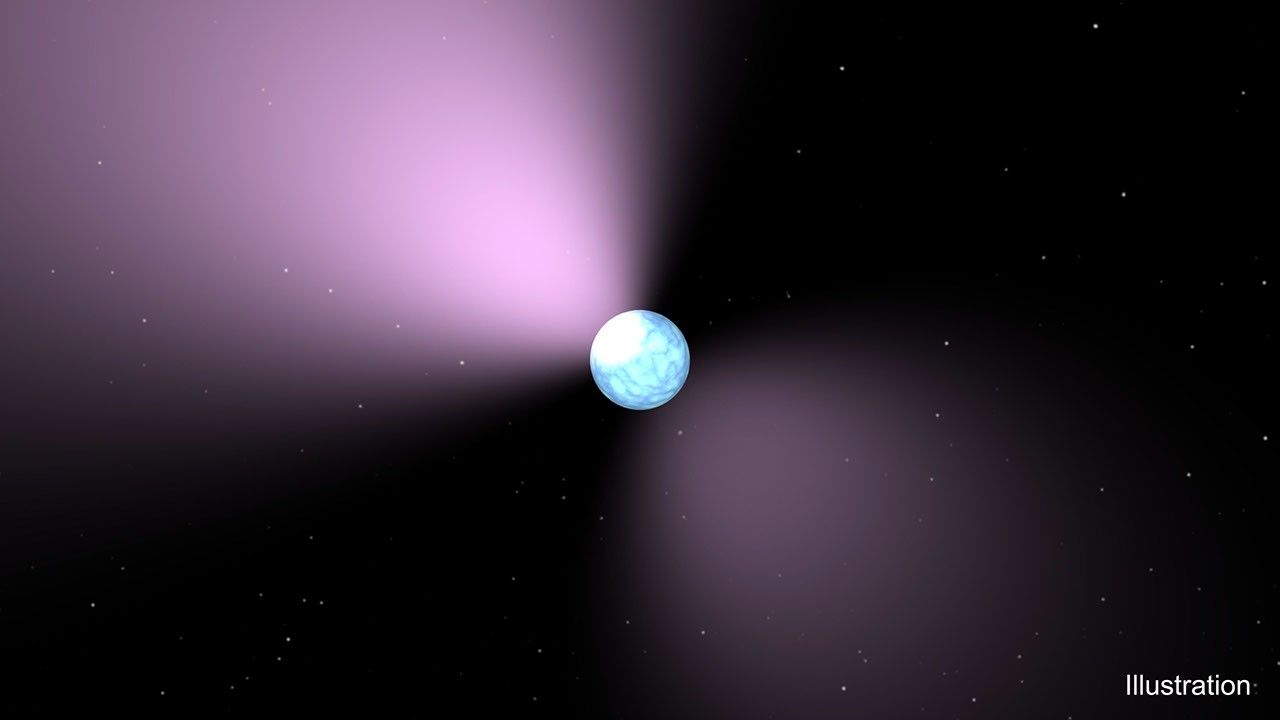
The numbers are staggering. A typical neutron star packs roughly 1.4 times the mass of our Sun into that 20-kilometre sphere, about the width of a small city. A single teaspoon of neutron star material would weigh approximately a billion tonnes on Earth. The density is so extreme that it strains analogy: you are looking at matter compressed to the very limit of what physics allows before it collapses into a black hole.
When a massive star’s core collapses, it conserves angular momentum, the same principle that makes a figure skater spin faster when she pulls her arms in. A star that once rotated lazily over the course of weeks is suddenly squeezed into an object a hundred thousand times smaller. The result is a neutron star that spins with extraordinary speed, sometimes dozens of times per second from the moment of its birth.
A pulsar is a neutron star whose powerful magnetic field is tilted relative to its rotation axis. That magnetic field (trillions of times stronger than Earth’s) funnels streams of charged particles along the star’s magnetic poles, producing narrow beams of radio waves, and sometimes X-rays and gamma rays, that shoot outward into space. As the neutron star rotates, these beams sweep across the cosmos like the turning lamp of a lighthouse. If Earth happens to lie in the path of that beam, we detect a regular flash of radiation: one pulse per rotation. That is what Bell heard in November 1967.
Most pulsars spin once every few seconds, but some have been accelerated to astonishing speeds. These are the millisecond pulsars: old neutron stars that have been “recycled” by accreting matter from a companion star in a tight binary orbit. The infalling material transfers angular momentum, gradually spinning the neutron star faster and faster over millions of years. The current record holder, PSR J1748−2446ad, discovered in the globular cluster Terzan 5, completes 716 full rotations every second. Its equator moves at roughly a quarter of the speed of light.
At the other extreme sit the magnetars: neutron stars whose magnetic fields are hundreds or thousands of times more powerful than those of ordinary pulsars, reaching up to a quadrillion (1015) times the strength of Earth’s field. Magnetars rotate slowly, completing one turn every two to twelve seconds. But they occasionally unleash enormous bursts of X-rays and gamma rays, powered not by rotation but by the violent rearrangement of their colossal magnetic fields. A single magnetar flare, lasting a fraction of a second, can release more energy than our Sun emits in hundreds of thousands of years.
Why the Universe Needs Its Clocks
Pulsars lose rotational energy over time, slowing down at an extraordinarily predictable rate: typically a millionth of a second per year. This makes them, paradoxically, some of the most precise natural timekeepers in the known universe. Millisecond pulsars in particular rival the stability of the best atomic clocks on Earth, maintaining their rhythm across millions of years without meaningful drift. Scientists have learned to exploit this cosmic punctuality in ways that would have seemed like science fiction when Bell first heard that signal in 1967.
The most ambitious application is the Pulsar Timing Array: a galaxy-sized gravitational wave detector built not from lasers and mirrors, but from pulsars themselves. The concept is elegant. If you monitor dozens of pulsars scattered across the sky and measure the exact arrival time of every pulse with nanosecond precision, any large-scale disturbance in spacetime (a passing gravitational wave, for instance) will leave a telltale fingerprint in the data, subtly stretching or compressing the travel time of pulses arriving from different directions in a distinctive quadrupolar pattern known as the Hellings-Downs curve.
In June 2023, four independent international collaborations, including NANOGrav in North America, announced a landmark result. Fifteen years of timing data from 68 pulsars had revealed compelling evidence for a gravitational wave background: a low, persistent hum of spacetime rippling across the cosmos, most likely generated by the mergers and inspiral of supermassive black holes in distant galaxies. It was a detection that ground-based instruments like LIGO and Virgo simply cannot make. Those detectors sense the high-frequency chirps of stellar-mass collisions; pulsar timing arrays tune in to something far deeper and slower, the bass notes of the most massive encounters in existence.
Pulsars are also being developed as a navigation system for deep space. In 2018, NASA’s NICER instrument aboard the International Space Station demonstrated that X-ray pulsar signals can pinpoint a spacecraft’s position to within about seven kilometres, anywhere in the solar system, without any reliance on ground-based tracking stations. The principle mirrors GPS, but uses millisecond pulsars as the reference beacons instead of satellites. For future missions venturing beyond the reach of Earth’s Deep Space Network, pulsar-based navigation may prove not just useful, but essential.
And then there is the matter of pure physics. In 1974, the same year Bell was passed over for the Nobel, astronomers Russell Hulse and Joseph Taylor discovered a binary system containing two neutron stars spiralling slowly toward each other, one of them a pulsar. The rate at which the pair was losing orbital energy matched, with extraordinary precision, what Einstein’s general relativity predicted for energy loss through gravitational wave emission. It was the first indirect evidence for gravitational waves, decades before LIGO would detect them directly, and it earned Hulse and Taylor their own Nobel Prize. Every new millisecond pulsar discovered since is another natural laboratory where general relativity can be stress-tested under the most extreme conditions the universe has to offer.
The massive stars that eventually become pulsars begin their lives in the dense, glowing clouds of gas and dust we call stellar nurseries. In that sense, every pulsar is a memorial: the compressed, spinning remnant of a star that once lit up a nebula, burned through its hydrogen, and died in a flash bright enough to momentarily outshine an entire galaxy. What remains is small, dense, and impossibly precise, ticking away in the dark like a watch left on a grave.
Astronomers have now catalogued more than 3,000 pulsars in the Milky Way alone, and the number grows with every new radio survey. Somewhere out there, right now, a neutron star the width of a small town is completing its seven-hundredth rotation this second, its magnetic lighthouse sweeping the dark with metronomic precision. It will still be ticking long after every clock we have ever built has stopped.

