

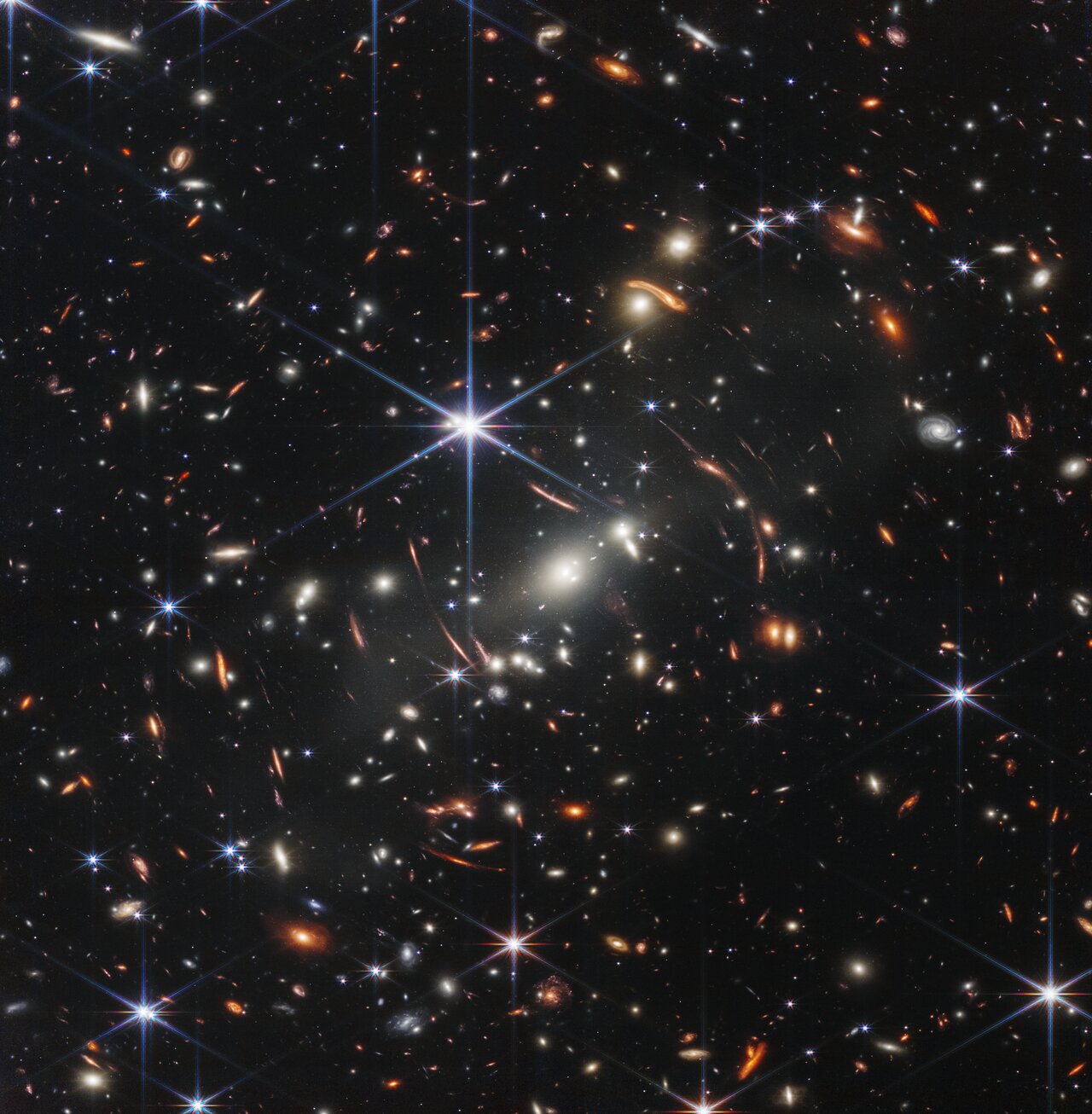
Something is pushing the universe apart. Not slowly, not gently, and not in the way anyone expected. The space between galaxies is growing faster right now than it was a billion years ago, and the force responsible has no particle anyone has detected, no theory that fully accounts for it, no laboratory experiment that has measured it directly. We call it dark energy, and it makes up roughly 68 percent of everything that exists.
What is dark energy? That turns out to be one of the most profound unanswered questions in all of science. The atoms in your body, the light from every star, the planets, the dust, the gas, the galaxies: all of it accounts for about 5 percent of the universe. Another 27 percent is dark matter, a separate mystery entirely. The remaining 68 percent is something we discovered barely a generation ago and still cannot describe. You are made of the universe’s rounding error, looking out at a cosmos dominated by forces you cannot see.
Here is what we know about dark energy. Here is what we don’t. And here is why the answer may determine the fate of everything.
Two Teams, One Impossible Answer
In the mid-1990s, two teams of astronomers were racing to answer one of cosmology’s most fundamental questions: how fast is the expansion of the universe slowing down?
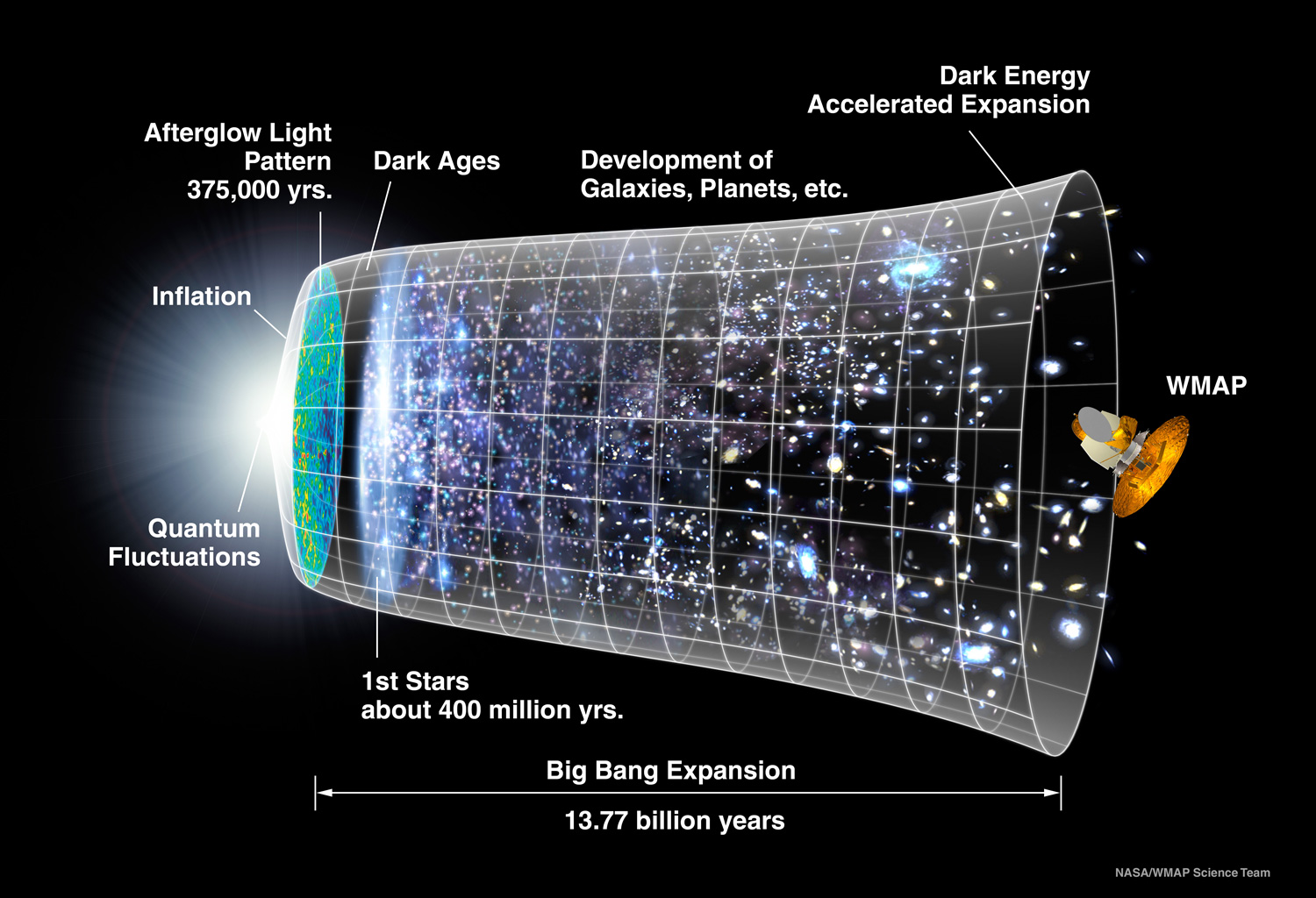
The universe had been expanding since the Big Bang, 13.8 billion years ago. Every cosmologist expected that gravity, the mutual pull of all the matter in the cosmos, would be gradually decelerating that expansion, like a ball thrown upward losing speed as it climbs. The question was not whether the expansion was slowing. The question was by how much, and whether it would ever stop.
Saul Perlmutter led the Supernova Cosmology Project, a team based at Lawrence Berkeley National Laboratory that had been working since 1988. Brian Schmidt led the High-z Supernova Search Team, launched in 1994, with Adam Riess playing a central role in the data analysis. Both teams used the same method: they hunted for Type Ia supernovae, a class of stellar explosion so uniform in peak brightness that each one functions as a “standard candle.” Because you know how bright the explosion truly is, you can measure how dim it appears in your telescope and calculate how far away it is.
By measuring dozens of these explosions in galaxies billions of light-years away, each team could reconstruct how the universe’s expansion rate had changed over cosmic time. Both expected to find deceleration.
Both found the opposite.
The distant supernovae were dimmer than they should have been. Not because something was blocking the light, but because the galaxies hosting them were farther away than any decelerating universe would allow. The expansion of the universe was not slowing down. It was speeding up. Something invisible was pushing space apart from within, and it was winning against the combined gravitational pull of every atom in the cosmos.
Perlmutter’s team published their results in 1999. Riess and Schmidt’s team published theirs in 1998. Two independent groups, two different data pipelines, the same impossible conclusion. In 2011, Perlmutter, Schmidt, and Riess shared the Nobel Prize in Physics “for the discovery of the accelerating expansion of the Universe through observations of distant supernovae.”
The discovery sent physicists back to a number that Albert Einstein had introduced, and then abandoned, nearly a century earlier.
In 1917, Einstein added a term to his equations of general relativity: the cosmological constant, represented by the Greek letter lambda (Λ). His equations predicted that the universe should be either expanding or contracting, but the scientific consensus at the time held that the cosmos was static and unchanging. So Einstein inserted Λ as a counterbalance, a kind of anti-gravity pressure woven into the fabric of space, to hold everything still.
Twelve years later, Edwin Hubble observed that distant galaxies were receding from us in every direction. The universe was expanding after all. Einstein reportedly called the cosmological constant his “greatest blunder” and struck it from his equations.
Then, seventy years after Hubble, the supernova teams found that the expansion was accelerating. Einstein’s “blunder” turned out to be closer to the truth than anyone had imagined. Physicists resurrected Λ as the simplest explanation for what was driving the cosmic acceleration: a uniform energy density permeating all of space, pushing it apart from within. This resurrected cosmological constant became the leading theoretical model for dark energy.
But the model carries an enormous unresolved problem. When physicists try to calculate the energy of empty space using quantum field theory, the number they get is roughly 10120 times larger than what we actually observe. That is not a small discrepancy. It is arguably the worst prediction in the history of physics. Either our understanding of quantum mechanics is missing something fundamental, or dark energy is not vacuum energy at all, but something else entirely.
And here is where people often get confused: dark energy is not dark matter. They share the word “dark,” and that is about all they share. Dark matter has mass. It pulls things together. It is the invisible scaffolding that holds galaxies in shape and keeps galaxy clusters bound to one another. Without it, stars at the edges of spiral galaxies would orbit too fast for visible matter alone to hold them in place. Dark matter makes up about 27 percent of the universe. We do not know what particle it is, though physicists have spent decades searching for candidates like weakly interacting massive particles and axions.
Dark energy does the opposite. It does not clump. It does not hold anything together. It fills all of space uniformly and drives everything apart. It has no known particle and no detected interaction other than its effect on the expansion rate of the cosmos. Dark matter and dark energy together account for 95 percent of the universe. The ordinary matter that makes up stars, planets, and the molecules in your bloodstream is just the remaining sliver.
Dark Energy May Not Be Constant
For a quarter-century after the 1998 discovery, most cosmologists treated dark energy as unchanging: the same strength yesterday as it would be a trillion years from now. Einstein’s cosmological constant, if dark energy is truly Λ, predicts exactly that. The standard model of cosmology, known as ΛCDM, encodes this assumption at its core.
But in March 2025, the Dark Energy Spectroscopic Instrument (DESI) collaboration released results that complicated the picture considerably. DESI is a robotic instrument mounted on the 4-metre Mayall Telescope at Kitt Peak National Observatory in Arizona. It can capture the spectra of 5,000 objects simultaneously, mapping the three-dimensional positions of galaxies and quasars across billions of light-years of cosmic history.
DESI’s Data Release 2 (DR2) drew on three years of observations and included more than 14 million galaxies and quasars, more than double the dataset from its first-year analysis. When the DESI team combined this data with measurements from the cosmic microwave background (the afterglow of the Big Bang) and with Type Ia supernova surveys, they found signs that dark energy may have been stronger several billion years ago and is roughly 10 percent weaker today.
The statistical evidence ranges from 2.8 to 4.2 sigma, depending on which supernova dataset is used. That falls below the 5-sigma threshold physicists require to declare a discovery, but it is well above the level where it can be dismissed as statistical noise. Separately, the Dark Energy Survey (DES) in Chile found results consistent with DESI’s, reinforcing the signal. If confirmed, the standard ΛCDM model will need revision, and a question that most cosmologists considered settled for a generation is suddenly wide open again: why is the universe expanding faster, and is it always going to?
How Does It End?
The fate of the universe depends on what dark energy does over the next tens of billions of years. And with DESI’s new data, the range of possibilities has expanded.
If dark energy remains constant, the universe faces a Big Freeze. Galaxies will continue to drift apart. Stars will exhaust their fuel over trillions of years. Black holes will slowly evaporate through Hawking radiation across timescales so vast they make the current age of the cosmos look like a rounding error. Eventually, nothing will remain but a cold, empty void and a few stray photons carrying the last waste heat of creation. This has been the consensus forecast for the past two decades.
If dark energy strengthens over time, a more violent ending awaits: the Big Rip. In this scenario, the accelerating expansion eventually overwhelms every force that holds matter together. First, galaxy clusters are torn apart. Then individual galaxies. Then solar systems. Then planets, then molecules, then atoms themselves. Everything is ripped apart on a finite timescale, space expanding so violently that the fabric of reality comes undone.
But if DESI is right and dark energy is weakening, a third possibility re-emerges: the Big Crunch. In October 2025, Cornell physicist Henry Tye published a calculation suggesting that if dark energy continues to fade, the cosmological constant could eventually become negative. Gravity would reclaim dominance. The expansion would slow, stop, and reverse. Tye calculated that the universe could reach its maximum size in about 11 billion years and then collapse over the following 9 billion years, ending in a total cosmic implosion roughly 20 billion years from now, at a total age of about 33 billion years.
This is a single calculation built on preliminary data, not a scientific consensus. Many physicists caution that DESI’s hints are just that: hints. The next few years will be decisive. DESI’s full five-year dataset is still being collected. ESA’s Euclid space telescope, launched in July 2023, is already mapping the geometry of the universe with unprecedented precision, with its first major cosmology data release expected in October 2026. And NASA’s Nancy Grace Roman Space Telescope, now fully assembled and on track for launch as early as late 2026, will survey thousands of supernovae across vast stretches of cosmic time. Together, these instruments will either confirm that dark energy is changing or push the evidence back toward a constant.
Either way, the question of how the universe ends is no longer academic. It is empirical. We have instruments capable of answering it.
The distances are difficult to hold in your mind. The universe is 13.8 billion years old, 93 billion light-years across, and 68 percent composed of something we found in 1998 and still cannot name. Somewhere right now, a robotic eye in Arizona is capturing the spectrum of a galaxy 10 billion light-years away, adding one more data point to a map that could tell us how everything ends. We are 5 percent of the universe, trying to understand the other 95. That is not a failure of science. That is where science lives.

