

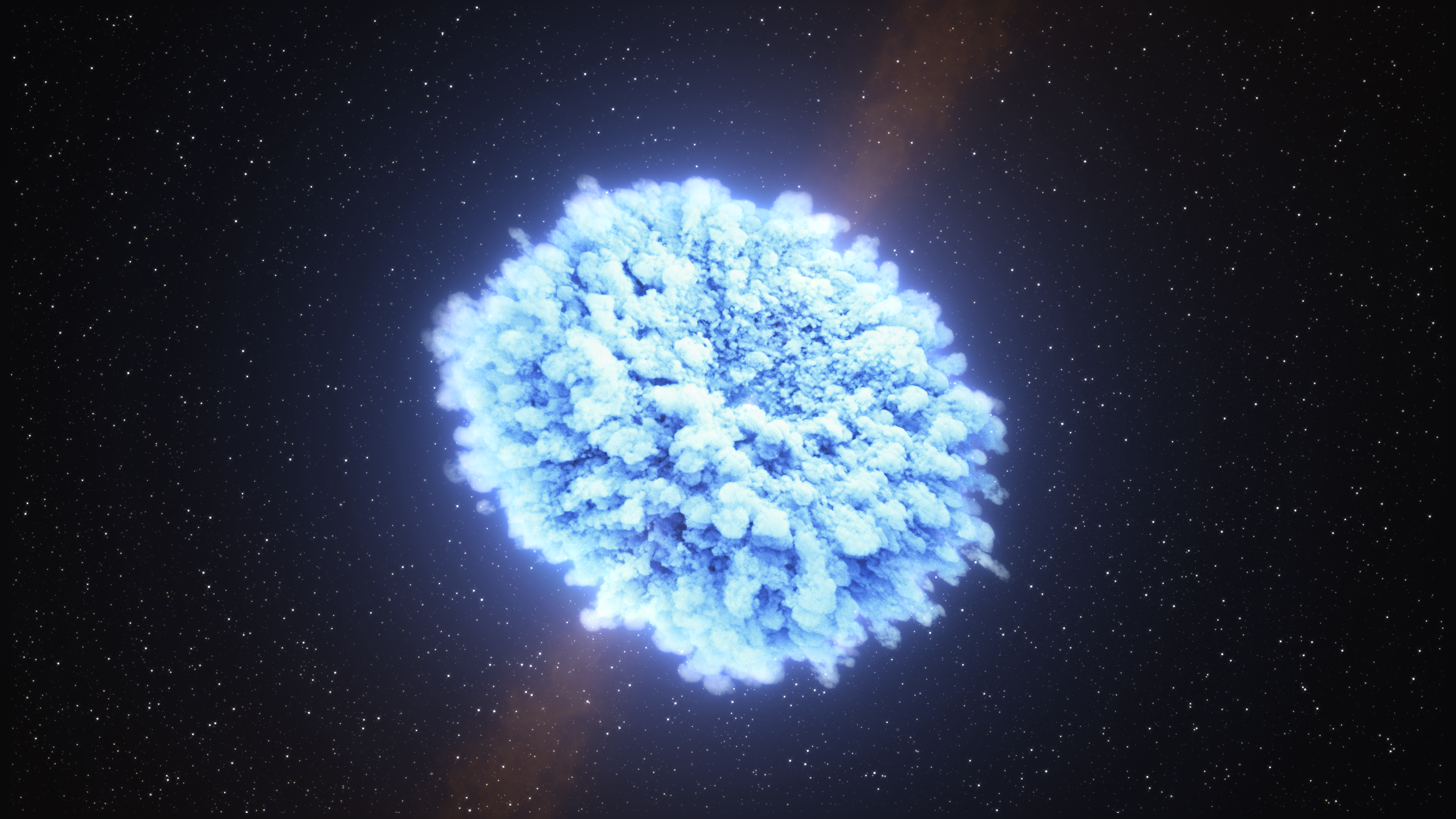
The gold in your ring is older than the Earth. Older than the Sun. The atoms that make it up were forged roughly 4.6 billion years ago (give or take a few hundred million years) in an event so violent it briefly outshone an entire galaxy: two dead stars, each packing more mass than our Sun into a sphere the size of a city, spiraling toward each other at a third the speed of light, and colliding with enough force to ripple the fabric of spacetime itself. That collision, called a kilonova, is where gold comes from in space. Not from stars. Not from supernovae. From the corpses of stars, crashing together in the dark.
If that sounds improbable, it should. The universe had to destroy two stars, wait millions of years for their remains to find each other, and then smash them together at relativistic speeds, all so that the heavy elements we treasure most could exist at all. Every gold bar in every vault, every fleck of platinum in every catalytic converter, every atom of iodine in your thyroid: all of it was born this way. And until very recently, we had no proof.
The Day We Watched Gold Being Made
On 17 August 2017, at 12:41:04 UTC, the twin detectors of the Laser Interferometer Gravitational-Wave Observatory (LIGO) in the United States and the Virgo interferometer in Italy picked up a signal unlike anything they had captured before. It was designated GW170817: gravitational waves from two neutron stars merging roughly 130 million light-years away, in an elliptical galaxy called NGC 4993 in the constellation Hydra.
Just 1.7 seconds later, NASA’s Fermi Gamma-ray Space Telescope detected a short gamma-ray burst, GRB 170817A, arriving from the same patch of sky. For the first time in history, astronomers had both a gravitational wave signal and an electromagnetic counterpart from the same cosmic event. Telescopes around the world swung toward Hydra. What they found glowing in the aftermath was a kilonova, catalogued as AT2017gfo, and its light told an extraordinary story.
The kilonova’s color evolved over days, shifting from blue to red, exactly as theoretical models had predicted for a cloud of freshly synthesized heavy elements expanding outward at a significant fraction of the speed of light. Spectroscopic analysis confirmed what physicists had theorized for decades: the merger had produced staggering quantities of r-process elements, the heaviest atoms on the periodic table. Early estimates suggest this single collision generated on the order of 10 Earth masses of gold and platinum combined (though subsequent spectroscopic analyses have debated the precise quantities), flung outward in a radioactive cloud of newly minted atoms.
Ten Earth masses of gold. From one collision. In a universe where these collisions happen perhaps once every 10,000 to 100,000 years per galaxy.
Why Stars Cannot Make Gold
To understand why kilonova gold is the only kind there is, you need to understand what happens inside a living star. Stars are fusion engines. In their cores, hydrogen atoms are crushed together to form helium. Helium fuses into carbon. Carbon into oxygen. The chain continues, building heavier and heavier elements, each stage releasing the energy that keeps the star inflated against its own gravity.
But the chain has a ceiling: iron. Element 26. When a massive star begins fusing iron in its core, the reaction no longer releases energy; it absorbs it. The star’s engine stalls. Within seconds, the core collapses. What follows is a supernova: a catastrophic explosion that can briefly outshine a billion suns. Supernovae are powerful enough to scatter lighter elements across space, seeding future stellar nurseries with the raw materials for new stars and planets. But even a supernova cannot forge gold. Gold has 79 protons. Building an atom that heavy requires something more extreme than any stellar furnace can provide.
It requires the r-process.
The R-Process: Nature’s Heavy Element Factory
The rapid neutron capture process, or r-process nucleosynthesis, is the mechanism responsible for creating roughly half of all elements heavier than iron, including gold, platinum, uranium, and thorium. The physics is conceptually simple but demands conditions so extreme that only a handful of environments in the universe can host it.
Here is what happens. When two neutron stars collide, the merger ejects a cloud of material with a neutron density so staggeringly high that atomic nuclei are bombarded by free neutrons faster than they can radioactively decay. A typical r-process event involves roughly 100 neutron captures per second on each seed nucleus. The nuclei swell with neutrons, becoming heavier and more unstable, racing along the neutron-rich side of the chart of nuclides until they hit so-called “waiting points” at closed neutron shells (magic numbers like 50, 82, and 126). At these shells, neutron capture slows briefly and beta decay takes over, converting neutrons into protons and pushing the nucleus toward stability.
The result is a cascade that builds atoms all the way up to and past gold (element 79), through platinum (78), uranium (92), and beyond. Approximately 95 percent of all gold in the universe was produced through r-process nucleosynthesis. The remaining fraction comes from a slower cousin, the s-process, which operates inside aging giant stars but cannot reach the heaviest elements. The r-process also creates iodine, without which your thyroid would not function; barium, used in medical imaging; and xenon, the noble gas that powers ion thrusters on deep-space probes. The periodic table above iron is, in a very real sense, a catalog of cosmic violence.
For decades, the r-process was a theory without a confirmed astrophysical site. Physicists knew the math. They could model the neutron flux required. But no one had directly observed heavy element production in real time. That changed with GW170817, and then again, more dramatically, with a telescope named Webb.
JWST Catches a Kilonova in the Act
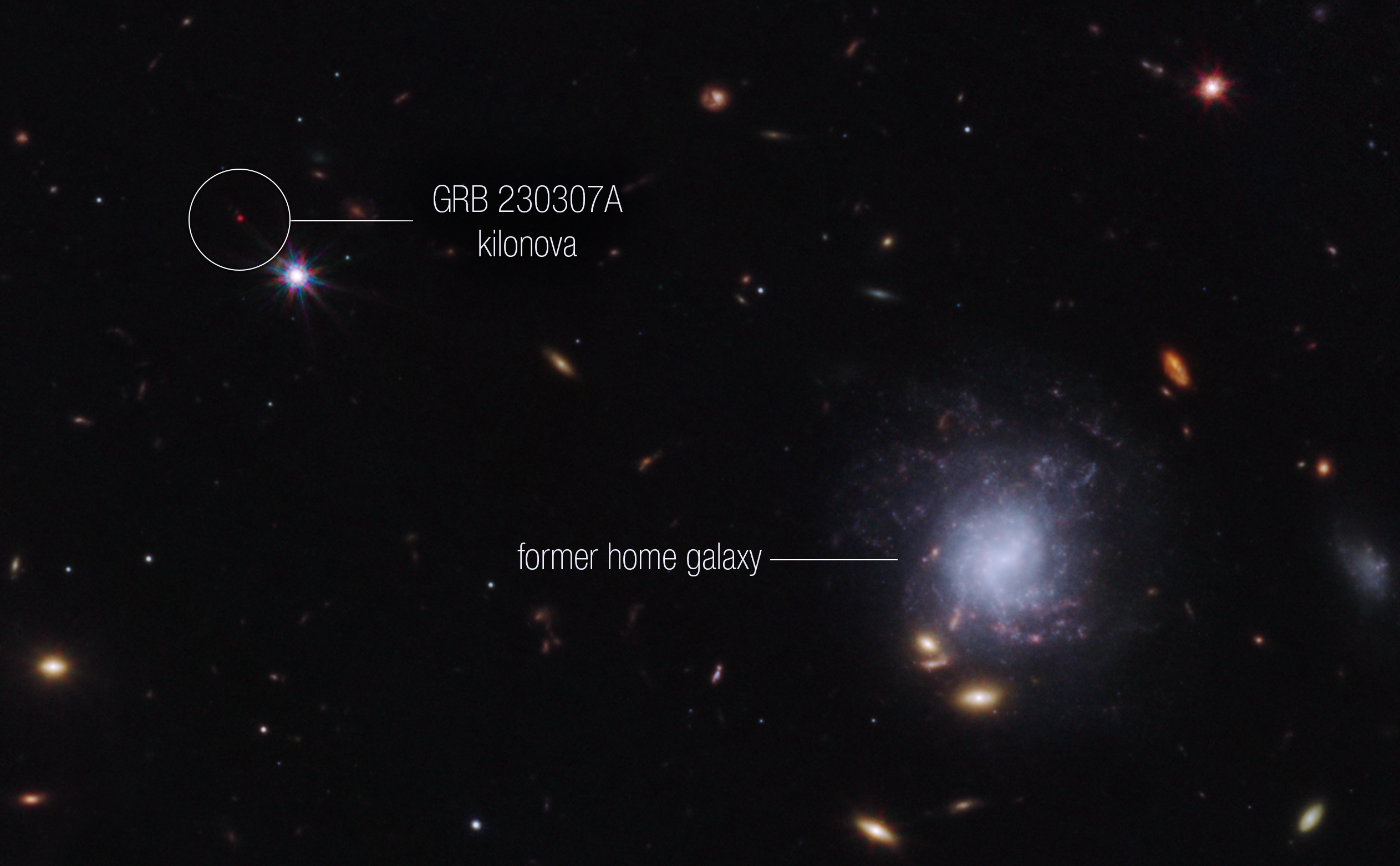
On 7 March 2023, an exceptionally bright gamma-ray burst designated GRB 230307A lit up detectors worldwide. It was the second-brightest gamma-ray burst ever recorded. Follow-up observations by the James Webb Space Telescope (JWST) at 29 and 61 days after the burst revealed something remarkable: a kilonova glowing in the mid-infrared, its light dominated by the radioactive decay of freshly synthesized heavy elements.
JWST’s spectroscopic instruments identified an emission line at 2.15 microns consistent with tellurium (element 52, atomic mass 130), a rare element that sits on the periodic table between antimony and iodine. The detection, published in Nature in October 2023 by a team led by Andrew Levan of Radboud University, marked the first identification of an individual heavy element produced in a kilonova. It confirmed, with direct spectroscopic evidence, that neutron star mergers forge elements far heavier than iron.
JWST also pinpointed the kilonova’s origin: the merging neutron stars had been ejected from a spiral galaxy roughly 120,000 light-years away from the burst site. They had traveled that vast distance, still gravitationally bound to each other, before finally spiraling together and detonating. The iodine in your body, the tellurium in solar panels, the gold in circuits: all of it born in events like this, scattered across intergalactic space, eventually swept up into the raw material of new solar systems.
From Kilonova to Your Hand
The gold on Earth did not arrive yesterday. Current models suggest that the heavy elements in our solar system were seeded by at least one neutron star merger that occurred roughly 80 million years before the Sun ignited. That collision, wherever it happened in our galactic neighborhood, ejected a cloud of r-process material into the interstellar medium. Over millions of years, that material mixed with hydrogen and helium gas, eventually collapsing into the solar nebula from which the Sun, the planets, and everything on them condensed.
Most of Earth’s primordial gold sank into the core during the planet’s formation, pulled inward by molten iron as the young Earth differentiated into layers. The gold we actually mine, the gold accessible in Earth’s crust, was delivered later by a period of intense asteroid bombardment called the Late Heavy Bombardment, roughly 3.8 to 4.1 billion years ago. Those asteroids, themselves formed from the same neutron-star-enriched nebula, deposited a thin veneer of heavy elements onto Earth’s already-solidified mantle. Without that bombardment, all of Earth’s gold would be locked thousands of kilometers below your feet, dissolved in liquid iron at the planet’s center, completely unreachable.
So the path from kilonova to wedding ring goes something like this: two neutron stars collide, forge gold in a fraction of a second, eject it at relativistic speeds, let it drift through interstellar space for millions of years, mix it into a collapsing gas cloud, bake it into asteroids, smash those asteroids into a young planet, wait four billion years for a species to evolve, dig it up, melt it down, and shape it into a circle. The universe is not efficient, but it is thorough.
What Comes Next
The field is accelerating. In 2025, astronomers studying an event designated AT2025ulz reported what may be the first observed “superkilonova,” a scenario in which a massive star’s supernova simultaneously birthed two neutron stars that then immediately merged. Led by Mansi Kasliwal at Caltech’s Palomar Observatory, the team observed the event shift from a red kilonova glow to an unexpected blue brightening, characteristic of hydrogen emission. The classification remains uncertain (some researchers suspect a supernova impostor), but if confirmed, it would represent a new channel for heavy element production, one that combines the power of a supernova and a kilonova in a single event.
LIGO and Virgo completed their landmark fourth observing run (O4) in November 2025, cataloguing over 250 merger events. The detectors are now undergoing upgrades, with a six-month interim run (IR1) planned for late 2026 and a more sensitive fifth observing run (O5) to follow, each capable of detecting neutron star mergers at ever greater distances. Looking further ahead, the European Space Agency’s LISA mission (Laser Interferometer Space Antenna), with construction underway and a planned 2035 launch, will extend gravitational wave detection into entirely new frequency bands, potentially catching mergers months before they happen and giving telescopes time to watch the collision unfold from the very first moment.
Each new detection refines our understanding of how much gold, platinum, and uranium the universe produces, how often, and where. We are building, merger by merger, a cosmic census of the elements that make our world possible.
The next time you hold something made of gold, consider that you are holding a relic of gravitational collapse, nuclear physics at its most extreme, and a love story between dead stars that took millions of years to reach its conclusion. The universe had to tear itself apart so that this metal could exist. It is, by any honest accounting, the most violently beautiful thing you will ever touch.

