

Right now, at this very moment, the top of your head is aging faster than the soles of your feet. The difference is vanishingly small (a few billionths of a second over a lifetime) but it is real, it has been measured, and it reveals something unsettling about the universe you live in: time does not pass at the same rate everywhere. Where gravity is stronger, clocks tick slower. And near a black hole, where gravity reaches its most extreme, time nearly stops.
This is not speculation. It is not a metaphor. It is one of the most precisely tested predictions in all of physics, and it means something profound: the flow of time you take for granted, the steady tick of every clock on your wall, is not a universal constant. It is a local condition, shaped by the mass beneath your feet and the curvature of the space around you.
Why Gravity Warps Time
In 1915, Albert Einstein published his general theory of relativity, and it contained an idea that still feels counterintuitive a century later. Mass does not simply pull objects toward it. Mass warps the fabric of spacetime itself, bending the geometry of the universe so that straight lines curve and clocks in different places disagree about how fast time is passing.
Think of it this way: spacetime is not a stage on which events happen. It is a participant. When you place something massive (a planet, a star, a black hole) into spacetime, the fabric stretches and curves around it. Objects moving through that curved fabric follow the curves naturally. That is what we experience as gravity. And because time is woven into the same fabric as space, gravity doesn’t just pull on matter; it pulls on time, too.
The closer you are to a massive object, the more spacetime is curved, and the slower your clock ticks relative to someone farther away. At the surface of the Earth, the effect is tiny. Near a neutron star, it becomes significant. At the edge of a black hole, it becomes infinite.
The Evidence Under Your Feet (and in Your Phone)
If gravitational time dilation sounds abstract, consider this: your phone depends on it. The Global Positioning System relies on a constellation of satellites orbiting roughly 20,200 kilometres above the Earth. Each satellite carries an atomic clock. And because those clocks sit higher in Earth’s gravitational field (where spacetime is less curved), they tick faster than identical clocks on the ground.
How much faster? About 45.8 microseconds per day due to the gravitational effect alone. There is also a competing effect from special relativity: because the satellites are moving at roughly 14,000 kilometres per hour, their clocks run about 7 microseconds per day slower than ground clocks. The net result is that GPS satellite clocks gain approximately 38 microseconds every day. Without correcting for this, GPS position errors would accumulate at a rate of about 10 kilometres per day. Your maps would become useless by lunchtime.
The engineers who built GPS knew this. The onboard clocks are pre-adjusted: their frequency is set slightly low (10.22999999543 MHz instead of 10.23 MHz) so that once in orbit, they tick in sync with ground-based clocks. Every time you open a navigation app, you are relying on Einstein’s century-old prediction.
But GPS was just the beginning. In 1959, physicists Robert Pound and Glen Rebka conducted a landmark experiment at Harvard, measuring the gravitational redshift of gamma rays across a vertical distance of just 22.5 metres inside a tower. The photons climbing upward against gravity lost energy (shifted to longer wavelengths) by exactly the amount Einstein predicted. It was the first direct laboratory confirmation that gravity affects the frequency of light, and by extension, the rate at which time passes.
In 2010, physicists at the National Institute of Standards and Technology (NIST) took things further. Using aluminium ion clocks of extraordinary precision, they measured gravitational time dilation across a height difference of just 33 centimetres: about the length of a ruler. The higher clock ticked faster, exactly as predicted. Your head really is aging faster than your feet.
Then, in February 2022, a team at JILA (a joint institute of NIST and the University of Colorado) pushed the frontier to an almost absurd degree. Using a network of strontium atoms trapped in an optical lattice, they measured time dilation across a height difference of one millimetre, the width of a sharp pencil tip. The result, published in Nature, confirmed general relativity at the smallest scale ever tested, with a precision better than one part in 1020.
Time Dilation Near Black Holes: The Ultimate Extreme
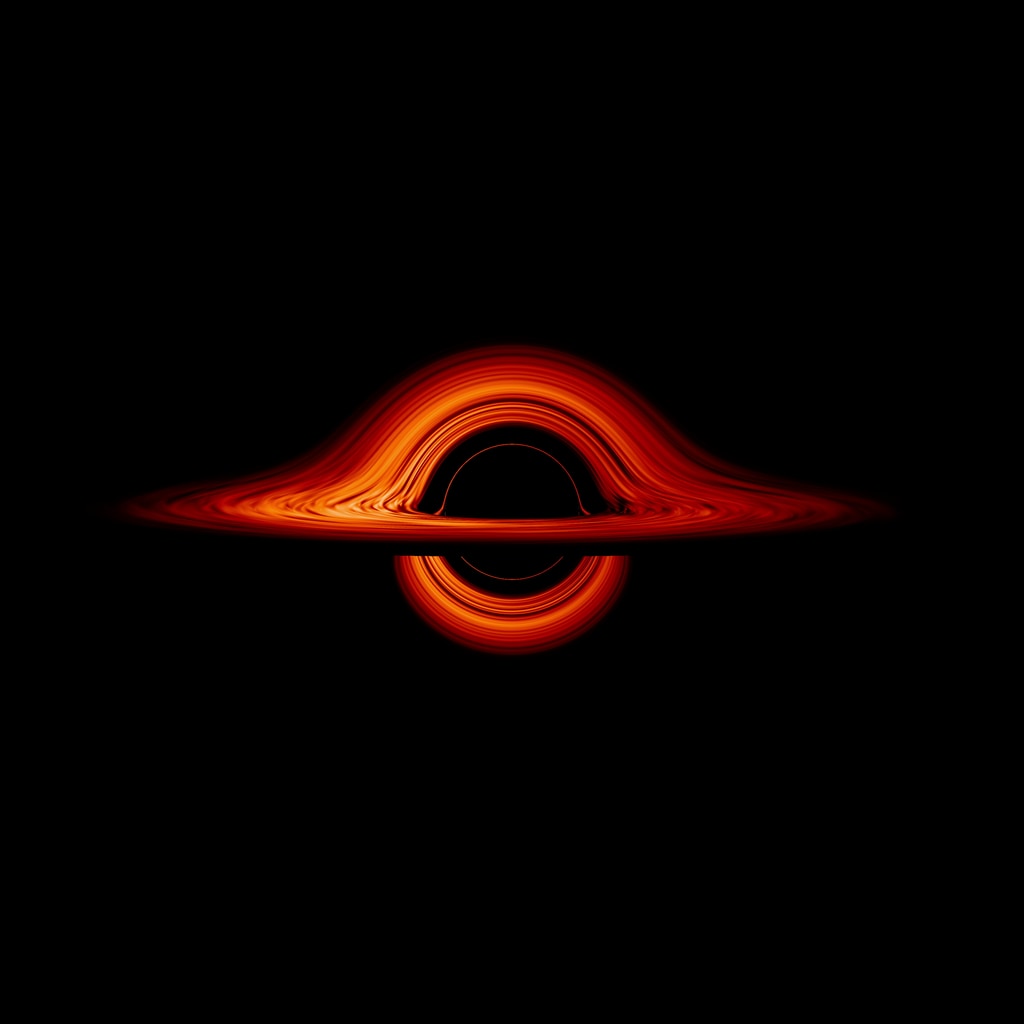
Everything described so far happens in relatively gentle gravitational fields: the Earth, a satellite orbit, a laboratory table. A black hole is something else entirely. It is what remains when a massive star collapses under its own gravity until no known force can stop the compression. The result is a region of spacetime so severely curved that nothing, not even light, can escape once it crosses the boundary known as the event horizon.
Near that boundary, gravitational time dilation reaches its most dramatic extreme. If you could hover just outside the event horizon of a black hole (setting aside the lethal tidal forces and radiation), your clock would tick extraordinarily slowly compared to a clock far away. A few hours for you might correspond to years, decades, or even centuries for a distant observer. At the event horizon itself, from an outside perspective, time stops altogether. An object falling in appears to slow down, redden, and fade, frozen at the threshold forever, though from its own perspective it crosses the horizon in finite time.
We do not need to send clocks to a black hole to confirm this. In 2018, the star known as S2 made its closest approach to Sagittarius A*, the supermassive black hole at the centre of our galaxy. S2 swung within 120 astronomical units of a black hole four million times the mass of the Sun, reaching a velocity of more than 7,600 kilometres per second, roughly 2.5 percent the speed of light. Teams at the European Southern Observatory, using the GRAVITY instrument on the Very Large Telescope, measured the gravitational redshift of light from S2 as it plunged through its closest approach. The result matched general relativity’s prediction with a confidence of five sigma: the gold standard in physics. Time was running measurably slower for that star, warped by the gravity of an unseen colossus 27,000 light-years away.
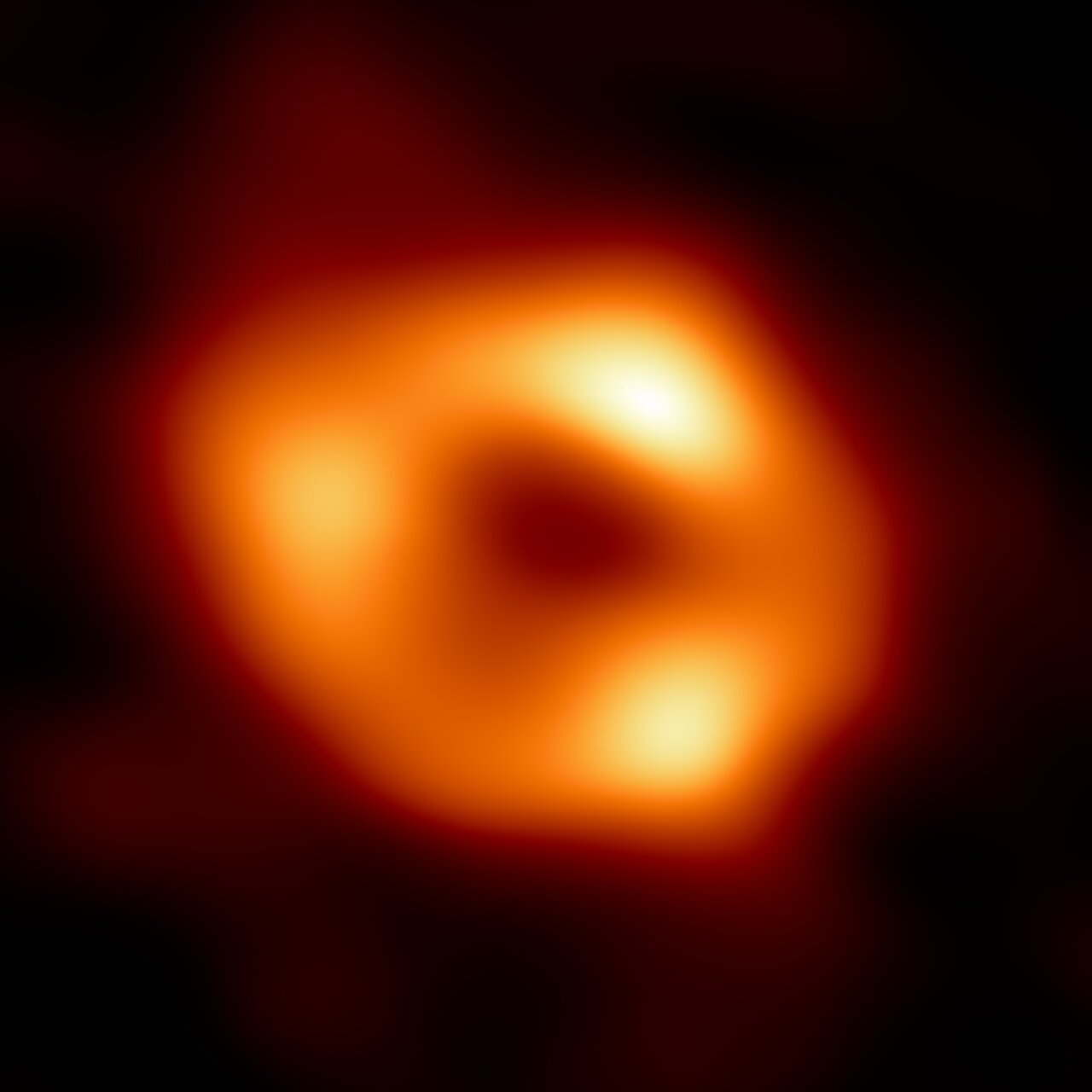
Three years later, in May 2022, the Event Horizon Telescope collaboration released the first image of Sagittarius A* itself. The glowing ring of superheated gas orbiting the black hole, and the dark shadow at its centre, provided a visual confirmation of spacetime curvature at the most extreme scale we can observe. The image above shows what four million solar masses of concentrated gravity looks like when it bends the light of everything around it.
What Interstellar Got Right
If any of this sounds familiar, you may be thinking of the 2014 film Interstellar, directed by Christopher Nolan and scientifically supervised by Nobel laureate Kip Thorne. The film’s fictional black hole, Gargantua, is a supermassive object with 100 million solar masses, spinning at 99.8 percent of the maximum rate allowed by physics.
In the film’s most famous sequence, astronauts land on Miller’s planet, which orbits perilously close to Gargantua’s event horizon. One hour on the planet’s surface corresponds to seven years back on their ship. This is not dramatic licence; it is a mathematically valid consequence of general relativity applied to an object with that mass and spin. Thorne’s team ran Einstein’s equations through rendering software, producing what was at the time the most physically accurate visualization of a black hole ever created. Each frame took approximately 100 hours to render.
The movie turned up the dial on a real phenomenon. Every measurement described in this article (GPS corrections, the Pound-Rebka experiment, NIST atomic clocks, the S2 star’s redshift) sits on the same spectrum as Miller’s planet. The physics is identical. The only difference is scale.
What Comes Next
The precision of our clocks is still improving. The 2022 JILA experiment measured time dilation at the millimetre scale; next-generation optical lattice clocks may push that even further, potentially sensing gravitational effects from individual mountains or underground mineral deposits. Researchers at NIST and the University of Colorado have been working on portable versions of these atomic clocks, aiming to carry them to mountaintops to measure relativistic effects across kilometres of altitude with unprecedented accuracy.
Meanwhile, the next-generation Event Horizon Telescope is expanding its array of radio observatories. With additional stations and higher-frequency observations, the collaboration aims to produce sharper images of the regions around Sagittarius A* and M87* (the 6.5-billion-solar-mass black hole in galaxy Messier 87, first imaged in 2019). These images will probe the dynamics of gas swirling just outside the event horizon, where time dilation sculpts the motion of matter and light in ways we are only beginning to map.
And further out, gravitational wave detectors like LISA (the Laser Interferometer Space Antenna, planned for launch in the 2030s by ESA) will listen for the ripples in spacetime produced when black holes merge. Each merger is a collision of two regions where time runs at a profoundly different rate from the rest of the universe, and the gravitational waves they emit carry encoded information about the geometry of spacetime at its most extreme.
Somewhere near the centre of our galaxy, a clock is ticking slower than yours. Not because it is broken, but because the universe itself bends around the thing it orbits. Time is not a river. It is a landscape, and gravity decides the slope.

