
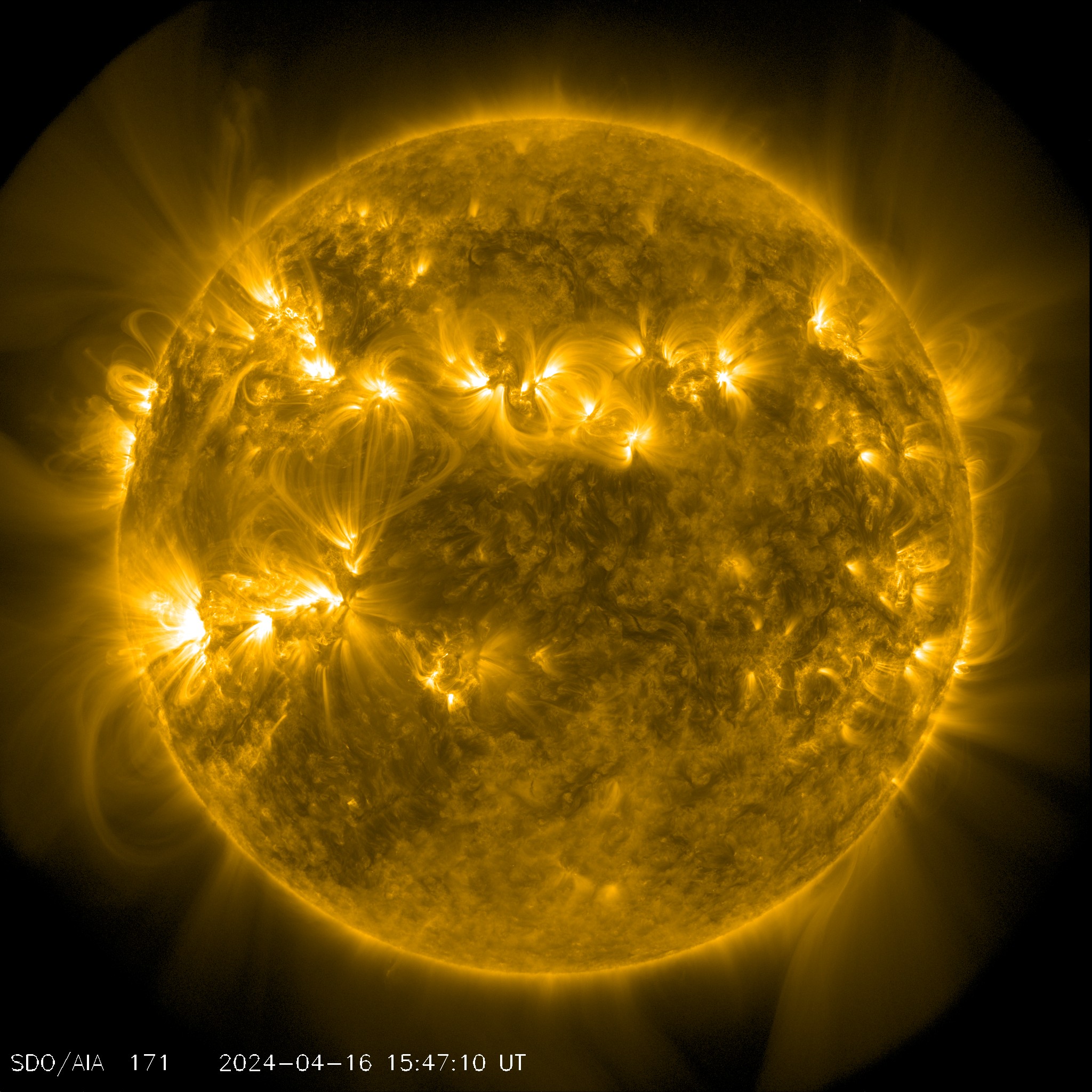
There is a star at the center of our solar system, and right now it is restless. Over the past two years, it has hurled billion-ton clouds of magnetized plasma into space, ignited auroras over the tropics, and fired off X-class flares in rapid succession. We live around a variable star, and Solar Cycle 25 has just reminded us of that fact in the most spectacular terms possible.
The sun reached its solar maximum, the peak of its roughly 11-year activity cycle, in October 2024. NASA and NOAA made the official announcement on October 15, 2024, confirming that the smoothed sunspot number had crested at 161: roughly 40% stronger than the panel of experts had forecast back in 2019, and the most powerful solar maximum since Cycle 23 in the early 2000s. That earlier cycle produced the famous Halloween Storms of 2003. Cycle 25 has now matched its intensity.
The headline number only tells part of the story. The cycle displayed a double-peaked pattern, surging, briefly stabilizing, then surging again before subsiding. Lisa Upton, co-chair of the Solar Cycle 25 Prediction Panel, described sunspot activity as having “slightly exceeded expectations.” That is, in the careful language of solar science, something of an understatement.
The defining event of the maximum came in May 2024, when a G5 geomagnetic storm (the highest severity rating on NOAA’s five-point scale) swept across Earth’s magnetosphere. Aurora borealis lit up skies over India, Morocco, and Mexico. Aurora australis was photographed from Perth, Argentina, and Namibia. It was the most powerful geomagnetic storm since 2003, and for millions of people who had never expected to see the northern or southern lights from their backyards, it was genuinely life-changing. Two further G4-class storms followed: one in October 2024, another in November 2025. Then, in the first four days of February 2026, the sun produced six X-class solar flares in rapid succession, the most energetic category of flare on the classification scale.

Why the Declining Phase Deserves Your Attention
As of April 2026, we are now in the declining phase of Solar Cycle 25. It would be easy to assume the drama is behind us. History suggests otherwise. Some of the most extreme space weather events on record have occurred not at the peak of a solar cycle, but during its descent. The most instructive example is the Carrington Event of 1859, the largest geomagnetic storm in recorded history, which struck during a declining phase and was powerful enough to set telegraph equipment on fire and produce auroras visible near the equator.
A Carrington-class event today would be a civilizational emergency. Power grids could suffer cascading failures across entire continents. Satellite systems, including GPS infrastructure and communications networks, would face catastrophic damage. The economic toll from a direct hit is difficult to fully calculate. This is not alarmism; it is the consensus assessment of space weather scientists and government risk analysts alike. The sun does not announce its most dangerous moments in advance.
On a gentler note, the declining phase also means this remains the best aurora-viewing window since 2001 to 2003. The magnetic activity that drives auroras does not switch off immediately after maximum. Coronal mass ejections will continue, geomagnetic storms will continue, and the skies at high and mid-latitudes will continue to perform. If you have been waiting for your moment to witness the lights firsthand, that window is still open. The same solar energy that fascinates astronomers is the force behind every aurora-chaser’s dream photograph.
What Comes Next
Solar scientists now look toward solar minimum, expected around 2030. Between now and then, the sun’s activity will gradually ease: fewer sunspots, quieter coronal activity, calmer space weather on average. But the February 2026 X-class flare sequence is a reminder that “on average” is doing a great deal of work in that sentence. Individual events can still be significant, and the monitoring networks at NASA, NOAA, and partner agencies around the world remain on continuous watch.
Cycle 26 predictions are still in early development. What Cycle 25 has already demonstrated is that our forecasting models, while improving, still have meaningful gaps when it comes to predicting the sun’s true potential. The star at the center of our solar system does not always behave as expected. It rarely does anything small when it decides to be surprising.
We have been orbiting this star for the entirety of human history, and it is still capable of astonishing us.
