

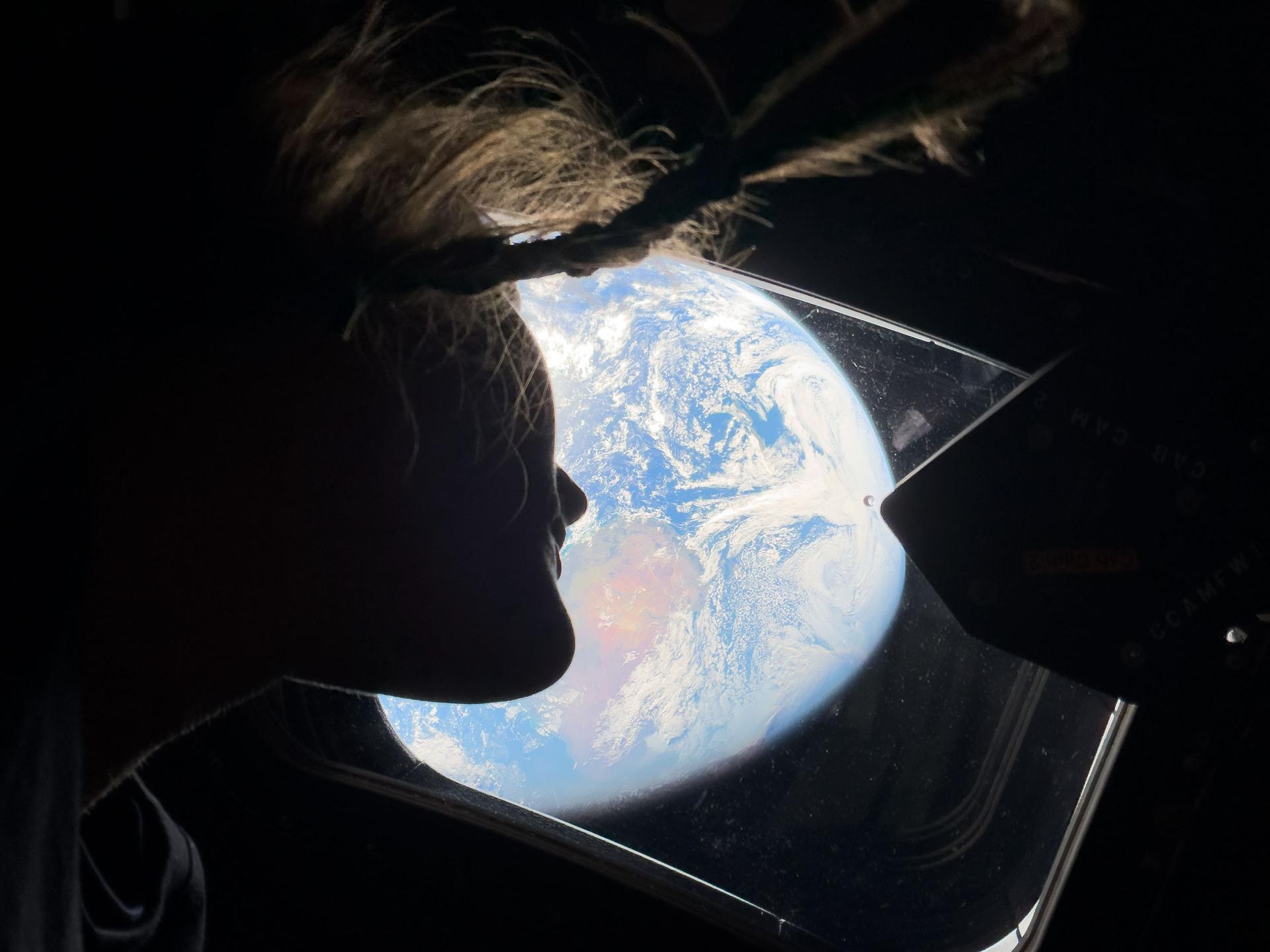
At 8:35 p.m. Eastern time on April 6, 2026, four human beings watched the Sun go out. Not from a rooftop, not through a pinhole projector as totality swept across a darkening field—but from a spacecraft drifting 252,757 miles from Earth, as the Moon slid between Orion and the Sun and swallowed it. For nearly an hour, Reid Wiseman, Victor Glover, Christina Koch, and Jeremy Hansen held eclipse glasses to their eyes and looked at something no human being has ever seen from this angle: the solar corona curling silently around the dark disc of the Moon, with Earth itself a crescent in the distance behind them.
There is no analog for this. There is no prior mission that witnessed an eclipse from this vantage. The Artemis II crew did not discover a new planet. What they did was simpler, and stranger: they went far enough from home that they could watch the Sun vanish—and lived to describe what the corona looks like from out there.
The Flyby
The lunar flyby window opened at 2:45 p.m. EDT on Monday. Orion swept to within 4,066 miles of the lunar surface at approximately 7:02 p.m.—close enough for the crew to photograph impact craters in fine detail, close enough to record a direct view of the Orientale basin on the western far side: a vast, multi-ring impact scar that has only ever been observed from orbit or through Earth’s atmosphere, never by human eyes at this proximity.
At 7:05 p.m., Orion reached its farthest point from our planet: 252,757 miles. The previous record belonged to the crew of Apollo 13—not by design, but by emergency. Their crippled spacecraft followed a free-return trajectory around the Moon in April 1970 that carried them 248,655 miles from Earth. They held that record for 56 years. Artemis II surpassed it by 4,102 miles.
Then came the eclipse. At 8:35 p.m. ET, the Sun moved behind the Moon as seen from Orion’s windows. For nearly an hour, the crew wore eclipse glasses and observed the corona—the Sun’s outermost atmosphere, ordinarily invisible against the blazing disc—shining fully against the black. They also turned cameras toward the darkened lunar surface, hunting for brief flashes of light from meteoroid impacts: each strike a datapoint in a hazard database that will matter to every astronaut who will one day work on that surface.
Why This Vantage Is Unrepeatable
Earlier this week, as Orion crossed through deep space, Commander Wiseman described the geometry of their position: “The Earth is almost in full eclipse. The Moon is almost in full daylight, and the only way you could get that view is to be halfway between the two entities.” He was describing something no photograph, no simulation, no planetarium dome can reproduce. The spacecraft occupied a position between Earth and Moon where both bodies appeared in the same windows—simultaneously lit in ways they never appear from the ground.
That positioning is what made the eclipse possible. For a spacecraft in low Earth orbit, the geometry that places it in the Moon’s solar shadow at the precise angle required for a total solar eclipse almost never presents. Here it was a scheduled science objective, a consequence of the trajectory rather than a lucky accident. The crew used it to gather data on the corona that feeds into space weather research and into our understanding of the Sun’s influence at the distance of the Moon—the very environment where future astronauts will spend weeks at a time, exposed to radiation and solar wind that Earth’s magnetosphere no longer blocks.
Something else may have been recorded too, though it takes longer to measure: what this does to a person. Canadian astronaut Jeremy Hansen described the early days of the mission simply: “Right away, you are humbled. The fact that four of us get to be out here just brings you to your knees.” Researchers who study this cognitive shift—the reordering of perspective that follows from seeing the planet from far enough away to feel its fragility—call it the Overview Effect. The crew of Artemis II felt it while watching their star disappear behind their Moon.
What Comes Next
The crew is now on their return arc. Splashdown in the Pacific Ocean is expected on April 10. What follows is an extended debrief: engineering review of Orion after its first crewed deep-space transit, health assessments after nearly a week beyond Earth’s protective magnetosphere, and the long, careful processing of images and data collected during the flyby.
The eclipse imagery and corona observations will take weeks to fully analyze. The meteoroid flash data—if any impacts were captured in the hour the crew spent watching the dark Moon—could yield the highest-resolution direct count of impact rates ever recorded at the lunar surface. All of it feeds into Artemis III, the mission designed to return humans to the lunar surface for the first time since December 1972. That mission now stands one successful flight closer.
For nearly an hour tonight, four people stood at a window halfway to the Moon and watched the light go out—and the corona was beautiful.

