

In the winter of 1915, on the Russian front of the First World War, a German artillery officer named Karl Schwarzschild was dying. Pemphigus, a rare autoimmune disease that blisters the skin from the inside, was already consuming him. But between artillery calculations and the slow advance of his own death, Schwarzschild did something that would outlast every battle fought in that war. He solved Einstein’s field equations of general relativity. What he found was the first exact mathematical description of a black hole: a place where gravity becomes so total that nothing, not even light, can escape.
He mailed the solution to Einstein from the front. Einstein presented it to the Prussian Academy of Sciences in January 1916, calling the mathematics elegant. He also believed it described something that could not physically exist: a point in spacetime where matter collapses so completely that gravity overwhelms light, time, and the geometry of space itself. It was, Einstein thought, a curiosity of the equations and nothing more.
He was wrong. Black holes are real. Over the past century, physicists have explained how they form, what they do to everything around them, and why they may hold the key to the deepest unsolved problems in science. In 2019, we finally photographed one. The story of how we got from Schwarzschild’s wartime equations to that image is one of the most remarkable arcs in the history of physics.
A black hole is not an object. It is a region of spacetime where gravity has become so extreme that nothing can leave. The boundary of this region is called the event horizon: not a physical surface you can touch, but an invisible threshold. Cross it, and every possible trajectory, even one travelling at the speed of light, leads only deeper in. No signal, no particle, no scrap of information can return. The event horizon is not a wall. It is a point of no return written into the fabric of space and time.
The distance from a black hole’s centre to its event horizon is known as the Schwarzschild radius, and it is shockingly small. For our Sun, the Schwarzschild radius would be about three kilometres. For the Earth, roughly nine millimetres. Compress any mass within its own Schwarzschild radius and it becomes a black hole. Schwarzschild derived this boundary from the equations of general relativity while serving on the Eastern Front, communicated the result to Einstein in December 1915, and died of his illness on May 11, 1916, in Potsdam. He was 42 years old. He had been the director of the Astrophysical Observatory there, one of the most accomplished astronomers of his generation, and a man who volunteered for military service out of a sense of duty.
From Stellar Death to the Edge of Physics
Black holes come in at least three sizes, and each tells a different story of origin.
Stellar-mass black holes form from the deaths of massive stars. When a star more than roughly 25 times the mass of our Sun exhausts its nuclear fuel, its core collapses in a fraction of a second. Sometimes this triggers a supernova, an explosion bright enough to briefly outshine an entire galaxy. Sometimes the star simply folds inward without fanfare, collapsing silently into darkness with no flash, no shockwave, no warning. What remains is a black hole with a mass between a few and roughly 100 suns.
Intermediate-mass black holes, between about 100 and 100,000 solar masses, are the rarest and least understood. In 2019, the LIGO and Virgo gravitational-wave observatories detected two black holes, of 85 and 66 solar masses, spiralling into each other and merging into a single black hole of 142 solar masses: the first direct evidence that this middle category exists. How they grow beyond that size, and whether they serve as seeds for the largest black holes, remains an open question.
At the centre of nearly every large galaxy sits a supermassive black hole, a monster ranging from millions to billions of solar masses. How they grew so large is one of the great unsolved puzzles in astrophysics. Some may have assembled over billions of years through steady mergers, consuming smaller black holes, gas, and stars. Others may have formed through the direct gravitational collapse of vast primordial gas clouds in the early universe, skipping the stellar stage entirely. The answer likely involves both processes, and the details are still being worked out.
What happens to you near a black hole depends entirely on which kind you encounter. At a stellar-mass black hole, where the event horizon might span only a few tens of kilometres, the difference in gravitational pull between your head and your feet becomes lethal long before you reach the boundary. Tidal forces stretch you lengthwise and compress you sideways in a process physicists call spaghettification. Your body would be drawn into a strand of matter thinner than a thread, torn apart atom by atom as you approached the horizon.
A supermassive black hole tells a different story. Its event horizon can stretch across billions of kilometres. At a black hole of ten million solar masses, the tidal force at the horizon is roughly the same as the gravity you feel standing on the surface of the Earth. You would cross the event horizon alive, noticing nothing unusual at the boundary itself. But you could never come back. And as you fell deeper, time would warp around you. Clocks closer to the singularity tick measurably slower than those farther away. To a distant observer watching you fall, you would appear to slow down, redshift, and gradually fade at the horizon, never quite vanishing but never quite crossing, frozen in light that grows dimmer across the ages.
Beyond the event horizon lies the singularity: a point where density approaches infinity, where the curvature of spacetime becomes unbounded, and where the known laws of physics cease to function. General relativity predicts it must be there. Quantum mechanics says infinite densities cannot exist. This is the place where the two most successful frameworks in all of physics collide head on, and neither survives the encounter intact. What actually exists at the centre of a black hole remains, genuinely, one of the deepest unknowns in science.
In 1974, Stephen Hawking introduced a prediction that transformed our understanding of these objects. Applying quantum field theory to the curved spacetime near a black hole, he showed that black holes are not perfectly black. At the event horizon, pairs of virtual particles constantly flicker into existence from the quantum vacuum. Normally, these pairs annihilate each other almost instantly. But at the boundary of a black hole, one particle can fall past the horizon while its partner escapes into space, carrying energy away. Over immense spans of time, the black hole loses mass.
This process, now called Hawking radiation, means that every black hole in the universe is slowly, imperceptibly evaporating. But the timescales involved defy human intuition. A black hole with the mass of our Sun would take roughly 1067 years to evaporate, trillions upon trillions of times the current age of the universe. A typical stellar-mass black hole would last even longer. For a supermassive black hole, the figure climbs beyond 10100 years. The cosmos will go dark, the last stars will burn out, and still these objects will persist, radiating at temperatures colder than the faintest echo of the Big Bang.
The deeper problem is what that radiation carries. Or rather, what it does not. Hawking radiation is thermal: random, featureless, carrying no trace of what fell into the black hole. No record of the star that collapsed, the planets that were consumed, or the light that was swallowed. If a black hole eventually evaporates completely, all of that information is gone.
This violates one of the most fundamental principles in quantum mechanics: that information can never be truly destroyed. The conflict between Hawking’s result and quantum unitarity is called the black hole information paradox, and more than fifty years after Hawking’s original paper, it remains unresolved. It sits at the exact frontier where gravity meets the quantum world. Its resolution may require an entirely new theory of physics, one that unifies general relativity and quantum mechanics into a single coherent framework. That theory does not yet exist.
The First Photograph of Darkness
For more than a century after Schwarzschild’s solution, black holes remained theoretical constructs. We inferred their presence from the wobble of companion stars, from X-ray emissions blazing off superheated accretion discs, from gravitational waves rippling outward through spacetime when two black holes spiralled together and merged. The evidence was overwhelming, but indirect. We had never seen one.
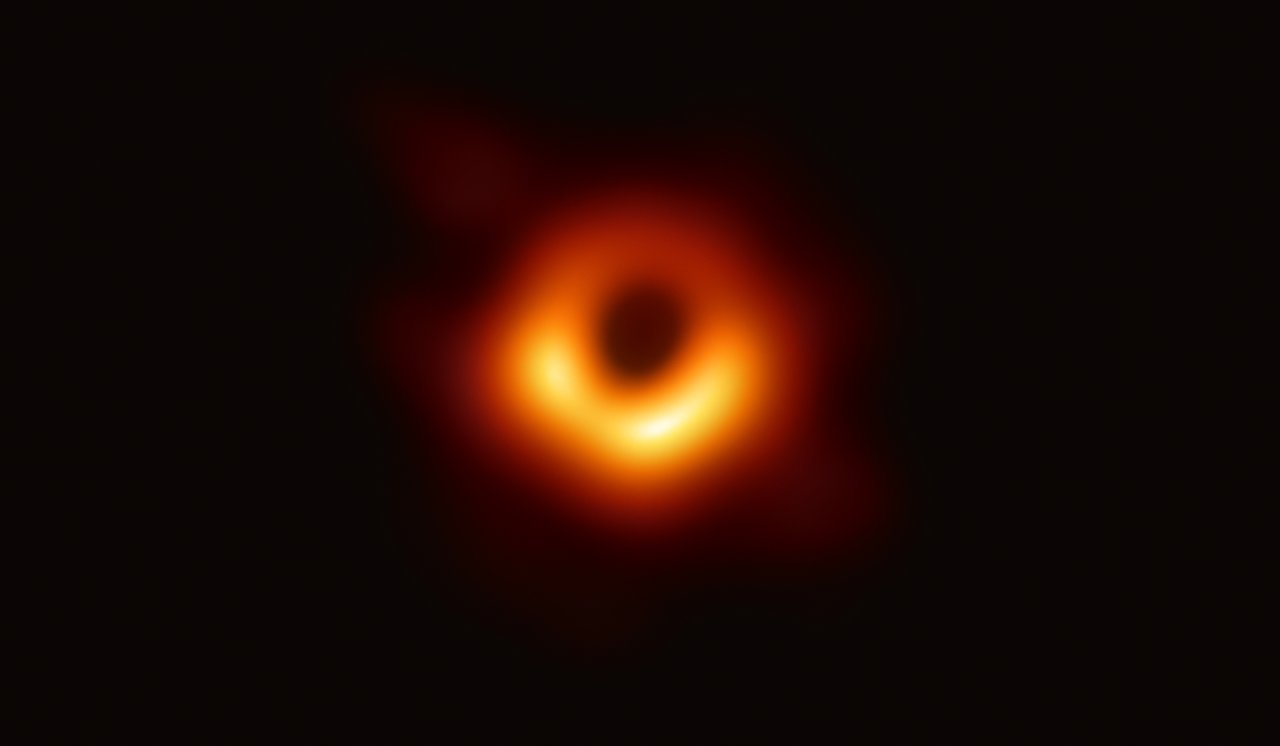
That changed on April 10, 2019. The Event Horizon Telescope (EHT), a network of eight radio observatories spanning four continents, linked together to form a single Earth-sized virtual dish, released the first direct image of a black hole’s shadow. The target was M87*, the supermassive black hole at the heart of the elliptical galaxy Messier 87, roughly 55 million light-years from Earth. Its mass: 6.5 billion suns. The data had been collected during a coordinated global observing campaign in April 2017, and more than 200 researchers across 20 countries spent two years processing it into a single image.
What the image shows is a bright, asymmetric ring of light: gas heated to billions of degrees as it spirals inward through the accretion disc, glowing in radio wavelengths at 1.3 millimetres. At the centre sits a dark void, the shadow cast by the event horizon. Not the black hole itself (you cannot photograph something that emits no light), but the absence it creates in the glow around it. The light that entered that shadow will never reach a telescope, an eye, or anything else again.

Three years later, on May 12, 2022, the same collaboration revealed the face of our own galactic centre. Sagittarius A* (Sgr A*) sits 26,000 light-years from Earth at the heart of the Milky Way, with a mass of about four million suns. It is more than a thousand times smaller and less massive than M87*, yet its shadow looks remarkably similar: the same bright ring, the same dark core. The physics, it turns out, scales perfectly from four million solar masses to 6.5 billion.
Imaging Sgr A* was significantly harder than M87*. Gas in the accretion disc of M87* orbits over days and weeks, giving the telescope time to build a stable picture. Gas around Sgr A* completes a full orbit in mere minutes, blurring the data even as it is being collected. The EHT team averaged thousands of independent computational reconstructions to extract the ring structure from beneath the noise, confirming a shadow consistent with the predictions of general relativity.
The Event Horizon Telescope continues to expand. New stations are being added to the array, and observations at shorter wavelengths are being tested, which will sharpen the resolution further. The next generation of EHT images may resolve fine structure within the accretion flow, track how material moves around a black hole in near real-time, and capture the relativistic jets of plasma that some supermassive black holes launch across hundreds of thousands of light-years at velocities approaching the speed of light.
Meanwhile, the information paradox continues to pull theorists forward. Proposed resolutions range from subtle corrections to Hawking’s calculation, to radical ideas like holographic encoding on the event horizon, to the possibility that black holes never fully evaporate at all. Somewhere in the mathematics of event horizons and quantum fields, general relativity and quantum mechanics must find a way to coexist. When they do, we will understand not just black holes, but the fundamental nature of spacetime, information, and reality itself.
Karl Schwarzschild died on May 11, 1916, four months after mailing his solution to Einstein. He never heard the term “black hole.” He never saw what he had predicted. But what he found in those trenches, while his own body was failing him, turned out to be the most complete description of how gravity ends: not with silence, but by becoming everything.

