

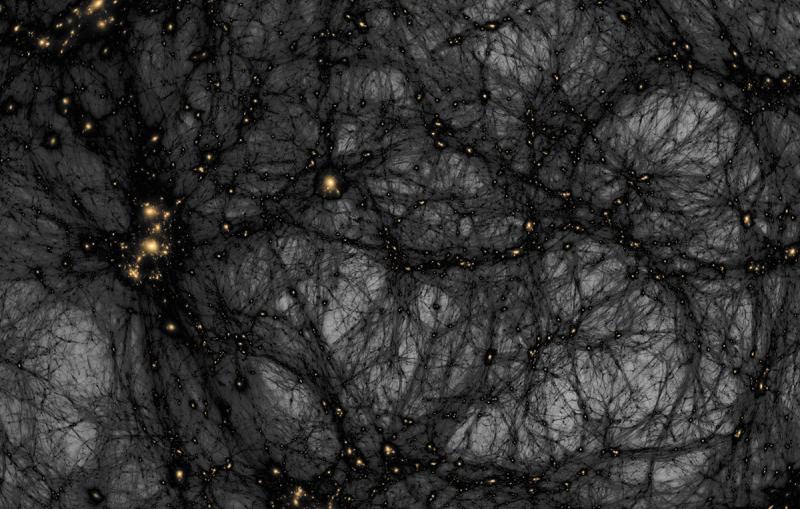
Eighty-five percent of all the matter in the universe is something we have never seen, never touched, never caught in a detector. We know it’s there because of what it does to the things around it: galaxies spin too fast, light bends around patches of seemingly empty space, and the largest structures in the cosmos could not have formed without it. We call it dark matter, and after nearly a century of searching, we still do not know what it is.
That is not a failure of science. It is the frontier of it. The evidence that dark matter exists is among the most robust in all of physics. The evidence for what dark matter actually is remains, as of April 2026, essentially zero. Every experiment designed to catch it has come up empty. Every particle accelerator built to create it has produced nothing unexpected. And yet the case for its existence grows stronger with each new observation. This is the paradox at the heart of modern cosmology: we are extraordinarily certain about something we cannot identify.
The Woman Who Proved the Universe Was Hiding
The story of dark matter, in its modern form, begins with Vera Rubin. In the 1970s, Rubin and her collaborator Kent Ford turned a sensitive new spectrograph toward the Andromeda galaxy and began measuring how fast its stars orbited the galactic center. What they found made no sense.
If you measured the visible mass of a spiral galaxy and calculated how fast its outer stars should be moving, you would expect them to slow down with distance from the center, the same way planets farther from the Sun orbit more slowly. But Rubin’s measurements told a different story. The stars at the edges of Andromeda were moving just as fast as those near the core. The rotation curves were flat. Something invisible, something with enormous gravitational pull, was holding those outer stars in orbit.
Rubin spent years facing skepticism. Many astronomers assumed her measurements were wrong. They were not wrong. Over the following decade, flat rotation curves were confirmed in galaxy after galaxy, hundreds of them. The pattern was universal. Every spiral galaxy behaved as though it were embedded in a vast halo of unseen mass, a halo that outweighed all its visible stars, gas, and dust by roughly five to one.
The invisible mass needed a name. It already had one: dark matter, a term that had floated around astrophysics since Fritz Zwicky noticed in 1933 that galaxies in the Coma Cluster were moving too fast to be held together by their visible mass alone. But it was Rubin’s rotation curves that turned a curiosity into a crisis, and then into a pillar of cosmology.
The Bullet That Sealed the Case
If rotation curves were the opening argument, the Bullet Cluster was the verdict. Formally designated 1E 0657-56, this system is the aftermath of a colossal collision between two galaxy clusters, one of the most energetic events in the universe since the Big Bang.
When two galaxy clusters collide, three things happen. The individual galaxies, which are mostly empty space, pass through each other like birds in a flock. The hot intracluster gas, which makes up most of the clusters’ ordinary matter, slams together and slows down, piling up in the collision zone. And the dark matter, if it exists, should pass right through as well, because it barely interacts with anything.
That is exactly what observations show. X-ray telescopes reveal the hot gas pooled between the two clusters, glowing in pink. Gravitational lensing maps, which trace mass by measuring how much background light is warped, show the bulk of the mass sitting with the galaxies, separated from the gas. The ordinary matter went one way; the gravitational mass went another. Something massive and invisible passed straight through the collision.
In June 2025, an international team published new observations of the Bullet Cluster in the Astrophysical Journal Letters, using NASA’s James Webb Space Telescope and the Chandra X-ray Observatory. Webb’s infrared sensitivity revealed far more background galaxies than previous instruments could detect, allowing the team to map the dark matter distribution with unprecedented precision through gravitational lensing. They found the entire cluster contains several hundred trillion solar masses, actually less than earlier estimates had suggested. The separation between gas and dark matter remains stark and unambiguous.
The Bullet Cluster is not alone in making the case. The cosmic web, the vast network of filaments and voids that forms the large-scale structure of the universe, could not have assembled from ordinary matter alone. In the early universe, tiny density fluctuations needed the gravitational scaffolding of dark matter to grow into the galaxies and galaxy clusters we see today. Computer simulations that include dark matter reproduce the cosmic web with remarkable fidelity. Simulations that leave it out produce a universe that looks nothing like ours.
What Dark Matter Is Not
Before exploring what dark matter might be, it helps to eliminate what it is not. Dark matter is not dark energy, the separate and even more mysterious phenomenon that is accelerating the expansion of the universe. Dark energy pushes things apart; dark matter pulls things together. They share a name only because both are invisible.
Dark matter is not antimatter. Antimatter annihilates on contact with ordinary matter, producing gamma rays we would easily detect. Dark matter is not ordinary matter hiding in hard-to-see forms like rogue planets or failed stars; surveys have effectively ruled out these objects, once called MACHOs (massive astrophysical compact halo objects), as a significant contributor. And while primordial black holes formed in the early universe remain a theoretical candidate, gravitational lensing surveys and other constraints have narrowed the window for them considerably.
Whatever dark matter is, it does not emit, absorb, or reflect light at any wavelength. It interacts gravitationally, and perhaps through the weak nuclear force, but it is transparent to the electromagnetic spectrum. That is why we cannot see it. And that is why catching it directly has proven so extraordinarily difficult.
The Search That Keeps Coming Up Empty
For 40 years, the leading candidate has been the WIMP: the weakly interacting massive particle. The appeal of WIMPs is elegant. If a particle with a mass roughly 10 to 1,000 times that of a proton interacted only through gravity and the weak force, the laws of thermodynamics predict it would have been produced in the early universe in almost exactly the right abundance to account for dark matter. Physicists call this the “WIMP miracle.”
The miracle inspired a generation of experiments. Deep underground, shielded from cosmic rays by kilometers of rock, detectors filled with ultra-pure xenon wait for the faint recoil of a xenon atom struck by a passing WIMP. The sensitivity of these experiments is staggering, and the results, so far, are silence.
LUX-ZEPLIN (LZ), currently the world’s largest dark matter detector, published results in October 2024 from 4.2 tonne-years of exposure. After a meticulous analysis using a new technique to tag background radiation from lead-214 decays, the collaboration found no evidence of WIMPs. They set the strongest constraint ever on the spin-independent WIMP-nucleon cross section: 2.1 × 10−48 cm² at a WIMP mass of 36 GeV/c². In plain language, if WIMPs exist at this mass, they interact with ordinary matter less than twice in every hundred trillion trillion trillion trillion encounters.
XENONnT, a rival experiment using 5.9 tonnes of liquid xenon at Italy’s Gran Sasso laboratory, has followed a parallel path to the same conclusion. Their February 2025 results from a 3.1 tonne-year exposure found no WIMP signal. In January 2026, they extended the search to lighter dark matter candidates using ionization-only signals across 7.8 tonne-years: still nothing. Both experiments have now reached a critical threshold known as the neutrino floor, the point at which solar neutrinos become the dominant background, making further progress exponentially harder without fundamentally new detector designs.
The Large Hadron Collider at CERN has likewise produced no dark matter candidates. If WIMPs exist, they are lighter, heavier, or more feeble than the simplest models predicted.
What Else Could It Be?
As WIMPs grow more constrained, alternative candidates are gaining ground.
Axions were originally proposed not to explain dark matter, but to solve a different puzzle: the strong CP problem in quantum chromodynamics. These hypothetical particles would be extraordinarily light, perhaps a trillion times lighter than an electron, but could have been produced in sufficient quantities in the early universe to account for all of dark matter. Experiments like ADMX (Axion Dark Matter Experiment) at the University of Washington are actively searching for axion signatures using tunable microwave cavities in powerful magnetic fields.
Sterile neutrinos, heavier cousins of the neutrinos we already know, remain theoretically viable but observationally elusive. Primordial black holes, formed from density fluctuations in the first fraction of a second after the Big Bang, have experienced a resurgence of interest since LIGO began detecting black hole mergers with masses that do not fit neatly into standard stellar evolution models. Recent theoretical work has explored how a “memory burden” effect could extend the lifetimes of small primordial black holes, keeping them viable as dark matter candidates.
And then there is MOND: Modified Newtonian Dynamics, first proposed by Mordehai Milgrom in 1983. Rather than postulating invisible matter, MOND modifies the laws of gravity at very low accelerations to explain flat rotation curves. It works remarkably well for individual galaxies and has made predictions, such as the Radial Acceleration Relation, that dark matter models had to be retrofitted to match. But MOND struggles at larger scales. It cannot fully explain the mass discrepancies in galaxy clusters. It conflicts with Solar System constraints. And it has no natural explanation for the Bullet Cluster, where gravitational mass is cleanly separated from visible matter. Most physicists view MOND as an important observational clue rather than a complete alternative.
The Observatory That Bears Her Name
The Vera C. Rubin Observatory in Chile, named for the woman who made dark matter impossible to ignore, captured its first on-sky images with an engineering camera in January 2025. After the full LSSTCam, the largest digital camera ever built, was installed on the 8.4-meter Simonyi Survey Telescope in March 2025, the observatory released its first science-quality images on June 23, 2025. Over the next ten years, the Legacy Survey of Space and Time (LSST) will photograph the entire visible southern sky every few nights, building a time-lapse record of the universe.
Among its core missions is mapping dark matter through weak gravitational lensing on a scale never before attempted. By measuring subtle distortions in the shapes of billions of galaxies, the LSST will trace the distribution of dark matter across cosmic time. The first data release is expected roughly 12 to 14 months after the survey’s formal start. If the tension between different measurements of the universe’s expansion rate has a dark matter connection, Rubin’s observatory may be the instrument that reveals it.
Meanwhile, next-generation direct detection experiments are being designed to push below the neutrino floor. The three major xenon collaborations (LZ, XENONnT, and China’s PandaX) have announced plans to merge into a single successor experiment called XLZD, aiming for a detector with 60 to 80 tonnes of liquid xenon and the sensitivity to either find WIMPs or rule out the simplest models entirely. Axion searches are expanding too: ADMX continues to scan new frequency ranges, and new experiments like MADMAX and ORGAN are probing axion masses that earlier detectors could not reach.
The question is no longer whether we will keep looking. It is whether the answer, when it comes, will be a particle we expected, something we never imagined, or a revision of gravity itself. All three possibilities remain open. That is what makes this one of the most compelling unsolved problems in all of science.
Vera Rubin devoted her career to understanding the motions of stars within galaxies, and of galaxies within the universe. Eighty-five percent of that universe is made of something she proved exists but no one has ever identified. The rotation curves were not wrong. The cosmos is hiding in plain sight, and we are still learning how to look.

