


The signal arrived on September 14, 2015, at 5:51 in the morning, Eastern time. No one was awake to see it. The two LIGO detectors, one in Hanford, Washington, and the other in Livingston, Louisiana, were running in engineering mode, three days before their official research campaign was scheduled to begin. They were supposed to be calibrating. Instead, they recorded a sound that had been travelling for 1.3 billion years.
It lasted two-tenths of a second. It rose in pitch across eight cycles, from 35 hertz to 250 hertz, like the last note of a song that had been playing since before complex life existed on Earth. The instruments that caught it measured a displacement of one-thousandth the diameter of a proton. That is the distance. That is how small the universe’s loudest events look by the time their echoes reach us.
Einstein predicted this sound in 1916. He privately doubted it could ever be measured. He was almost right.
A gravitational wave is not light. It is not radiation in the electromagnetic spectrum. It is a ripple in the fabric of spacetime itself, produced when massive objects accelerate: when black holes spiral into each other, when neutron stars collide, when the geometry of the universe flexes under the weight of its own contents.
As a gravitational wave passes through you, space stretches in one direction and compresses in the perpendicular direction, then reverses. Your body stretches and compresses with it. You do not feel this, because the effect is unimaginably small. At the distance of a billion light-years, the distortion is smaller than the nucleus of an atom. Detecting it required building the most sensitive instrument humanity has ever constructed.
The Prediction That Nearly Died
Albert Einstein first described gravitational waves in 1916, as a consequence of his general theory of relativity. The mathematics were clear: accelerating masses should produce ripples in spacetime, propagating outward at the speed of light.
But Einstein was never fully comfortable with the idea. In 1936, twenty years after his prediction, he and his collaborator Nathan Rosen submitted a paper to Physical Review titled “Do Gravitational Waves Exist?” Their conclusion: they do not. Einstein and Rosen had found what appeared to be a singularity in the wave solutions, which they interpreted as proof that gravitational radiation was a mathematical artefact rather than a physical reality.
The journal sent the paper to an anonymous referee: the cosmologist Howard Percy Robertson. He identified a fundamental error, a pathological coordinate transformation that had disguised the waves as singularities. Physical Review rejected the paper. Einstein, furious, vowed never to submit to the journal again.
He did, however, fix the error. The corrected paper appeared in the Journal of the Franklin Institute in 1937, now affirming the existence of cylindrical gravitational waves. Einstein had nearly killed his own greatest prediction through a coordinate mistake, and it took an anonymous reviewer to save it.
The question of whether gravitational waves were physically real continued to divide physicists for decades. It was not fully settled theoretically until the 1957 Chapel Hill conference, where Richard Feynman presented the “sticky bead” argument demonstrating that gravitational waves must carry energy. It would take another 58 years to measure one directly.
LIGO (the Laser Interferometer Gravitational-Wave Observatory) consists of two identical L-shaped detectors. Each arm of the L is four kilometres long. A laser beam is split at the corner, sent down both arms, bounced off mirrors at the far ends, and recombined. If the arms are exactly the same length, the returning beams cancel each other out perfectly: destructive interference. Darkness.
If a gravitational wave passes through, it stretches one arm and compresses the other by a vanishingly small amount. The returning beams no longer cancel perfectly. A flicker of light appears.
The sensitivity required is staggering. LIGO can detect a change in arm length of 10−19 metres: one ten-thousandth the diameter of a proton. To achieve this, the mirrors float on multi-stage pendulums inside vacuum chambers. The laser bounces 280 times inside each arm, effectively extending the path length to 1,120 kilometres. Seismic isolation systems shield the instrument from passing trucks, ocean waves, and the micro-tremors of the Earth’s crust. Even so, the raw data is overwhelmed by noise. The signal emerges only through comparison between the two detectors, 3,000 kilometres apart: a genuine gravitational wave will arrive at both sites within 10 milliseconds, producing the same waveform.
Building LIGO took four decades. Rainer Weiss proposed the concept in 1972. The project was funded, defunded, restructured, and nearly cancelled multiple times. Construction of the initial detectors began in 1994. They ran from 2002 to 2010 without detecting anything. The Advanced LIGO upgrade, which increased sensitivity tenfold, was installed between 2010 and 2015.
On September 14, 2015, three days before Advanced LIGO’s first official observing run was set to begin, the universe sent its calling card.
GW150914, as the event was formally designated, was produced by two black holes, approximately 29 and 36 times the mass of the Sun, spiralling into each other 1.3 billion light-years away. In the final moments of their inspiral, they were orbiting each other hundreds of times per second, at roughly half the speed of light.
The signal arrived at Livingston seven milliseconds before Hanford, consistent with the speed-of-light travel time between the two sites. The statistical significance was calculated at 5.1 sigma: a one-in-3.5-million chance of being a false alarm. When the team plotted the waveform against the prediction from general relativity for a binary black hole merger, the match was exact.
The announcement came on February 11, 2016. A century after Einstein’s prediction, his theory had been confirmed in the most direct way possible: we had heard the sound of two black holes becoming one.
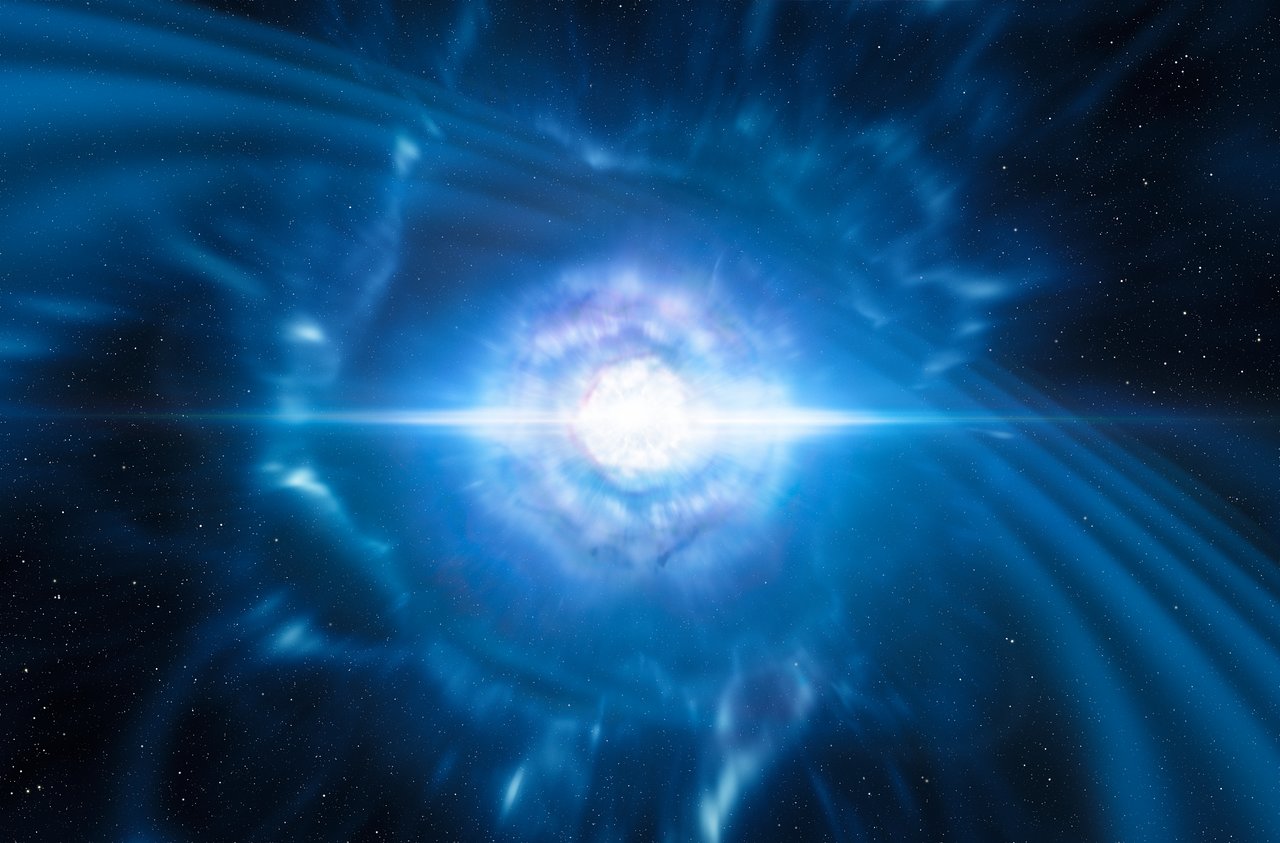
When We Heard It in Every Wavelength at Once
The second great gravitational-wave event came on August 17, 2017. GW170817 was different. It was not two black holes. It was two neutron stars: collapsed remnants of massive stars, each with the mass of the Sun compressed into a sphere roughly 20 kilometres across. They spiralled together in galaxy NGC 4993, approximately 140 million light-years from Earth.
This time, LIGO was not alone. The Virgo detector in Italy had recently come online, giving three detectors to triangulate the signal. And 1.7 seconds after the gravitational wave reached Earth, NASA’s Fermi Gamma-ray Space Telescope detected a short gamma-ray burst from the same patch of sky.
Within hours, approximately 70 observatories on the ground and in space turned to look. What they found was a kilonova: the afterglow of a neutron star collision, glowing across the entire electromagnetic spectrum, from gamma rays to radio waves. The observations confirmed something theorists had long suspected: neutron star mergers forge the heaviest elements in the periodic table. The gold in the ring on your finger, the platinum in a catalytic converter, the uranium in a reactor: all of it was created in collisions like this one, then scattered across the cosmos.
GW170817 was the birth of multimessenger astronomy: the practice of observing a single event through completely independent channels, gravitational waves and electromagnetic radiation, two different kinds of information about the same violent moment. We had not just heard the universe. We had heard it and seen it at the same time.
In June 2023, the NANOGrav collaboration published 15 years of data from a different kind of instrument: a galaxy-sized gravitational-wave detector made of millisecond pulsars. Pulsars are rapidly spinning neutron stars that emit beams of radiation with extraordinary regularity. By monitoring 67 of these cosmic clocks spread across the Milky Way, NANOGrav could detect the subtle stretching and squeezing of spacetime between Earth and each pulsar.
What they found was not a chirp. It was a low, omnipresent hum: the gravitational-wave background, a constant rumble produced by the superposition of thousands of supermassive black-hole binaries slowly spiralling toward merger in galaxies across the observable universe. The Hellings-Downs correlation pattern, the key signature that distinguishes gravitational waves from noise, was confirmed at approximately 4 sigma.
You are immersed in this hum right now. It passes through you, through the Earth, through the Sun. It is the collective gravitational sound of every pair of supermassive black holes in the observable universe, slowly, over millions of years, falling toward each other. We needed 15 years of watching pulsars to hear it.
What LISA Will Hear
Ground-based detectors like LIGO are limited by the seismic noise of the Earth itself. Below about one hertz, the planet shakes too much for any terrestrial instrument to function. To hear the deep bass of the gravitational-wave universe, we need to go to space.
LISA (the Laser Interferometer Space Antenna), an ESA-led mission with NASA as a collaborative partner, is scheduled to launch in 2035. It will consist of three spacecraft arranged in an equilateral triangle, each side 2.5 million kilometres long, trailing Earth in a heliocentric orbit. Laser beams will link the three spacecraft, forming an interferometer at a scale that dwarfs anything on the ground.
LISA will detect gravitational waves in the millihertz range: tens of thousands of small binary systems in our own galaxy, the mergers of massive black holes as galaxies collided in the early universe, and possibly signals from the earliest moments after the Big Bang. Where LIGO hears sharp collisions, LISA will hear the slow, deep gravitational songs of objects that take years to orbit each other.
The gravitational-wave spectrum is opening the way the electromagnetic spectrum once did: frequency by frequency, instrument by instrument. Each new band reveals a universe that was always there, always vibrating, always singing. We simply had not built the ears to hear it.
For 99 years, gravitational waves were a prediction written in equations that most physicists believed but none could prove. Then, on a September morning when nobody was watching, a detector measured a displacement smaller than a proton and heard the last two-tenths of a second of a conversation between two black holes that began before life crawled out of the ocean. The universe had been speaking this whole time. We just learned how to listen.

