

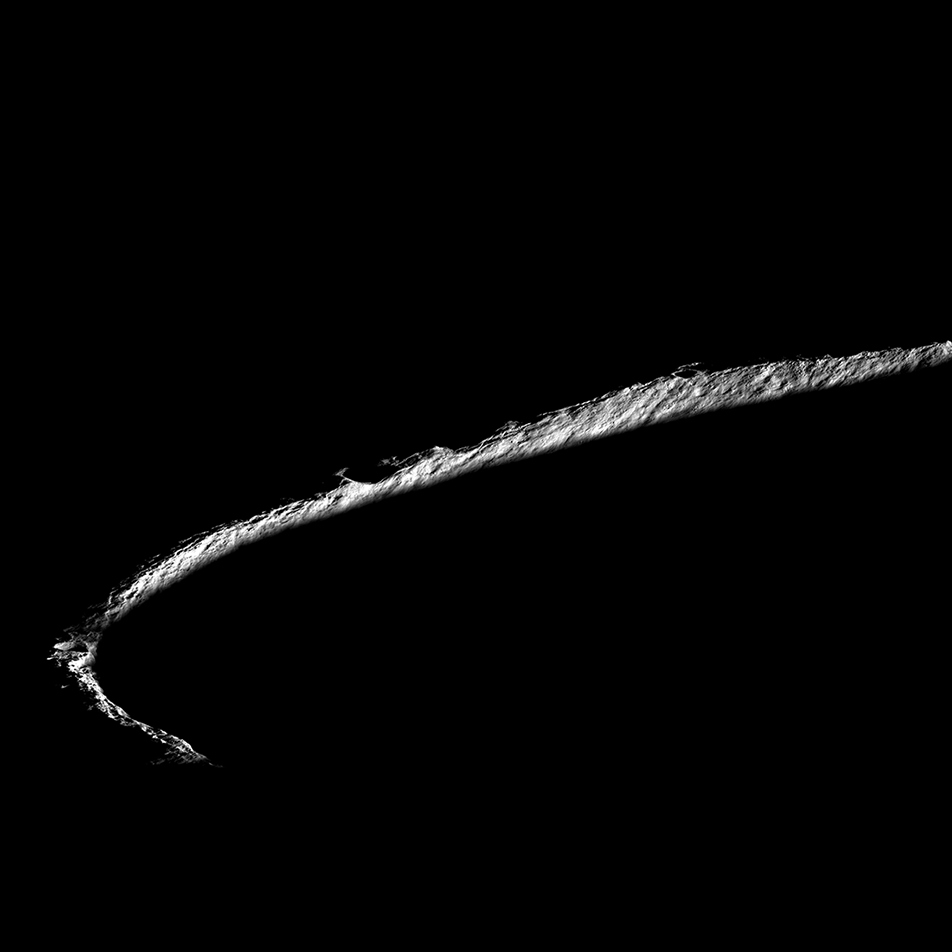
Imagine a place 240,000 miles from where you sit right now. The temperature has dropped to minus 248 degrees Celsius: colder than the surface of Pluto, colder than anything measured on any world beyond Neptune. You are standing at the bottom of a crater so deep that the walls block every angle the sun could take to reach the floor. No photon of sunlight has struck this ground in billions of years. Not since before the Cambrian Explosion. Not since before anything with a backbone existed on Earth.
And beneath your feet, locked in the frozen regolith, there is water. Ice, delivered by comets when the solar system was still young. Pristine. Untouched. Ancient beyond easy comprehension.
We are about to go and get it.
The Craters That Never See the Sun
The Moon tilts on its axis by just 1.5 degrees. Earth tilts at 23.5. That small number changes everything.
On Earth, our generous axial tilt creates seasons. It swings the poles between months of midnight sun and months of polar night, and it ensures that even the deepest canyon eventually catches the light. The Moon gets none of that. At its poles, the sun never climbs high. It skims along the horizon in a permanent low arc, casting shadows that stretch for kilometers across the grey terrain. In most places, the shadows shift as the Moon rotates. But in certain craters near the south pole, craters where the rim walls rise high enough and the geometry aligns just so, the sun’s angle is never steep enough to clear the edge. The floor lives in permanent night.
Scientists call these permanently shadowed regions, or PSRs. There are hundreds of them scattered across the lunar south pole, ranging from small depressions a few meters across to enormous impact basins. The largest and most studied is Shackleton Crater, a 21-kilometer-wide impact scar positioned almost exactly at the geographic south pole. Its peaks catch sunlight for more than 90 percent of the lunar year. Its floor, four kilometers below the rim, has not seen the sun in at least two billion years. The crater itself formed roughly 3.6 billion years ago, and it may have been dark, or nearly so, for most of its existence.
When NASA’s Lunar Reconnaissance Orbiter trained its Diviner radiometer on these regions beginning in 2009, it measured temperatures below minus 238 degrees Celsius: approximately 35 Kelvin. In the deepest cold traps, temperatures may drop as low as 25 Kelvin (minus 248 degrees Celsius). For context, Pluto’s average surface temperature sits around minus 230 degrees Celsius. The floors of these lunar craters are among the coldest measured surfaces in our entire solar system, colder than worlds that orbit billions of miles farther from the sun.
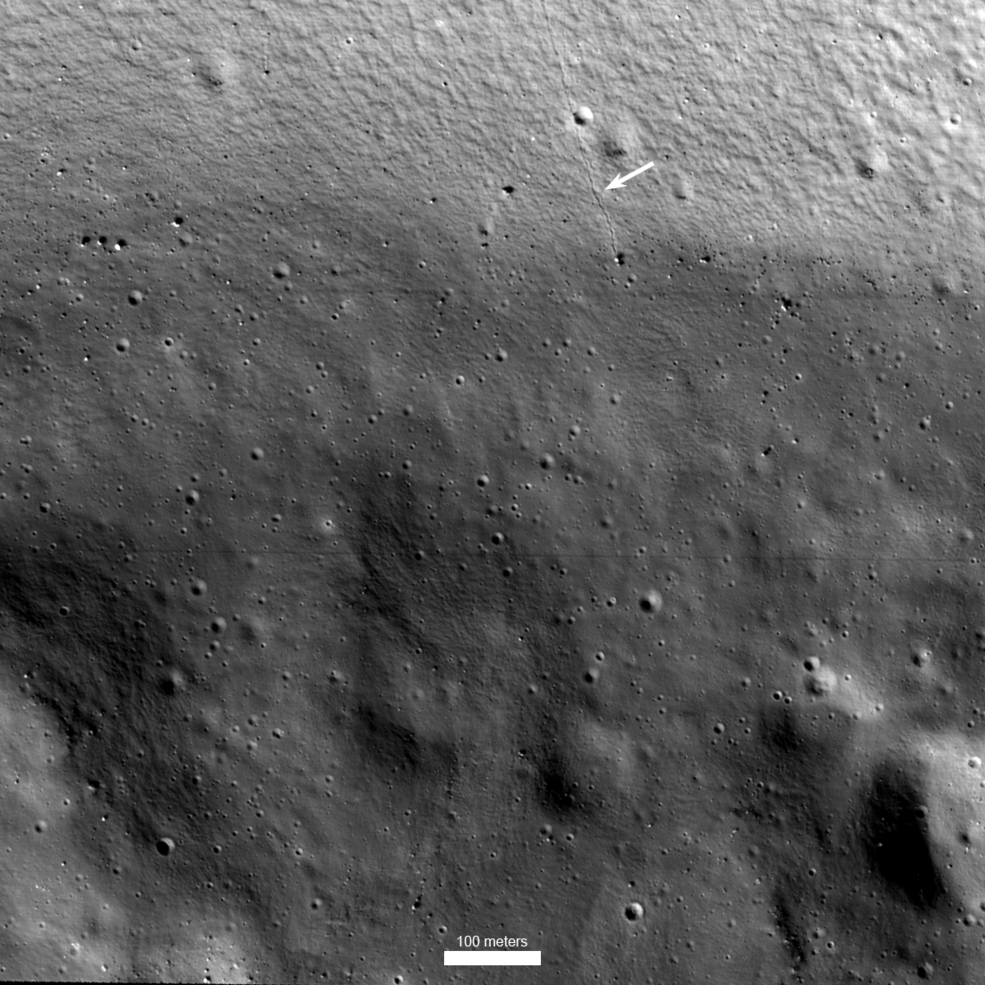
For years, we could only infer what lay inside those shadows. Then, in 2023, NASA’s ShadowCam instrument, riding aboard the Korean Aerospace Research Institute’s Danuri orbiter, began imaging the interiors of permanently shadowed craters using reflected light bouncing off nearby sunlit terrain. Two hundred times more sensitive than the LRO’s own cameras, ShadowCam revealed boulder fields, soil textures, and slope features inside craters that had never been photographed before. The dark patches on the Moon had finally begun to give up their secrets.
Ancient Ice
The idea that water ice might hide in the Moon’s permanently shadowed craters was proposed decades ago, but proving it required something dramatic: a deliberate crash.
On October 9, 2009, NASA’s LCROSS (Lunar Crater Observation and Sensing Satellite) sent a spent Centaur rocket stage into Cabeus, a permanently shadowed crater near the south pole. The two-ton impactor struck at roughly 9,000 kilometers per hour, blasting a plume of debris above the crater rim and into sunlight for the first time in geological ages. A trailing shepherding spacecraft flew through the plume four minutes later with its full instrument suite open, measuring everything the impact had kicked up.
On November 13, 2009, NASA announced the results. The regolith inside Cabeus contained water ice at a concentration of 5.6 percent by mass, plus or minus 2.9 percent. The impact liberated roughly 155 kilograms of water vapor. Mixed in with the water: mercury, magnesium, calcium, sodium, and traces of silver. The Moon was not the bone-dry world that decades of Apollo sample analysis had led us to believe. Hidden in its darkest places, it had been quietly accumulating a complex chemistry of its own.
Where did the water come from? The leading theory points to the Late Heavy Bombardment, a violent epoch roughly 3.8 to 4.1 billion years ago when the inner solar system was being hammered by leftover debris from planetary formation. Comets and water-rich asteroids struck the Moon in enormous numbers during this period. Some of the water they delivered migrated to the poles and settled into the cold traps. Additional ice may have formed through interactions between solar-wind hydrogen and oxygen in the lunar soil, a slow process that continues at trace levels even today.
However it arrived, once water reached those craters, it stayed. At 25 Kelvin, ice does not sublimate. It does not drift. It sits in the regolith, grain by frozen grain, and waits.
How much is down there? The honest answer: we do not know precisely. Estimates range from 600 million to 2 billion metric tons across both poles, depending on the model and assumptions used. The uncertainty spans more than an order of magnitude. Narrowing that range is one of the principal scientific reasons we are going back.
India brought us closer in 2023. On August 23, ISRO’s Chandrayaan-3 mission landed its Vikram lander near the lunar south pole, making India the first nation to reach this region and the fourth country to soft-land on the Moon. Its Pragyan rover spent 14 Earth days analyzing the surrounding soil with laser and X-ray spectrometers while a thermal probe measured temperatures that fluctuated dramatically over astonishingly short distances. The mineral composition data offered further evidence that the lunar surface was entirely molten shortly after the Moon formed, and confirmed what orbital data had long suggested: the south pole is a geologically complex, thermally extreme environment. Its resources exist. Extracting them will demand engineering that does not yet exist. But now we know they are real.
The Return
Water in space is not just something you drink. Split a water molecule into its constituent atoms, hydrogen and oxygen, and you have two of the most valuable substances in rocketry. Liquid hydrogen is one of the most efficient chemical propellants ever used in rocket engines. Liquid oxygen serves as both the oxidizer that makes combustion possible and, separately, the air that keeps a crew alive.
A crewed outpost near the lunar south pole with access to water ice would not need to ship its propellant from Earth. It would not need to ship its breathing air. In an enterprise where every kilogram launched from Earth’s surface to the lunar surface costs tens of thousands of dollars, local water changes the economics of deep-space exploration entirely. The savings are not incremental. They are transformational.
Picture a processing facility on the sunlit Shackleton-de Gerlache Ridge, solar panels soaking up near-constant light, cracking ice into hydrogen and oxygen. Missions bound for Mars and the asteroid belt refueling at the Moon instead of hauling every gram of propellant up from the bottom of Earth’s gravity well. The Moon stops being a destination and becomes a waypoint: the first supply depot on the road to everywhere else.
But the scientific value of this ice may exceed even its industrial promise. The water frozen in those craters is old, potentially as old as the solar system itself. Studying its isotopic ratios, the balance of hydrogen to deuterium, could reveal whether Earth’s oceans were delivered primarily by comets or by asteroids, a question that remains genuinely open. The south pole is not just a future fuel depot. It is a time capsule from an epoch when the planets were still being assembled, preserved in the only freezer cold enough to keep it intact for billions of years.
We are already partway there. On April 1, 2026, NASA’s Artemis II mission launched from Kennedy Space Center carrying astronauts Reid Wiseman, Victor Glover, and Christina Koch, along with Canadian Space Agency astronaut Jeremy Hansen, on a ten-day flight around the Moon. It was the first time humans had traveled beyond low Earth orbit since Apollo 17 in December 1972: more than 53 years of absence.
During a seven-hour lunar flyby on April 6, the crew flew within 4,067 miles of the surface. They set a new record for the farthest distance from Earth reached by any crewed mission: 252,756 miles, surpassing Apollo 13’s long-standing mark of 248,655 miles. They photographed the far side, studied ancient lava flows and impact craters, and watched a solar eclipse as Orion, the Moon, and the Sun aligned, the corona flaring around the lunar edge in a sight no human had witnessed from that vantage in half a century.
But Artemis II was a flyby. The landing comes next.
NASA has restructured its Artemis architecture since then. Artemis III, originally designed as the landing mission, has been redesigned as a low-Earth-orbit demonstration of rendezvous and docking between Orion and the commercial landers being developed by SpaceX and Blue Origin, targeted for mid-2027. The crewed south pole landing now belongs to Artemis IV, currently planned for early 2028. Two astronauts will descend to the surface and spend approximately one week exploring terrain near the lunar south pole before rejoining their crew in orbit.
The leading candidate for that landing is the Shackleton-de Gerlache Ridge, the elevated terrain between Shackleton and the neighboring de Gerlache Crater. Three points along the ridge remain collectively sunlit for more than 90 percent of the year, providing reliable solar power and a continuous line of sight to Earth for communications. Within walking distance of those sunlit peaks: the permanently shadowed craters, where the ice has been waiting since before anything on Earth had eyes to see the Moon.
NASA is not alone in the pursuit. China’s Chang’e 7 mission, targeting the illuminated rim of Shackleton Crater in late 2026, aims to detect water ice in the polar regolith with ground-penetrating radar and a volatile analyzer. JAXA and ISRO’s joint LUPEX rover, carrying a NASA-built neutron spectrometer, is expected to follow no earlier than 2028. The south pole is becoming the most contested piece of real estate beyond Earth.
The timelines have slipped more than once. They will probably slip again. But the direction has not changed. We know where we are going. The south pole is the place.
Billions of years of silence. The cold gathering in craters that have never known warmth. Water delivered by ancient comets, settling into regolith that no wind has ever stirred. And then, if the hardware holds and the schedules converge: a pair of boots in the dust, in the oldest, coldest, quietest place any human being has ever stood.

