

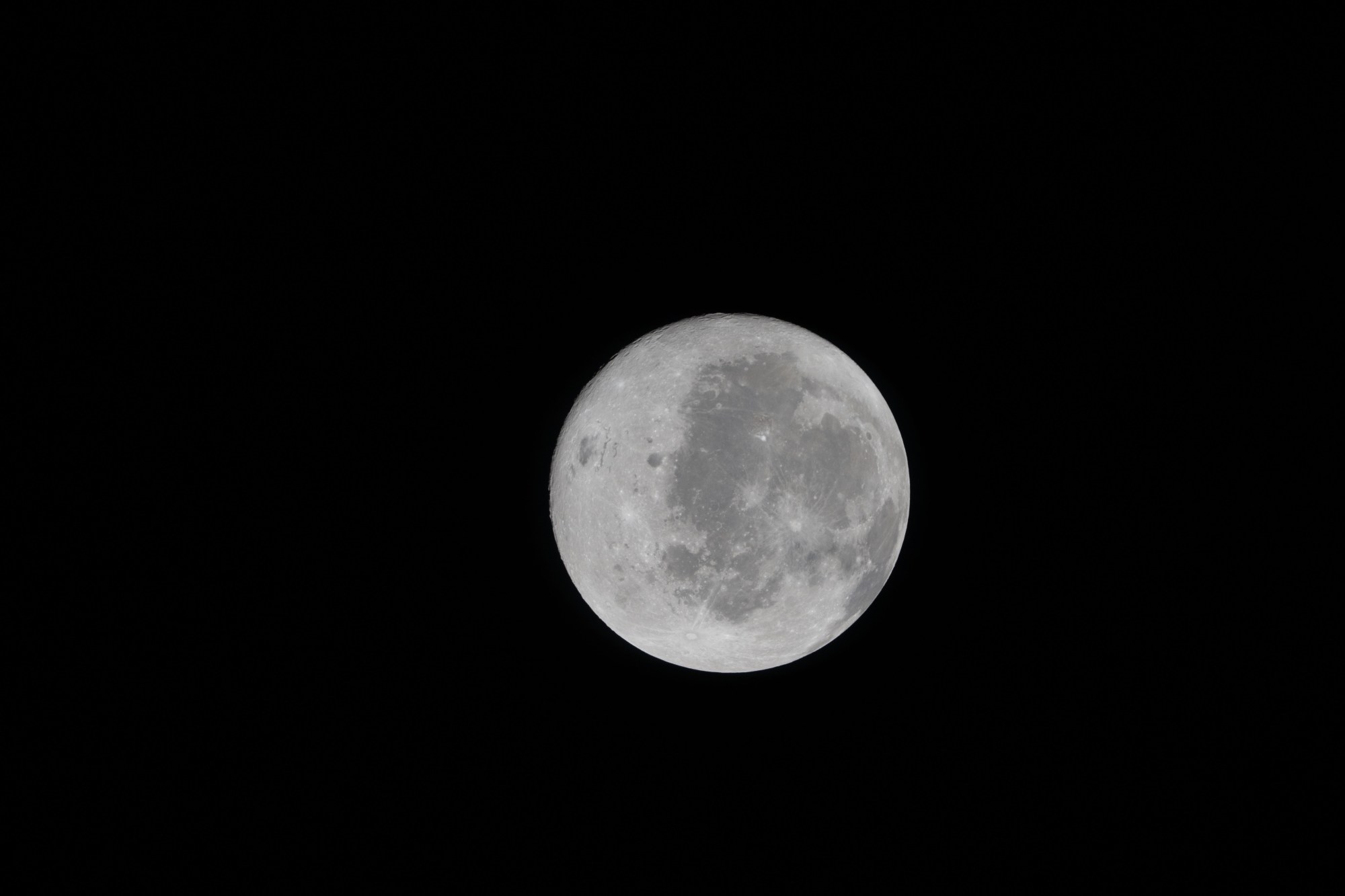
Step outside tonight and look up. Find the Moon, and find the dark plain that dominates the upper-left quadrant of its face: smooth, vast, the color of wet slate. That is not a shadow. It is not water. It is the frozen floor of a wound 1,145 kilometers wide, left by a collision so violent it reshaped the entire near side of the Moon. This is Mare Imbrium, the Sea of Rains: one of the most storied places in the solar system, and the feature that gives this publication its name.
What you are looking at, with nothing but your own eyes, is 3.9 billion years of lunar history compressed into a single dark oval. A protoplanet the size of New Jersey struck here. Magma flooded the crater for hundreds of millions of years. Seventeenth-century astronomers named it after rain that never fell. In 1971, two astronauts drove a car along its eastern rim and pulled a piece of the Moon’s original crust from the soil. And on April 6, 2026, four astronauts aboard Artemis II flew past it at 4,067 miles above the surface, the first humans to see Mare Imbrium from space in more than 53 years.
What Is Mare Imbrium?
Mare Imbrium (Latin for “Sea of Rains”) is the second-largest mare on the Moon’s near side. It fills the Imbrium Basin, a multi-ring impact structure so large it can be seen without a telescope: roughly 1,145 kilometers (about 750 miles) in diameter, approximately the distance from London to Rome. When you look up at the Moon and see its familiar face, the dark region forming what early observers called its right “eye” is Mare Imbrium.
But calling it a “sea” is one of astronomy’s oldest and most poetic mistakes. When Galileo turned his telescope on the Moon in 1609, he noted the dark, smooth regions but did not name them. That came in 1651, when Italian astronomer Giovanni Riccioli published Almagestum Novum, a lunar atlas in which he and his colleague Francesco Maria Grimaldi gave the dark plains their Latin names: seas, lakes, bays, and marshes. Riccioli likely knew these features were not water. He chose the names anyway, and they endured. The Sea of Rains has never known a single drop.
What Mare Imbrium actually is, we now understand, is basalt: dark volcanic rock that flooded the basin long after the impact that created it. The distinction matters. The collision and the flooding were two separate events, separated by hundreds of millions of years, and together they tell a story about the Moon’s violent youth and its slow, cooling old age.
The Day a Protoplanet Broke the Moon
3.9 billion years ago, during an era called the Late Heavy Bombardment, a protoplanet roughly 250 kilometers in diameter struck the Moon. Research led by planetary scientist Peter Schultz at Brown University, published in Nature in 2016, estimated the impactor was roughly 2.5 times larger in diameter than previous models had suggested, and many times more massive. At 250 kilometers across, the object was about the length of New Jersey. This was not a boulder. It was a small world, large enough to qualify as a protoplanet.
The collision was catastrophic beyond modern experience. The initial crater may have been as deep as 100 kilometers, though the basin floor rebounded almost immediately. The impact thrust up three concentric rings of mountains around the wound: the Montes Carpatus to the south, the Montes Apenninus to the southeast (some of the tallest peaks on the Moon, rising 5 kilometers above the surrounding plain), and the Montes Caucasus to the east. The outermost ring spans 1,300 kilometers. Beyond it, debris blasted outward at low angles carved radial furrows into the lunar surface for 800 kilometers in every direction: a pattern called the Imbrium Sculpture, still visible today in orbital imagery.
Then, slowly, the Moon began to heal. Magma from the interior seeped upward through fractures in the shattered basin floor. At least three major lava flows have been identified, spanning from 3.5 billion to approximately 2 billion years ago. Over that immense stretch of time, layer upon layer of basalt accumulated, filling the basin to a depth of 2 to 5 kilometers and creating the smooth, dark plain visible from your backyard tonight. Each flow carried a slightly different chemical signature; variations in iron oxide and titanium dioxide concentrations that scientists have used to map the flooding sequence, reading the basin’s history the way a geologist reads layers of sedimentary rock.
Beneath that plain lies a gravitational anomaly called a mascon (mass concentration): dense material that accumulated after the impact, first detected in 1968 when NASA’s Lunar Orbiter spacecraft noticed unexpected gravitational tugs while passing overhead. The Imbrium mascon is the largest on the Moon, its pull strong enough to perturb the orbits of passing spacecraft. It is a hidden fingerprint of the protoplanet that struck here when Earth itself was still cooling from its own formation.

On the Shore of a Frozen Sea
Three centuries after Riccioli named it, humanity finally sent someone to walk its shore.
On July 26, 1971, Apollo 15 launched from Kennedy Space Center carrying Commander David Scott, Lunar Module Pilot James Irwin, and Command Module Pilot Alfred Worden. Their destination: the Hadley-Apennine region on the southeastern rim of Mare Imbrium, where the basin’s mountain walls drop to meet the dark basalt floor. The landing site sat on Palus Putredinis (the Marsh of Decay), a small volcanic plain nestled against the Apennine front at 26.1° N, 3.9° E.
It was the first of NASA’s “J series” missions, designed for extended stays and deeper science. For the first time on the Moon, astronauts had a car. The Lunar Roving Vehicle allowed Scott and Irwin to range far from the lunar module Falcon, covering terrain previous crews could only study from orbit or reach on foot.
The landscape that greeted them was unlike anything previous Apollo crews had seen. The Apennine Mountains rose more than 4 kilometers above the landing site, their slopes sharp and steep, unweathered by wind or rain. To the west, the dark floor of Mare Imbrium stretched to the horizon, flat and featureless except for subtle wrinkle ridges where the cooling basalt had buckled under its own weight. And cutting across the plain like a canyon scaled to lunar proportions lay Hadley Rille.
Over three days, Scott and Irwin conducted three moonwalks totaling 18 hours and 35 minutes outside the spacecraft. They drove 27.9 kilometers across the basin rim, collected 77 kilograms of rock and soil, and parked at the edge of Hadley Rille: a sinuous channel 1.5 kilometers wide and 400 meters deep that winds for more than 120 kilometers across the landscape, carved by ancient lava flows that once coursed across this plain like slow, incandescent rivers.
But the mission’s defining moment came on August 1, at the rim of Spur Crater. There, sitting on a small pedestal of soil as if placed on display, Scott spotted a white, crystalline rock. He and Irwin collected it carefully: sample 15415, a ferroan anorthosite later nicknamed the Genesis Rock. Analysis revealed it was approximately 4.1 billion years old, a fragment of the Moon’s primordial crust that predated even the Imbrium impact itself. In their gloved hands was a piece of the surface that had existed before the protoplanet arrived. The original ground, from before the wound.
Scott and Irwin spent 67 hours on the surface before lifting off in Falcon on August 2. They had driven to the edge of the rille, climbed foothills thrust up by an ancient apocalypse, and held a rock older than the scar beneath their feet. And when they finally looked up from the boulders and the basalt, they could see Earth hanging above the Apennine ridge: small, blue, and impossibly fragile. Every astronaut who has seen that view comes back changed. They call it the Overview Effect.
For more than half a century after Apollo 15, no human saw Mare Imbrium from orbit. The Apollo program ended with Apollo 17 in December 1972, and for more than 53 years, the basin existed only in photographs, remote sensing data, and the memories of the twelve people who had walked on the Moon.
That changed on April 6, 2026.
At 8:35 p.m. EDT, as Orion emerged from behind the far side, the Artemis II crew witnessed a solar eclipse: the Sun slipping behind the Moon’s limb and vanishing for nearly an hour, its corona blazing in a ring of white light against the black. Then the near side came into view, sunlit and sharp, and with it the familiar pattern of dark maria that has guided navigators and inspired storytellers for millennia.
Four astronauts were aboard: Commander Reid Wiseman, pilot Victor Glover, and mission specialists Christina Koch and Jeremy Hansen. They were flying Artemis II on a free-return trajectory, a figure-eight path that used gravity to sling them around the far side and back toward home. At closest approach, they passed within 4,067 miles of the lunar surface. At their farthest point from Earth, 252,756 miles out, they broke the distance record set by Apollo 13 in 1970. It was the first crewed mission beyond low Earth orbit since December 1972.
NASA had identified approximately 35 geological features for the crew to observe during the flyby window, which lasted from about 2:45 to 9:40 p.m. EDT. Working in pairs, the astronauts described the terrain in real time to scientists at Mission Control in Houston, noting color variations, shadow angles, and surface textures that cameras alone cannot fully resolve. The human eye can distinguish shades of brown and blue on the lunar surface that reveal mineral composition and relative age; observations that complement, rather than duplicate, what orbital instruments measure.
Among the crew’s views was the near side of the Moon in full disc, dominated by the dark expanse of Mare Imbrium: ringed by its three mountain ranges, scored by Hadley Rille, stretching to the curved horizon. From 4,000 miles, the basin becomes something more than a dark patch. It becomes a landscape. A place with topography, with edges, with a story written in basalt and mountain walls. We covered the full geological story of the flyby, including the observation sites and the crew’s real-time descriptions, in “What Artemis II Saw: The Moon Up Close.”
The Artemis II crew is heading home as you read this, with splashdown scheduled for April 10 in the Pacific Ocean off San Diego. But their flyby is only a beginning. Artemis III, planned to land astronauts near the Moon’s south pole, will be the next step toward a sustained human presence on the lunar surface. And while the south pole’s permanently shadowed craters hold the water ice that could sustain a future base, the geology of the great northern basins (Mare Imbrium among them) remains central to understanding the Moon’s history and the violent early years of the inner solar system.
China’s Chang’e 3 mission landed the Yutu rover on Mare Imbrium in December 2013, returning data that has refined our understanding of the basin’s lava flow stratigraphy. Future robotic missions may sample the basalt at greater depths, probing the boundary between volcanic fill and the original impact melt sheet. Each layer is a chapter. The oldest basalts record conditions 3.5 billion years ago; the youngest, roughly 2 billion years old, document the Moon’s last gasps of volcanic activity. Somewhere beneath them lies the shattered floor of the original crater, and within it, clues to the size and composition of the protoplanet that created the wound.
The questions that remain are the same ones that drew Apollo 15 to Hadley-Apennine in 1971. How exactly did the Late Heavy Bombardment reshape the inner solar system? What can the Imbrium impact tell us about the population of protoplanets that once roamed the space between Mars and Jupiter? And what else lies buried beneath that dark, quiet plain?
Tonight, step outside and look up. The Sea of Rains is right where it has always been: patient, dark, and older than anything you will ever touch.

