

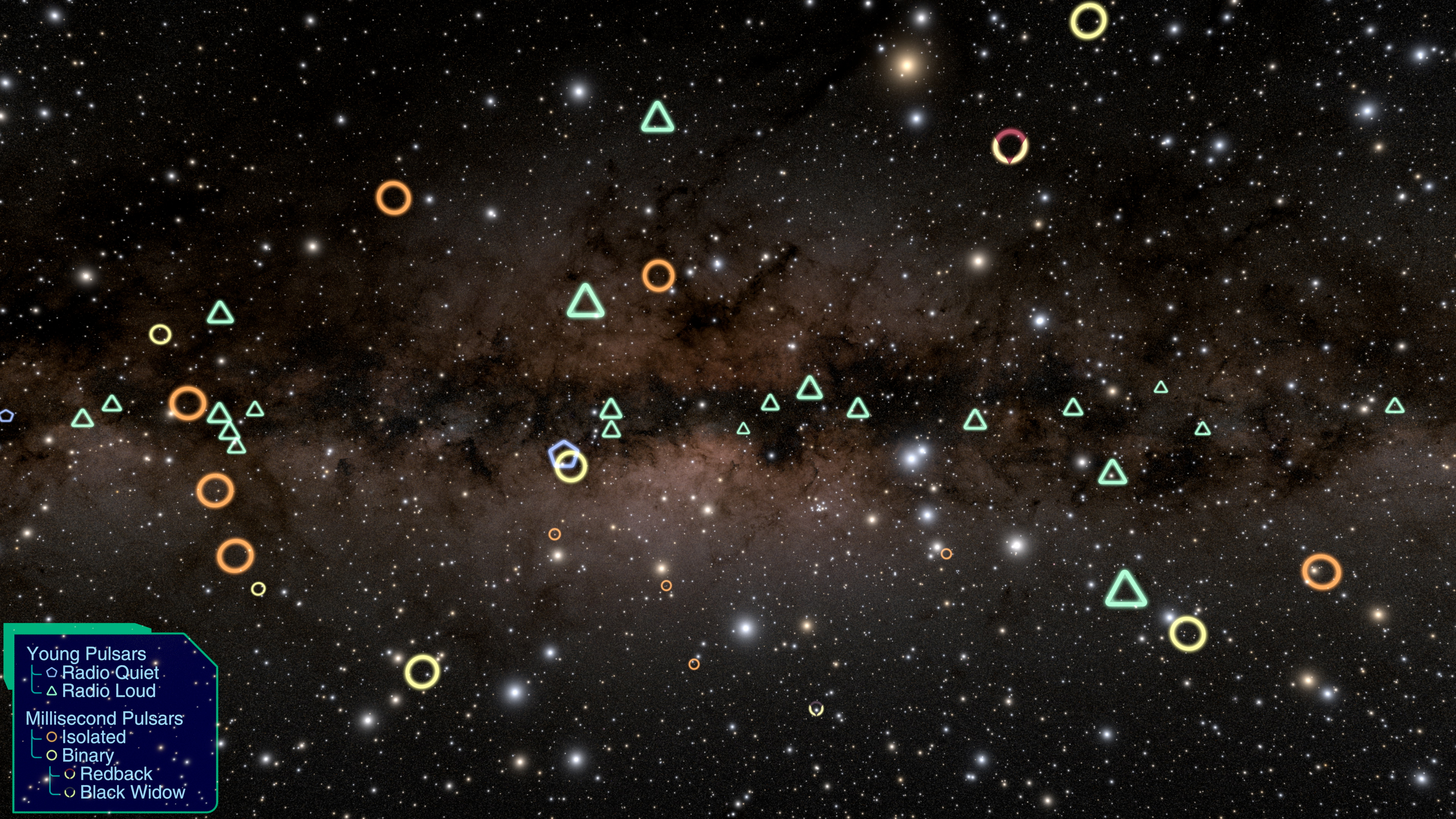
In the autumn of 1967, a 24-year-old graduate student in Cambridge noticed something strange on 30 metres of chart paper. A tiny smudge of signal, repeating with a regularity that should not have existed in nature. Her supervisor’s team labelled it LGM-1: Little Green Men. They were not entirely joking.
The signal pulsed once every 1.3373 seconds. Not roughly. Not approximately. Exactly 1.3373 seconds, pulse after pulse, night after night. No known natural source behaved like that. For a brief, bewildering stretch of weeks, the possibility that this was an artificial beacon from another civilisation was taken seriously enough to be written into the project log.
It was not aliens. It was something, in its own way, far stranger: the spinning corpse of a star, broadcasting across the galaxy with a precision that puts most human-made clocks to shame. Jocelyn Bell Burnell had discovered the first pulsar, and the universe would never look quite the same again.
A Star Collapses. The Clock Begins.
To understand what a pulsar is, you have to start with how a massive star dies.
When a star eight or more times the mass of our Sun exhausts its nuclear fuel, its core can no longer support its own weight. In a fraction of a second, the core collapses under gravity so intense that protons and electrons are crushed together into neutrons. The outer layers of the star are blasted outward in a supernova. What remains at the centre is a neutron star: an object roughly 20 kilometres across, yet containing one and a half to two times the mass of our Sun.
The density is almost impossible to picture. A single teaspoon of neutron star material would weigh around a billion tonnes on Earth. The entire mass of Mount Everest, compressed into a sugar cube. The object is so compact that its surface gravity is roughly 200 billion times stronger than what holds you in your chair right now.
And it spins. Think of the classic ice-skater analogy: pull your arms in, you spin faster. A star that once rotated lazily over the course of weeks now completes a full revolution in seconds or less, because the same angular momentum has been concentrated into a sphere smaller than most cities. Its magnetic field, already powerful in the parent star, has been compressed too, intensifying to a trillion times the strength of Earth’s.
This is a neutron star. When it happens to point a beam of radio waves in our direction, we call it a pulsar.
The Lighthouse in the Dark
So how do pulsars work? The answer lies in a geometric accident.
A neutron star’s magnetic field is extraordinarily powerful, but its magnetic poles are rarely aligned with its axis of rotation. Charged particles, accelerated to tremendous energies along those magnetic field lines, stream outward from both poles and produce intense beams of radio waves (and sometimes X-rays and gamma rays). As the star spins, these beams sweep through space like the rotating beam of a lighthouse.
If Earth happens to lie in the path of that sweep, we detect a brief flash of radio energy once per rotation. That flash is the “pulse” in pulsar. Miss the beam, and the neutron star is invisible to us at radio wavelengths, silently spinning in the dark. Astronomers estimate that for every pulsar we detect, several more are beaming in directions we will never see.
Bell Burnell’s pulsar, now catalogued as PSR B1919+21, sits in the constellation Vulpecula. Its beam sweeps past Earth once every 1.3373 seconds, and it has been doing so with metronomic regularity for thousands of years. That regularity is not a coincidence. Isolated neutron stars lose rotational energy very slowly; their spin-down rates are so gradual that they can serve as natural timekeepers of extraordinary precision.
By 1968, Bell Burnell had found three more pulsars in her data. The “little green men” hypothesis was officially dead. Nature, it turned out, had built something more remarkable than any alien beacon: a class of objects whose existence confirmed theoretical predictions about neutron stars that had seemed almost absurdly exotic when Walter Baade and Fritz Zwicky first proposed them in 1934.
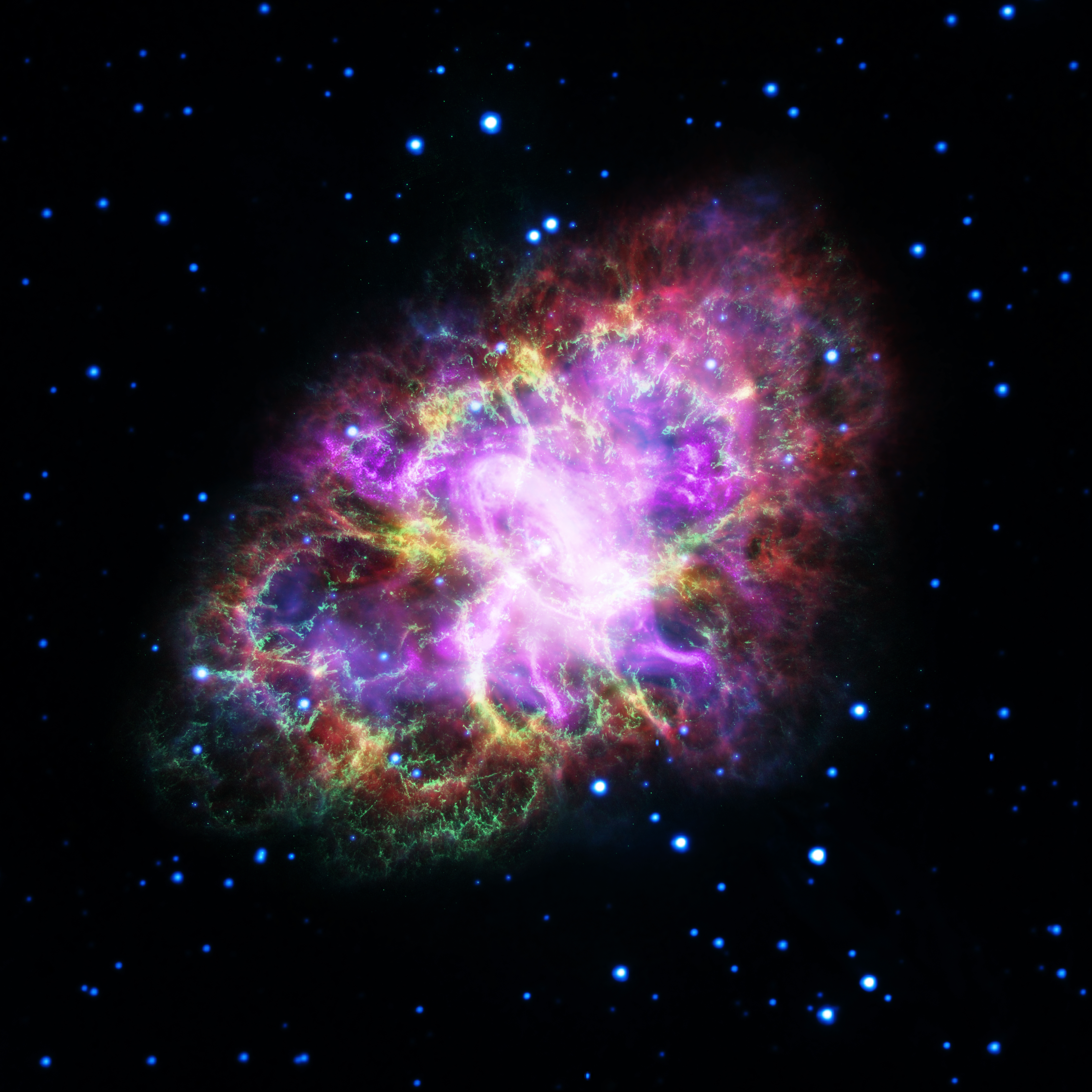
The most famous pulsar visible today sits at the centre of the Crab Nebula, the remnant of a supernova that Chinese astronomers recorded in 1054 AD. The Crab Pulsar spins roughly 30 times every second, and the energy it pumps into the surrounding nebula keeps the entire structure glowing nearly a thousand years after the explosion that created it. It is, in a sense, a dead star that refuses to go dark.
The Most Precise Clocks in the Universe
Some pulsars spin far faster than the Crab. These are the millisecond pulsars, and they are among the most remarkable objects in astrophysics.
A millisecond pulsar is an old neutron star that has been “recycled”: spun back up to extraordinary speeds by accreting matter from a companion star in a binary system. As gas spirals onto the neutron star, it transfers angular momentum, gradually accelerating the spin until the star completes hundreds of rotations every second. The fastest known millisecond pulsar, PSR J1748-2446ad, spins 716 times per second. Its equator moves at roughly 24% the speed of light.
What makes millisecond pulsars truly extraordinary is their stability. Their pulse arrival times can be predicted with a precision that rivals the best atomic clocks on Earth. This is not a metaphor. Astronomers have seriously proposed using a network of millisecond pulsars as a kind of galactic GPS: a navigation system for spacecraft operating far from Earth, where each pulsar serves as a fixed reference beacon.
But the most ambitious use of pulsars as precision instruments is the pulsar timing array.
The concept is elegant. If a gravitational wave passes between Earth and a distant pulsar, it will stretch and compress the spacetime in between, subtly altering the arrival time of the pulses. A single pulsar would not tell you much, because many other effects can shift pulse timing. But if you monitor dozens of pulsars spread across the sky, all at once, and you see a correlated pattern of timing deviations consistent with the predictions of general relativity, then you have detected something: a gravitational wave too long and low for any laboratory detector to capture.
In June 2023, the NANOGrav collaboration announced exactly that. After 15 years of monitoring 68 millisecond pulsars, they found compelling evidence for a gravitational wave background: a persistent hum of spacetime distortions permeating the cosmos, most likely generated by pairs of supermassive black holes spiralling toward each other in the cores of distant galaxies. The statistical confidence ranged from 3 to 4.6 sigma, and four other international pulsar timing collaborations reported consistent findings simultaneously.
Think about what this means. Astronomers took dead stars scattered across the Milky Way, measured their pulses with nanosecond precision, and used them as a galaxy-spanning antenna to detect ripples in the fabric of spacetime itself. The universe is humming, and pulsars are how we learned to hear it.
If you’ve read about black holes and the extremes of gravity, this is where those extremes become audible. Pulsars gave us ears.
The Woman Who Started It All
In 1974, the Nobel Prize in Physics was awarded to Antony Hewish and Martin Ryle “for their pioneering research in radio astrophysics,” with Hewish cited specifically for “his decisive role in the discovery of pulsars.” Jocelyn Bell Burnell, who had actually found the signal in hundreds of metres of chart paper, who had identified the anomaly and pushed for its investigation, received nothing.
The omission became one of the most discussed controversies in the history of the Nobel Prizes. Astronomer Fred Hoyle publicly called it out. Physicists around the world recognised what had happened. A graduate student, a woman, in a field overwhelmingly dominated by men, had been overlooked in favour of her male supervisor.
Bell Burnell’s response to the snub is, in its own way, as remarkable as the discovery itself. She has never expressed bitterness. “I believe it would demean Nobel Prizes if they were awarded to research students, except in very exceptional cases,” she said in the years that followed. Later, with characteristic dry humour: “I feel I’ve done very well out of not getting a Nobel Prize. If you get a Nobel Prize you have this fantastic week and then nobody gives you anything else. If you don’t get a Nobel Prize you get everything that moves.”
In 2018, Bell Burnell was awarded the Special Breakthrough Prize in Fundamental Physics, worth $3 million. She donated the entire sum to the Institute of Physics to fund scholarships for women, underrepresented ethnic minorities, and refugee students pursuing physics research. “I don’t want or need the money myself,” she said, “and it seemed to me that this was perhaps the best use I could put to it.”
The difference between a pulsar and a magnetar, its more violent cousin, comes down to the magnetic field. Where a typical pulsar has a magnetic field a trillion times stronger than Earth’s, a magnetar cranks that up another thousand-fold, to a quadrillion times Earth’s field strength. Magnetars do not tick; they scream, occasionally releasing bursts of energy that can be detected from tens of thousands of light-years away. They belong to the same neutron star family, but if pulsars are the steady clocks, magnetars are the earthquakes. (We have more on magnetars here.)
A Signal That Never Stops
Since Bell Burnell’s discovery, astronomers have catalogued more than 3,700 pulsars in the Milky Way alone. NASA’s Fermi Gamma-ray Space Telescope has identified over 300 that pulse in gamma rays. Some are embedded in the glowing wreckage of supernovae. Some orbit other neutron stars in tight, spiralling pairs that will one day collide in cataclysms that forge gold and platinum, the kind of event that lights up gravitational wave detectors on Earth.
And PSR B1919+21, the first one, the signal that made a graduate student briefly consider extraterrestrial intelligence? It is still there. Still pulsing. Still sweeping its beam past our planet once every 1.3373 seconds, as it has done since before there were radio telescopes to notice.
Its pulse profile was so distinctive that in 1979, the graphic designer Peter Saville used a visualisation of it as the cover art for Joy Division’s debut album Unknown Pleasures. Most people who have worn that image on a t-shirt have no idea they are wearing a dead star’s heartbeat.
Somewhere above you tonight, right now, a star that died before humans existed is still keeping time. If you had the right antenna, you could hear it.

