


The first planets ever confirmed beyond our solar system were orbiting a corpse. Not a warm, yellow sun; a pulsar, the collapsed remnant of a star that had already exploded. A city-sized ball of matter so dense that a teaspoon of it would outweigh a mountain, spinning hundreds of times per second and sweeping beams of radiation across the galaxy like a lighthouse in the dark. In January 1992, Aleksander Wolszczan and Dale Frail announced that this dead neutron star, PSR B1257+12, had at least two planets circling it. That anything could survive such a catastrophe was strange enough. That planets could exist there, apparently reborn from the wreckage of a stellar explosion, felt like a message: the universe makes worlds wherever it can.
Three years later came the discovery everyone had been waiting for. In October 1995, Michel Mayor and Didier Queloz found the first planet orbiting a living, sun-like star: 51 Pegasi b. It should have been the reassuring confirmation that other solar systems look like ours. Instead, it broke every model we had.
51 Pegasi b was a gas giant, roughly half the mass of Jupiter, orbiting its star once every 4.2 days. For perspective: Mercury, the closest planet to our Sun, takes 88 days. This world was practically skimming the surface of its star, with an atmospheric temperature exceeding 1,000°C. Theorists had spent decades building models of how solar systems form, and every model said gas giants could only form far from their stars, where temperatures were cold enough for ice and gas to accumulate slowly over millions of years. 51 Pegasi b ignored all of that.
Mayor and Queloz received the Nobel Prize in Physics in 2019 for this discovery. It did not just add a new planet to the catalogue. It told us that our understanding of how worlds are built was fundamentally incomplete.
Today, the count stands at more than 6,100 confirmed exoplanets, with the NASA Exoplanet Archive crossing the 6,000 milestone in late 2025. In roughly thirty years, we went from knowing of zero worlds beyond our solar system to cataloguing thousands. And the variety of what we have found would have seemed like science fiction a generation ago.
Seeing What You Cannot See
Exoplanets are, almost by definition, invisible. The star they orbit outshines them by factors of millions or billions. For decades, the challenge was not whether other planets existed (most astronomers assumed they did) but whether we could ever prove it.
Two detection methods changed everything. The first, radial velocity, is the technique Mayor and Queloz used. A planet’s gravity tugs its host star into a tiny orbit of its own. By measuring the subtle Doppler shift of the star’s light as it moves toward and away from us (blueshift, then redshift, repeating with each orbit), astronomers can infer the planet’s minimum mass and orbital period without ever seeing the planet itself. You detect the world by watching the star wobble.
The second method, the transit technique, is even more elegant. When a planet crosses in front of its star from our line of sight, it blocks a tiny fraction of the star’s light. That dip, sometimes less than one percent of total brightness, repeats with clockwork regularity on every orbit. From the depth and duration of the dip, astronomers can calculate the planet’s size, its orbital distance, and even hints about its atmosphere. You detect the world by watching the star dim.
Both methods are indirect. We are reading shadows and tremors in starlight. And yet they have revealed a galaxy teeming with planets.
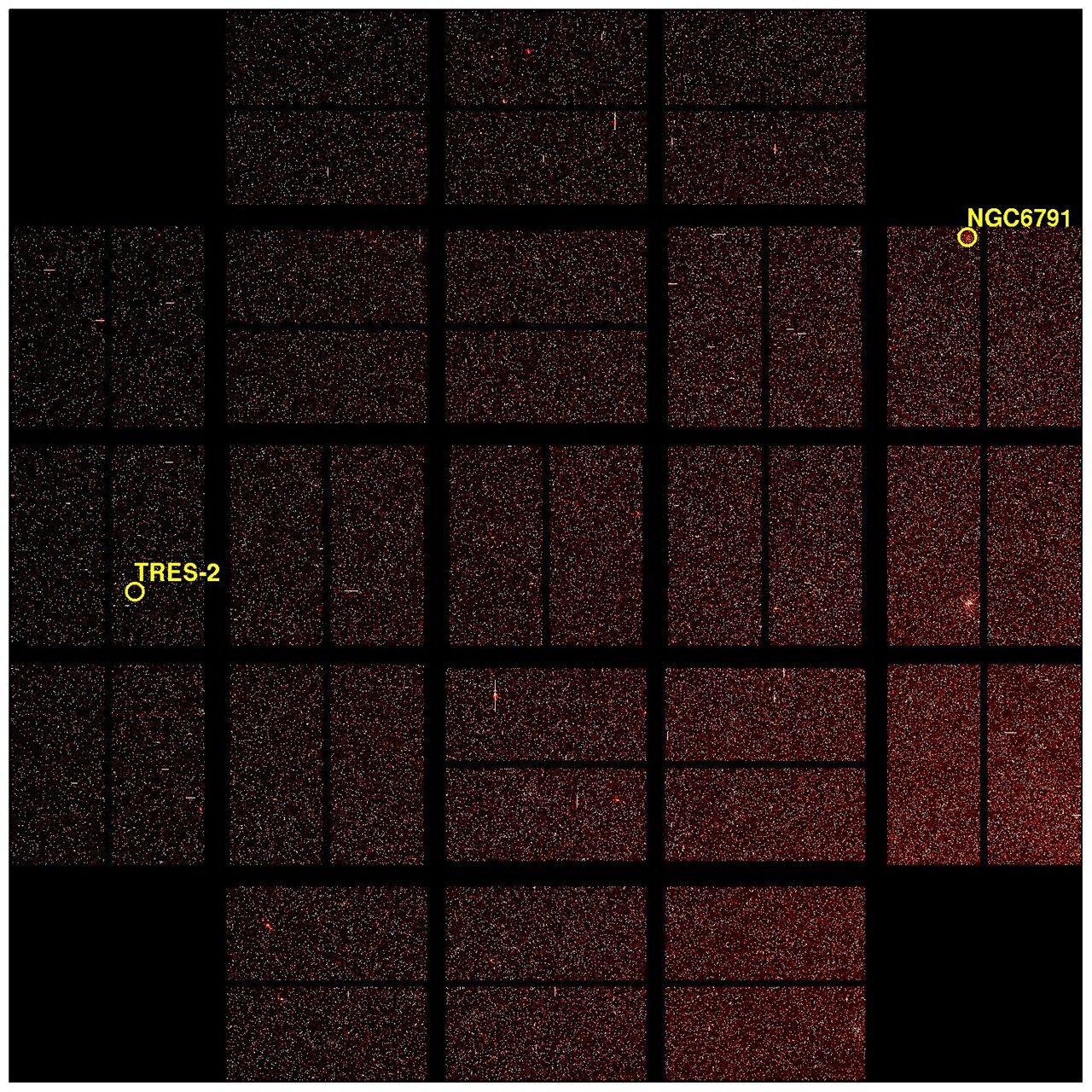
No instrument used the transit method more productively than the Kepler Space Telescope. Launched in 2009, Kepler stared at a single patch of sky in the constellations Cygnus and Lyra for four years, watching roughly 150,000 stars simultaneously for the telltale dip of a transiting planet. The results were staggering. By the time the mission ended in 2018, Kepler and its extended K2 mission had confirmed more than 2,700 exoplanets, and its statistical legacy was larger still: its data showed that, on average, every star in the Milky Way has at least one planet. The galaxy is not mostly empty space with the occasional solar system. It is packed with worlds.
Kepler’s deeper statistical finding may be its greatest legacy. Analysis of the mission data suggests that roughly 20 to 50 percent of sun-like stars have small, rocky planets in their habitable zones. That translates to billions of potentially temperate worlds in our galaxy alone.
A Zoo of Worlds
One of the great surprises of the exoplanet era is the sheer diversity of what exists. Our solar system has four small rocky planets close to the Sun and four gas or ice giants farther out, a tidy arrangement that once seemed like a universal template. It is not. The universe, it turns out, is far more inventive with planets than any theorist imagined.
Hot Jupiters were the first shock: gas giants orbiting so close to their stars that their years last only days, their atmospheres roasting at thousands of degrees. Super-Earths, planets between one and ten times Earth’s mass with no equivalent in our solar system, turned out to be among the most common planet types in the galaxy. Mini-Neptunes, slightly larger and wrapped in thick hydrogen-helium envelopes, are everywhere. There are worlds where the surface may be entirely molten rock, glowing red beneath a silicate atmosphere. There are worlds where models suggest it rains liquid iron. And there are planets with no star at all: rogue planets, adrift in interstellar space, ejected from their birth systems by gravitational encounters, alone in the dark between the stars.
The diversity does not end at their surfaces. Some exoplanets orbit binary star systems, their skies lit by two suns. Others trace such elongated orbits that their distance from their star varies by hundreds of millions of kilometres each year, producing extreme seasonal swings. Some have been found in regions where new stars are still forming, evidence that planet-building begins earlier than we once assumed.
And then there is the habitable zone: the orbital region around a star where liquid water could, in principle, exist on a planet’s surface. The concept sounds straightforward. It is anything but. The habitable zone depends on the star’s luminosity, the planet’s atmospheric composition, the strength of its greenhouse effect, its magnetic field, its volcanic activity. A planet can sit squarely in the habitable zone and be a frozen wasteland if it lacks an atmosphere, or a pressure cooker like Venus if its atmosphere traps too much heat. The habitable zone is a starting point for investigation, not a promise of habitability.
Still, the numbers are striking. The TRAPPIST-1 system, located about 40 light-years from Earth, contains seven roughly Earth-sized rocky planets, at least three of which orbit within the habitable zone of their cool red dwarf star. Seven worlds around a single star, several of them potentially temperate. When TRAPPIST-1 was announced in 2017, it felt like the opening line of a story the entire field had been waiting to read.
Reading the Air of Another World
Finding exoplanets was the first revolution. Understanding what they are made of is the second. And that is where the James Webb Space Telescope has changed everything.
When a planet transits its star, a sliver of starlight passes through the planet’s atmosphere before reaching us. Different molecules absorb different wavelengths of that light. By comparing the spectrum of starlight during a transit to the spectrum without the planet in the way, astronomers can identify the chemical fingerprints of gases in the planet’s atmosphere: a technique called transmission spectroscopy. The concept was theorised for years. JWST has made it routine.
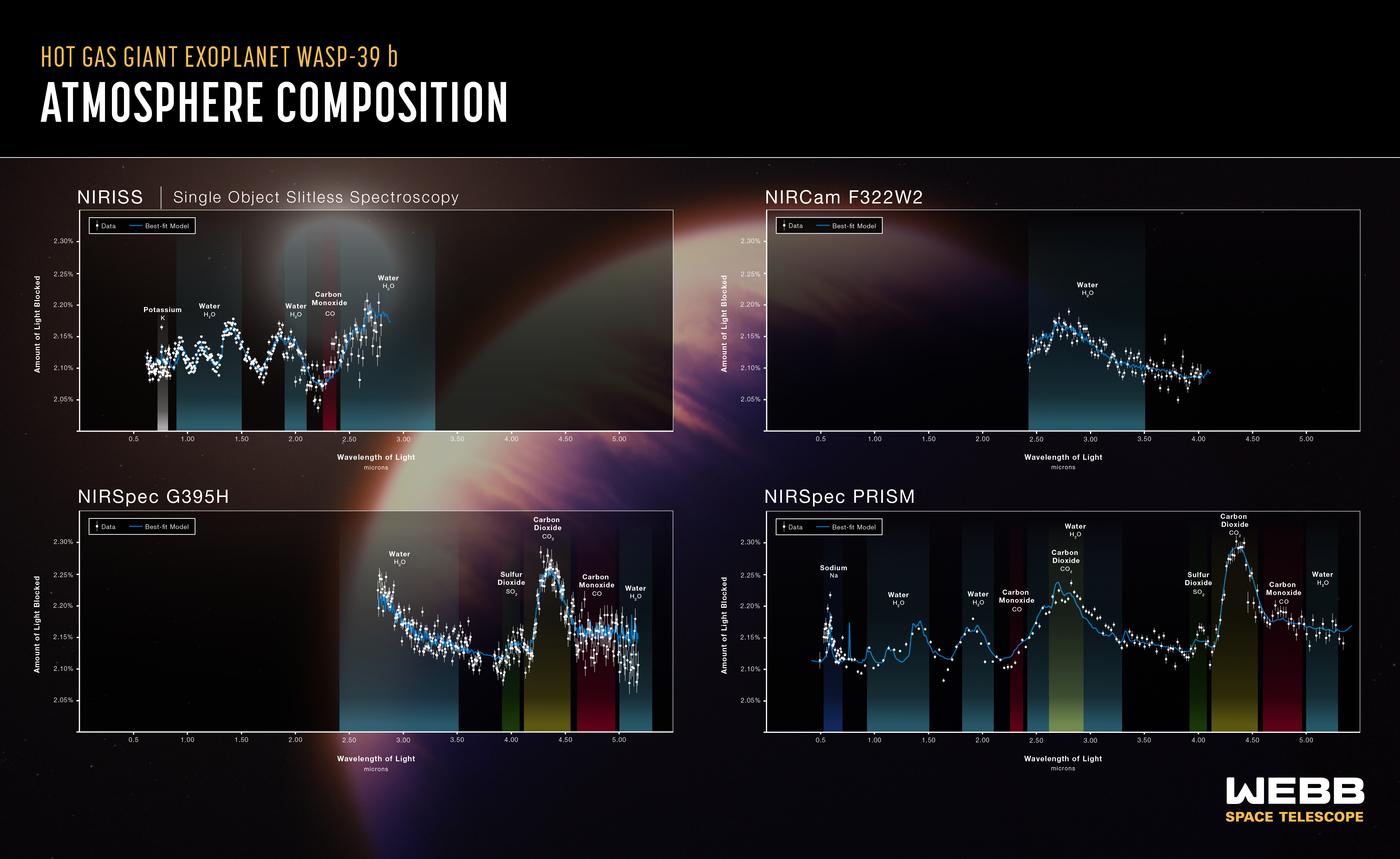
In 2022, JWST turned its instruments on WASP-39b, a hot gas giant roughly 700 light-years away, and produced the most detailed atmospheric portrait of any exoplanet to date. The results were extraordinary: clear detections of water vapour at 33 sigma significance, carbon dioxide at 28 sigma, sodium at 19 sigma, and carbon monoxide. Most unexpectedly, JWST detected sulphur dioxide, a molecule produced by photochemical reactions in the planet’s upper atmosphere. The telescope was not just cataloguing what was there. It was revealing active chemistry: a living atmosphere responding to its star’s ultraviolet radiation in real time.
JWST has also examined smaller, rockier targets. LHS 475 b, an Earth-sized planet 41 light-years away, became one of the first exoplanets independently confirmed by the telescope. Its transmission spectrum, however, showed no clear atmospheric features, suggesting either a very thin atmosphere, none at all, or an opaque cloud layer at high altitude. The TRAPPIST-1 planets have been studied closely too. Thermal observations confirmed that the two innermost worlds, TRAPPIST-1 b and c, lack thick atmospheres, consistent with bare rocky surfaces stripped by stellar radiation. TRAPPIST-1 e, sitting in the habitable zone, has yielded more tantalising but ambiguous results: early data hinted at methane, though subsequent analysis suggested the signal might be noise from the host star rather than a genuine detection. The question remains open, and more observation time has been allocated.
Perhaps the most provocative result so far belongs to K2-18 b, a sub-Neptune in the habitable zone of its star, about 120 light-years away. In late 2023, a research team reported detecting dimethyl sulphide (DMS) in its atmosphere at roughly three-sigma statistical significance. On Earth, DMS is produced almost exclusively by marine microorganisms, primarily phytoplankton. If confirmed at higher significance, it would be the strongest evidence yet of possible biological activity beyond our solar system. But the finding is contested: a separate analysis of the same JWST data suggested the signal could be instrumental noise, and the scientific community has called for 16 to 24 additional hours of observation before drawing conclusions. This is how the search for life proceeds: not with a single eureka moment, but with patience, repetition, and the rigorous elimination of every alternative explanation. You can read more about what JWST has found so far in the search for life.
What, exactly, are we looking for? The field of biosignature science has grown rapidly. Researchers have identified at least 15 potential biosignature gases: molecules whose presence in a planetary atmosphere would be difficult to explain without biology. Oxygen is the most famous candidate, but it can also be produced by non-biological processes such as water photolysis. Methane combined with oxygen is a stronger indicator, because the two gases react with each other and should not coexist in equilibrium unless something is continually replenishing them. DMS, phosphine, and certain chlorofluorocarbon compounds are on the list as well. The challenge is not merely detecting these molecules at interstellar distances. It is ruling out every non-biological pathway that could produce the same chemical signature.
We are not yet sure what the fingerprint of life looks like from 40 light-years away. We are getting remarkably good at looking.
The decades ahead will push further. ESA’s PLATO mission, scheduled to launch in late 2026, will survey bright, nearby stars for transiting rocky planets in habitable zones, with the precision to measure their masses, radii, and ages. NASA’s Nancy Grace Roman Space Telescope, with construction completed in late 2025 and launch expected by 2027, will use gravitational microlensing surveys to detect planets that transit methods miss, including rogue worlds drifting starless through the Milky Way. And early concept studies for a future Habitable Worlds Observatory aim to directly image Earth-like planets and analyse their atmospheres for signs of life: a capability that would have been unimaginable when Wolszczan first noticed something odd in the timing of a pulsar’s radio pulses in the early 1990s.
We have gone from zero confirmed exoplanets to more than six thousand in a single human generation. Every model we started with was wrong. The galaxy, it turns out, is brimming with worlds. Most of them are nothing like Earth. Some of them might be.
Somewhere out there, right now, starlight is filtering through an atmosphere we have not yet measured, carrying a chemical signature we have not yet learned to read.

