


“Orange!” Harrison Schmitt called out. It was December 11, 1972, and the Apollo 17 geologist had just stirred the lunar regolith with his boot at a small crater called Shorty. Something impossible was staring up at him from the surface of what everyone assumed was a grey world. His crewmate Gene Cernan echoed it back: “Orange!” The color was unmistakable. And it changed, quietly, everything.
The orange turned out to be volcanic glass: tiny spheres formed in ancient fire-fountain eruptions more than three billion years ago, carrying iron and titanium that had preserved their color through geological time. But the orange soil at Shorty Crater was not a one-off curiosity. It was a clue. The moon has been hiding its colors in plain sight ever since.
Grey Is Just the First Layer
To your naked eye, the moon appears as a study in grey and white. That impression is mostly accurate at human scales: the surface is dominated by fine-grained regolith, ground-up rock that reflects only 3 to 12% of the sunlight that hits it, giving the whole sphere a muted, monochrome quality from Earth.
But zoom in with the right instruments, and a different world emerges. The moon’s color varies systematically with its mineral composition, and those minerals tell a 4.5-billion-year story of volcanism, impacts, and slow chemical evolution.
The dark regions you can see from Earth, the maria (Latin for seas), are ancient lava plains composed of basalt. But not all basalt is identical. Mare Tranquillitatis, where Apollo 11 landed, is unusually rich in titanium oxide. Instruments on NASA’s Lunar Reconnaissance Orbiter and data from the Galileo spacecraft’s 1992 flyby both confirm: that sea is faintly blue. Not metaphorically. Measurably. In false-color and photometrically normalized imaging, it glows a distinct cobalt against the orange of lower-titanium maria like stretches of Oceanus Procellarum to the west.
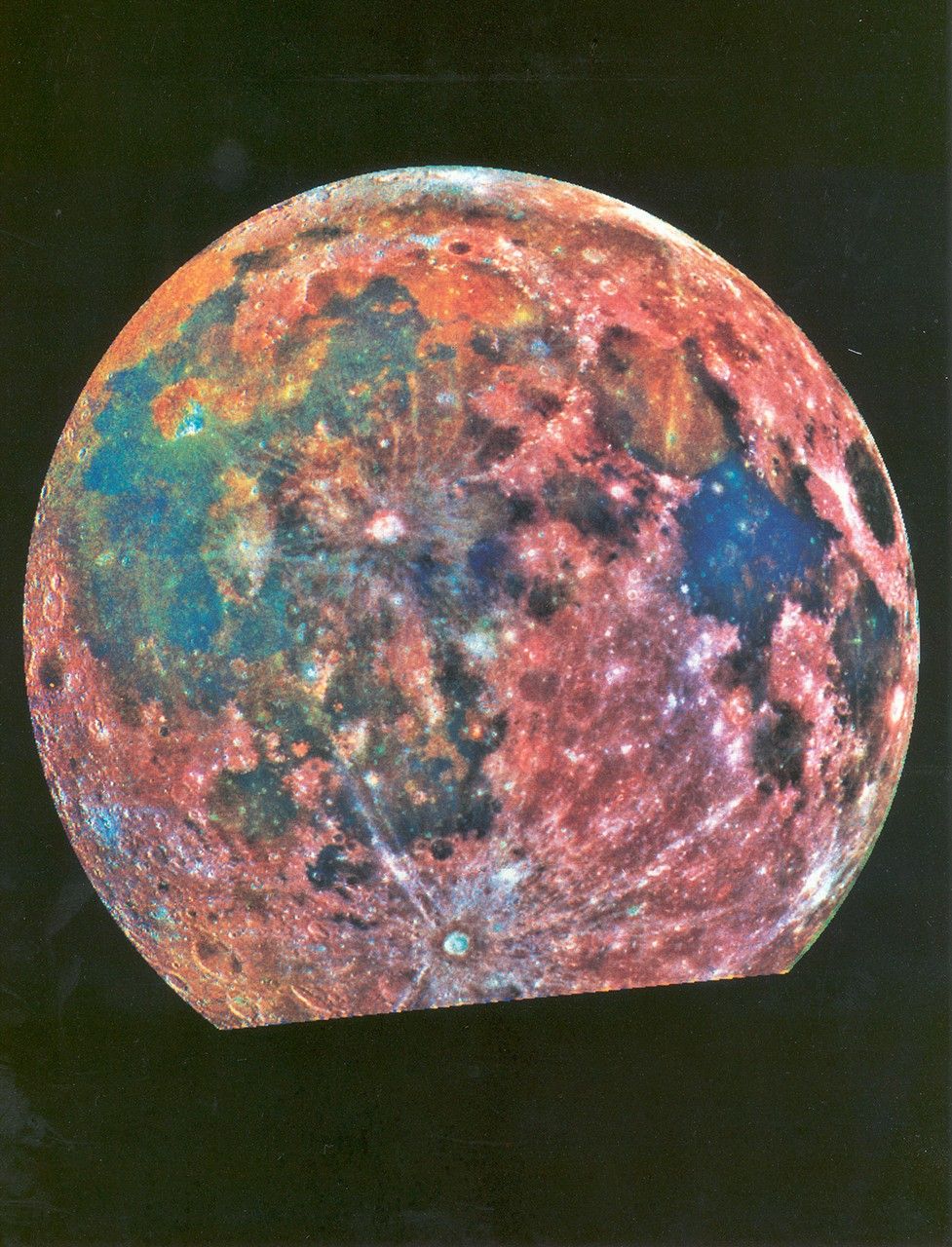
The pattern holds across the whole surface. Regions rich in olivine, a magnesium-iron silicate, carry a faint green. The bright highland terrain, terrae, is composed mostly of anorthosite, a pale calcium feldspar that reads as yellow-ochre under enhanced imaging. Ancient pyroclastic deposits, the remnants of explosive volcanic eruptions that predated even the basalt flooding of the maria, appear purple. The moon contains every color it has ever made. It just asks you to look carefully.
Artemis II Came Closer Than Anyone in 54 Years
On April 6, 2026, Commander Reid Wiseman, Pilot Victor Glover, and Mission Specialists Christina Koch and Jeremy Hansen flew the Orion spacecraft within 4,067 miles of the lunar surface during a seven-hour arc over the far side. It was the closest any human crew had come to the moon since Eugene Cernan left it in December 1972. The same month Harrison Schmitt found the orange soil.
The crew was not just sightseeing. One of their explicit scientific objectives was to document color, brightness, and texture variation across the terrain. These three variables are how geologists, from orbit or from the ground, read what a surface is made of without touching it. The Artemis II crew photographed Vavilov Crater on the Hertzsprung Basin rim, the ancient floor of the South Pole-Aitken Basin (one of the largest confirmed impact structures in the solar system), and Orientale Basin, 580 miles wide, 3.8 billion years old, and still containing excavated material from deep within the lunar interior.
They also reported watching six meteoroid impacts flash on the darkened lunar surface during a near-total solar eclipse. The moon, it turns out, is still being written.
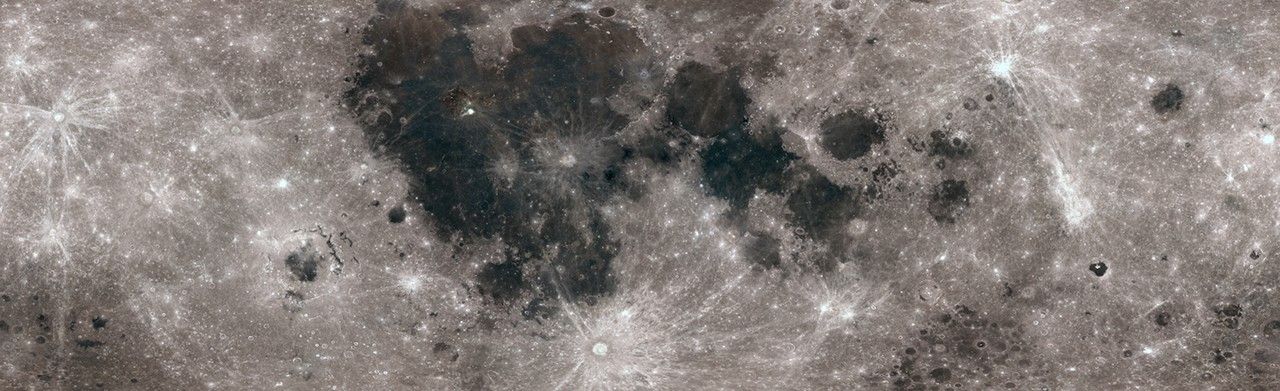
The Earthset image the crew captured that day shows the lunar surface as “grey-brown.” Not grey. Grey-brown: the honest color of a world made of iron and silica and volcanic history. The crescent Earth setting behind its cratered edge looks impossibly fragile by comparison.
What Comes Next
The full Artemis II image set is still being downlinked and processed as of this writing. The initial gallery reveals the far side features the crew documented, including the Hertzsprung Basin’s concentric mountain rings and the terminator-sharp shadows of Ohm Crater’s terraced walls. More images will follow.
Artemis III, which aims to land humans near the lunar south pole, will be the first crewed landing since Apollo 17. When those astronauts step out and look around, they will do so in an area we have never visited: a region of permanently shadowed craters, ancient ice deposits, and a geological record untouched for billions of years. They may find more orange. They may find more colors we have not named yet. What they see will change them, the way it changed everyone who has seen the lunar surface in person, which is 12 people in all of human history.
The full color image of the moon is still being taken.
Somewhere on the surface of the moon, three billion years ago, a volcanic vent opened and flung glass beads into the sky. They landed, cooled, and waited. In 1972, a geologist in a spacesuit kicked one with his boot and said: orange. That moment is still reverberating.

