

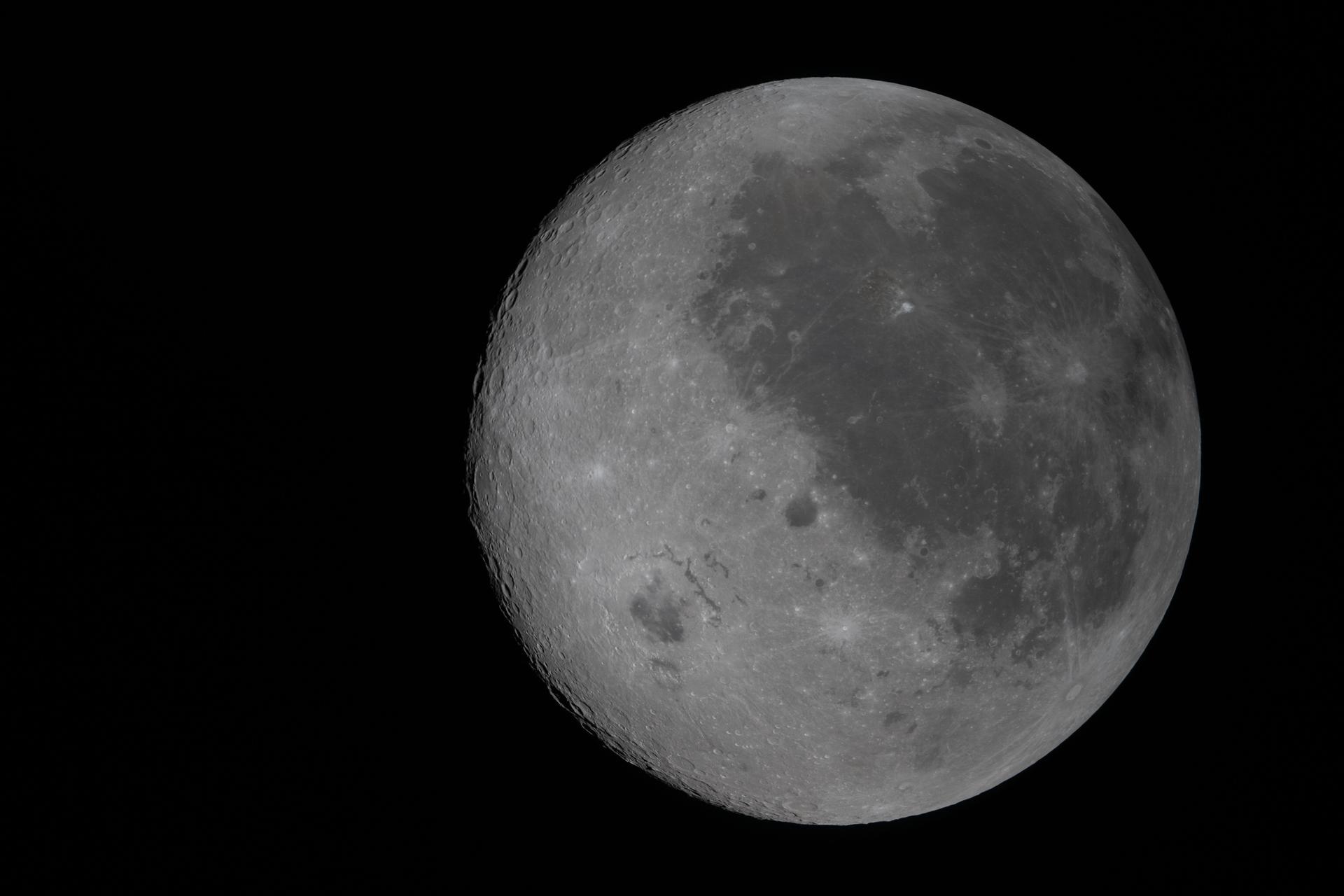
Go outside tonight and look at the Moon. You don’t need a telescope. The dark shapes are right there, pooling across the bright surface like ink on silver: sprawling patches that generations of observers took for water. They were wrong about the water. But the names they gave these places, the Sea of Tranquility, the Sea of Crises, the Ocean of Storms, have endured for nearly four centuries. And they are worth learning.
There are 22 named seas on the Moon, and one ocean. None of them hold a single drop. What they hold is something far older: billions of years of geological memory, written in basalt so dark you can see it with your bare eyes from 384,000 kilometres away. Each one fills an ancient wound, an impact basin gouged out by an asteroid, then flooded from below by molten rock that seeped up through fractures in the lunar crust. They are the Moon’s autobiography, written in stone. This is a complete guide to every named sea on the Moon: where to find them, how they formed, and which ones humanity has touched.
The technical term is maria, the plural of the Latin mare. They formed between 3.1 and 3.9 billion years ago, when the Moon was still hot enough to bleed. Enormous asteroid impacts excavated basins hundreds of kilometres across. Then, over hundreds of millions of years, iron- and titanium-rich basalt rose from deep inside the lunar interior and pooled in those basins, flow upon flow, until the plains reached depths of 500 to 1,500 metres. The basalt is darker than the pale highland rock (composed mostly of a mineral called anorthosite), which is why the Moon has its distinctive two-toned face.
Almost all the maria sit on the near side. The far side’s crust is thicker (up to 150 kilometres, compared with roughly 60 on the near side), which sealed the magma below and kept it from reaching the surface. Only three named seas exist on the far side of the Moon. Together, the maria cover roughly 16 percent of the lunar surface, but they account for almost everything you recognise when you look up.
Most of the names come from the Italian astronomer Giovanni Riccioli, whose 1651 lunar map replaced earlier schemes by Michael van Langren and Johannes Hevelius and gave us the nomenclature the International Astronomical Union still uses today. Riccioli chose names that are evocative and slightly melancholic: Serenity, Tranquility, Crises, Storms. Whether he intended a philosophical statement about the Moon is debated, but the result is a lunar geography that reads like a map of human feeling.
The 22 Seas of the Moon
Here is every named sea and ocean on the Moon, grouped by the region where you’ll find them.
The Western Expanse
Start in the west, where the largest dark plain on the Moon dominates the view. Oceanus Procellarum, the Ocean of Storms, is the only lunar sea classified as an oceanus rather than a mare. It stretches 2,592 kilometres across the western near side, larger than the Mediterranean, with no single impact basin to contain it. Current models suggest it formed over a network of ancient rifts rather than from one colossal collision. Apollo 12 set down on its southeastern edge in November 1969, making it the second place humans ever walked on another world. In December 2020, China’s Chang’e 5 scooped samples from its northern reaches, the first lunar sample return mission in 44 years. Analysis of those samples revealed some of the youngest volcanic rock ever found on the Moon: just 2 billion years old, proof that the Moon’s interior stayed active far longer than anyone expected.
Bordering Procellarum to the northeast is Mare Imbrium, the Sea of Rains (1,146 km), the mare that gives this publication its name. It fills one of the last great impact basins carved during the Late Heavy Bombardment, a collision so violent it scattered ejecta across the entire near side and left mountain ranges (the Apennines, the Carpathians, the Alps) ringing the scar. Apollo 15 explored its southeastern edge in 1971, and China’s Chang’e 3 landed on its surface in 2013. We have written about the Sea of Rains in detail.
Between these two giants lie three smaller seas. Mare Insularum, the Sea of Islands (512 km), takes its name from the highland “islands” that poke above its lava like mountaintops above a flood. Mare Cognitum, the Known Sea (350 km), earned its name in 1964 when NASA’s Ranger 7 became the first American spacecraft to photograph the lunar surface up close, transmitting more than 4,300 images in the final 17 minutes before impact. And Mare Humorum, the Sea of Moisture (420 km), sits in a nearly circular basin whose floor still shows ghostly outlines of older craters buried beneath the lava.
South of them all spreads Mare Nubium, the Sea of Clouds (715 km). Its heavily cratered surface suggests the basalt here is among the oldest of the maria, some of the first lava to ever reach the surface.
The Eastern Arc
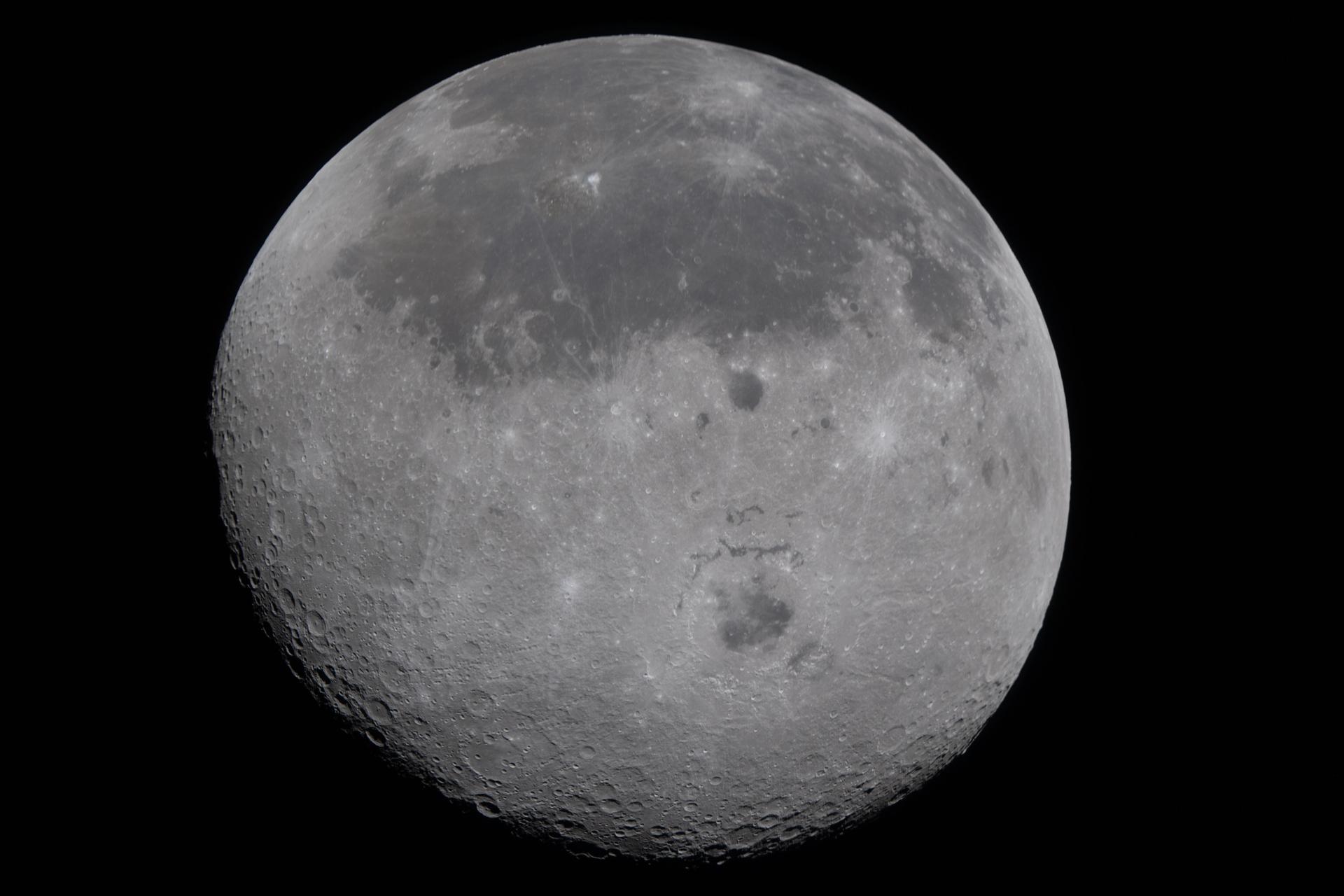
Turn east and you reach the most historically significant cluster of seas on the Moon.
Mare Tranquillitatis, the Sea of Tranquility (876 km), needs little introduction. On July 20, 1969, Apollo 11’s lunar module Eagle touched down on its surface, and Neil Armstrong stepped onto basalt that had not been disturbed for 3.6 billion years. The regolith here is unusually rich in titanium, giving Tranquillitatis a faintly blue-grey tint that, through a telescope, sets it apart from its paler neighbours. When you look at the Moon with the naked eye, it is one of the largest and most central dark patches you can see.
Bordering Tranquillitatis to the north is Mare Serenitatis, the Sea of Serenity (674 km). Through a good telescope you can trace concentric rings of subtly different shades across its floor: evidence of separate eruptions that flooded the basin at different times over hundreds of millions of years. Apollo 17, the last crewed mission to the Moon, explored the valley of Taurus-Littrow on its southeastern edge in December 1972. There, geologist-astronaut Harrison Schmitt discovered orange volcanic glass beads in the soil, evidence of ancient fire fountains erupting from the lunar interior billions of years before humans existed to see them.
Standing isolated near the eastern limb, like a dark, watchful eye, is Mare Crisium, the Sea of Crises (556 km). Its nearly circular shape and sharp mountainous rim make it one of the easiest maria to spot with the naked eye. The Soviet Luna 24 mission drilled into its floor in 1976 and returned samples to Earth, the last extraterrestrial sample return mission of the twentieth century.
Southeast of Tranquillitatis stretches Mare Fecunditatis, the Sea of Fecundity (840 km). In September 1970, the Soviet Luna 16 achieved a milestone here: the first robotic sample return from another world, scooping 101 grams of regolith from the surface and delivering it safely to Earth in a small re-entry capsule.
The arc closes with Mare Nectaris, the Sea of Nectar (339 km), a small, well-defined basin with concentric rings preserved almost as clearly as the day its lava cooled.
The Northern Reach and the Centre
Mare Frigoris, the Sea of Cold (1,446 km), is the longest mare on the Moon, but also among the narrowest. It stretches in an elongated band across the high northern latitudes like a dark scarf draped over the pole, an unusual shape that suggests it formed from multiple connected basins rather than a single impact.
Mare Humboldtianum, the Sea of Humboldt (231 km), hides against the northeastern limb, named for the Prussian naturalist Alexander von Humboldt. It reveals itself only when the Moon’s gentle wobble (called libration) tilts it into view, making it one of the most elusive seas to observe from Earth.
Near the centre of the near side, close to the Apennine Mountains, sits Mare Vaporum, the Sea of Vapors (242 km). Small and easy to overlook, its central position makes it a useful landmark for anyone navigating the lunar surface through a telescope.
The Limb Seas
Six small maria cling to the edges of the visible disk, on the boundary between the familiar near side and the hidden far side. They appear and disappear with the Moon’s libration: sometimes visible, sometimes not, always at the mercy of perspective.
Mare Marginis, the Sea of the Edge (358 km), and Mare Smythii, Smyth’s Sea (374 km), sit along the eastern equatorial limb. Both are partly on the far side, visible only when the Moon tips slightly in our direction. Smythii is named for the British astronomer William Henry Smyth, who catalogued it in the 1830s.
Mare Australe, the Southern Sea (997 km), is the largest limb mare and one of the most unusual. It is not a single flooded basin but a collection of filled craters that blur together into a diffuse dark region along the southeastern limb, so spread out that it barely registers as a single feature.
Three small seas cluster near Mare Crisium on the eastern near side. Mare Anguis, the Serpent Sea (146 km), is a thin sliver to the northeast. Mare Undarum, the Sea of Waves (245 km), is a patchwork of dark pools to Crisium’s east. And Mare Spumans, the Foaming Sea (143 km), is the smallest recognised mare on the Moon: a modest dark oval tucked between Undarum and Fecunditatis.
The Far Side
Three maria lie hidden on the far side of the Moon, invisible from Earth. No one knew they existed until the Space Age.
Mare Moscoviense, the Sea of Moscow (276 km), was discovered in October 1959 when the Soviet Union’s Luna 3 probe transmitted the first photographs ever taken of the Moon’s far side. The Soviets named it after their capital. It remains one of the few substantial basalt plains on the far hemisphere, a stark reminder of how unusual the near side’s volcanic flooding truly is.
Mare Ingenii, the Sea of Cleverness (282 km), lies in the southern far side. Its surface carries mysterious bright swirl patterns, similar to the Reiner Gamma formation on the near side, which scientists believe are created by localised magnetic fields shielding the regolith from the darkening effects of the solar wind.
Mare Orientale, the Eastern Sea (294 km), is the most dramatic. It sits on the extreme western limb; its name is a relic of old telescopic conventions that placed east on the opposite side from modern maps. In spacecraft imagery, Orientale reveals itself as a bullseye: concentric rings of mountains and valleys marking the impact that created it roughly 3.8 billion years ago. It is one of the youngest and best-preserved large impact structures in the solar system. And last week, the Artemis II crew became the first humans to see it in full.
What Artemis II Saw
On April 6, 2026, four astronauts aboard Orion saw the seas of the Moon from a vantage point no living person had held before.
The Artemis II crew, Commander Reid Wiseman, Pilot Victor Glover, Mission Specialist Christina Koch, and Canadian Space Agency astronaut Jeremy Hansen, flew within roughly 6,500 kilometres of the lunar surface during a seven-hour flyby. They swept over the near side and behind the far side, setting a new human spaceflight distance record of approximately 406,700 kilometres from Earth, surpassing Apollo 13’s 1970 mark by more than 6,500 kilometres.
From that proximity, the crew reported something that photographs had only hinted at: the maria, so uniformly dark when viewed from Earth, revealed subtle gradients of brown and blue visible to the naked eye. Those colour differences correspond to variations in mineral composition and eruption age, layers of geological history that ground-based telescopes flatten into a single shade of grey. The crew were, in that moment, reading the Moon’s geological record with their own eyes.
They observed 30 surface targets during the flyby. They described the full expanse of the Orientale Basin for the first time as human witnesses. They studied the bright swirl of Reiner Gamma on Oceanus Procellarum (a candidate for a future landing site), and the 400-kilometre-wide Hertzsprung Basin on the far side. They named two previously unnamed craters: Integrity, after their spacecraft, and Carroll, in memory of Commander Wiseman’s late wife. As Hansen put it from beyond the Moon: “We will continue our journey even further into space before Mother Earth succeeds in pulling us back.”
During the flyby, the crew watched Earth disappear behind the lunar horizon and re-emerge on the other side. They witnessed a solar eclipse from the Moon’s shadow, the Sun’s corona blazing around the dark lunar limb, and documented six meteoroid impacts as flashes of light on the unlit surface. It was the kind of perspective shift that astronauts have struggled to articulate for decades: a feeling that begins with seeing a familiar world from an unfamiliar place, and ends with the quiet recognition that the place you left is very, very small.
For a closer look at the crew’s observations, read our coverage of what Artemis II saw up close.
These seas are not just scenery. They are where we have landed, and where we will return. Five of the six Apollo missions that reached the surface touched down on or beside the maria. Future missions will push beyond them. NASA’s Artemis programme is targeting the lunar south pole for its first crewed landing, currently planned as Artemis IV in 2028, where permanently shadowed craters may hold water ice and nearby ridgelines offer near-continuous solar power. The south pole sits far from any named sea, deep in the ancient battered highlands.
But the maria will remain essential. Their basalt records the thermal evolution of the Moon’s interior. Their crater counts calibrate the timeline scientists use to date surfaces across the entire solar system. And as landmarks, landing sites, and resource regions, the seas of the Moon will shape the geography of the next era of human exploration, just as they shaped the first.
Tonight, when the Moon rises, you will see them: the same dark shapes that Galileo sketched, the same basalt plains where Armstrong walked, the same ancient floods that four astronauts flew over this week. They have been waiting three billion years. They are patient.

