

You grew up with nine planets. You learned their names in order, probably to a mnemonic, probably before you were ten. Mercury, Venus, Earth, Mars, Jupiter, Saturn, Uranus, Neptune, Pluto. The ninth one was always the smallest, always the strangest, always the one at the edge. And then, on a single afternoon in Prague, 424 astronomers took it away.
But here is the part they never explained: Pluto’s demotion was not a bureaucratic accident, nor a petty squabble among scientists. It was the consequence of a discovery so significant that it forced us to ask a question we thought we had answered centuries ago. What is a planet? And the person who triggered that question spent years searching for exactly the thing he found, knowing that finding it might kill the solar system he loved.
This is the story of how we lost a planet. Or, more accurately, how we found a solar system.
A Farm Boy and a Blink Comparator
In 1928, a hailstorm hit the Tombaugh family farm in Burdett, Kansas, and wiped out the crops. With them went the money that would have sent 22-year-old Clyde Tombaugh to college. Born on February 4, 1906, in Streator, Illinois, Tombaugh had grown up moving between farms, watching the skies from fields where the horizon never ended. He had no formal training in astronomy. What he had was patience, obsession, and a talent for building things with his hands.
On the Kansas farm, he dug a 24-foot underground testing room in the dirt behind the farmhouse, where he ground lenses and mirrors by hand. He built a 9-inch Newtonian reflector telescope from spare parts and used it to make detailed drawings of Mars and Jupiter, capturing the banding on Jupiter’s atmosphere and the polar caps on Mars with a precision that belied his lack of credentials. In a moment of hopeful ambition, he mailed those drawings to Lowell Observatory in Flagstaff, Arizona, asking for feedback.
They offered him a job instead.
Lowell Observatory had been searching for “Planet X” since the early 1900s, following a prediction by astronomer Percival Lowell that gravitational perturbations in the orbits of Uranus and Neptune pointed to an unseen world beyond. Tombaugh was hired to do the tedious, painstaking work of photographing the night sky and comparing the images. Starting in April 1929, he used the observatory’s 13-inch astrograph to photograph the same strip of sky on different nights, then examined pairs of photographs through a blink comparator, a device that rapidly alternated between two images. Stars, being unimaginably far away, stayed fixed. Anything in our solar system would appear to jump.
On February 18, 1930, Tombaugh was comparing two plates taken on January 23 and January 29. A tiny dot moved. He was 24 years old, a farm boy with no degree, and he had just discovered the ninth planet.
The world fell in love immediately. The name came from an 11-year-old girl in Oxford, England. Venetia Burney was eating breakfast with her grandfather, Falconer Madan, a retired librarian at the Bodleian Library, when they read the morning papers. She suggested Pluto, the Roman god of the underworld: ruler of the cold and the dark, capable of making himself invisible. The name was formally adopted on May 1, 1930. Tombaugh himself liked it; the first two letters, P and L, were also the initials of Percival Lowell.
For 76 years, Pluto held its place. It appeared on every classroom wall chart, in every textbook diagram, in every mnemonic a child would ever memorize. It was small. It was distant. It was peculiar. And it was ours.
The Belt Beyond Neptune
Then the universe, as it tends to do, turned out to be bigger than we thought.
Astronomers had long suspected that Pluto might not be alone in the outer solar system. In 1951, Dutch-American astronomer Gerard Kuiper theorized that a belt of icy debris might exist beyond Neptune, left over from the formation of the solar system. For decades, the theory remained untested. The objects, if they existed, would be small, faint, and achingly far away.
On August 30, 1992, David Jewitt and Jane Luu, working at Mauna Kea Observatory in Hawaii, found the proof. An object designated 1992 QB1 (later named 15760 Albion) was confirmed as the first body in the Kuiper Belt beyond Pluto and its moon Charon. It was roughly 160 kilometres across; tiny, ancient, and profoundly important. It meant the outer solar system was not empty. It was full of things we simply hadn’t been able to see.
Within a decade, hundreds of Kuiper Belt objects had been catalogued. By 2018, the count exceeded 2,000. Pluto was no longer an outlier at the edge of the solar system; it was the largest known member of a vast population. And the discoveries kept getting bigger.
Quaoar, found in 2002, was about half the diameter of Pluto. Sedna, discovered in 2003, followed a staggering elliptical orbit that carries it more than 900 astronomical units from the Sun at its farthest point (for context, Pluto orbits at roughly 40 AU; at 900 AU, the Sun is just another bright star). Haumea, identified in 2004, spins so rapidly that gravity has flattened it into a shape resembling a rugby ball, completing a full rotation in under four hours. Makemake, found in March 2005, is one of the brightest objects in the Kuiper Belt.
And then came the one that changed everything.
Mike Brown, a planetary astronomer at the California Institute of Technology, had been systematically surveying the outer solar system with his colleagues Chad Trujillo and David Rabinowitz, using the 1.2-metre Samuel Oschin Telescope at Palomar Observatory in Southern California. On January 5, 2005, Brown was reviewing images his team had captured on October 21, 2003, when he noticed something. A dot, moving against the background stars. Moving slowly. The kind of slowly that means very, very far away.
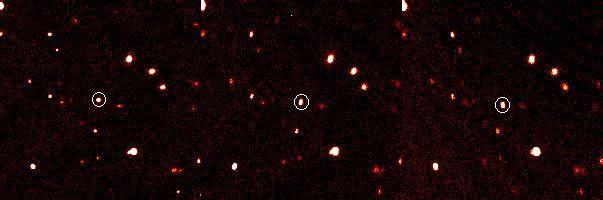
It was a world. And it was more massive than Pluto.
Brown’s team had found Eris: a dense, icy body 27% more massive than Pluto, orbiting in the scattered disc beyond the Kuiper Belt. The discovery was announced on July 29, 2005. (Years later, when NASA’s New Horizons spacecraft flew past Pluto in July 2015, it revealed that Pluto was slightly larger by diameter: 2,370 kilometres compared to Eris’s 2,326. But Eris, denser and rockier, remains the heavier of the two.)
Brown understood immediately what he had done. If Eris was a planet, then the solar system had ten planets, and counting. If Eris was not a planet, then neither was Pluto. There was no clean middle ground. He had found the thing he had spent his career searching for, and it had broken the map.
424 Hands in Prague
The International Astronomical Union convened its 26th General Assembly in Prague on August 14, 2006. The conference was supposed to be a celebration: new results, new instruments, new collaborations. But the question of Eris, and of Pluto, had made the gathering electric. For ten days, astronomers debated what should have been a straightforward question. It was not.
The initial proposal would have expanded the planetary club, keeping Pluto and adding Eris, Ceres, and even Pluto’s moon Charon to the roster. Opponents argued this was absurd; the solar system could end up with dozens of planets, a number that would grow every year as new objects were found. The counter-proposal was more radical: redefine what a planet actually is, and let the chips fall.
On August 24, the final day of the assembly, the IAU put it to a vote. The room had thinned dramatically. Of the roughly 2,500 astronomers who had attended the conference, only 424 remained, less than 5% of the IAU’s total membership of nearly 10,000. It was the last afternoon of a long meeting in a beautiful city. Many had already left for the airport.
Those 424 raised their hands and changed the solar system. The vote that reshaped every textbook on Earth was decided by fewer people than attend an average rock concert.
Resolution 5A passed by a wide margin. A planet, they decided, must meet three criteria: it orbits the Sun; it has sufficient mass for its own gravity to pull it into a roughly spherical shape; and it has “cleared the neighbourhood” around its orbit. That third criterion was the blade. Pluto, sharing its orbital zone with thousands of other Kuiper Belt objects, had not cleared its neighbourhood. It never could.
Resolution 6A followed: 237 votes in favour, 157 against, 17 abstentions. Pluto was reclassified as a dwarf planet, a new category that also included Eris and the asteroid belt’s largest resident, Ceres.
The public response was swift and furious. Schoolchildren wrote letters of protest. The state of New Mexico, honouring Clyde Tombaugh, who had spent the later decades of his career at New Mexico State University in Las Cruces, passed House Joint Memorial 54 in March 2007. It declared that Pluto would always be considered a planet while in New Mexican skies, and designated March 13, 2007, as “Pluto Planet Day.” (The memorial was non-binding, a “feeling of the House,” but the feeling was sincere.) The date was chosen because March 13 is the birthday of Percival Lowell, the man whose prediction had set Tombaugh searching in the first place.
And Mike Brown? He leaned into the role. He titled his 2010 memoir How I Killed Pluto and Why It Had It Coming. His handle on social media is @plutokiller. He has never apologized, because he does not believe there is anything to apologize for. “Pluto is dead,” he once said. But what replaced it, he would argue, is more interesting than what we lost.
The definition remains contested. Planetary scientist Alan Stern, the principal investigator on the New Horizons mission, has argued for years that the IAU’s “clearing the neighbourhood” criterion is scientifically dubious and that Pluto, Eris, and hundreds of similar bodies should all be considered planets. The debate is not over. It may never be.
But the map has already changed.
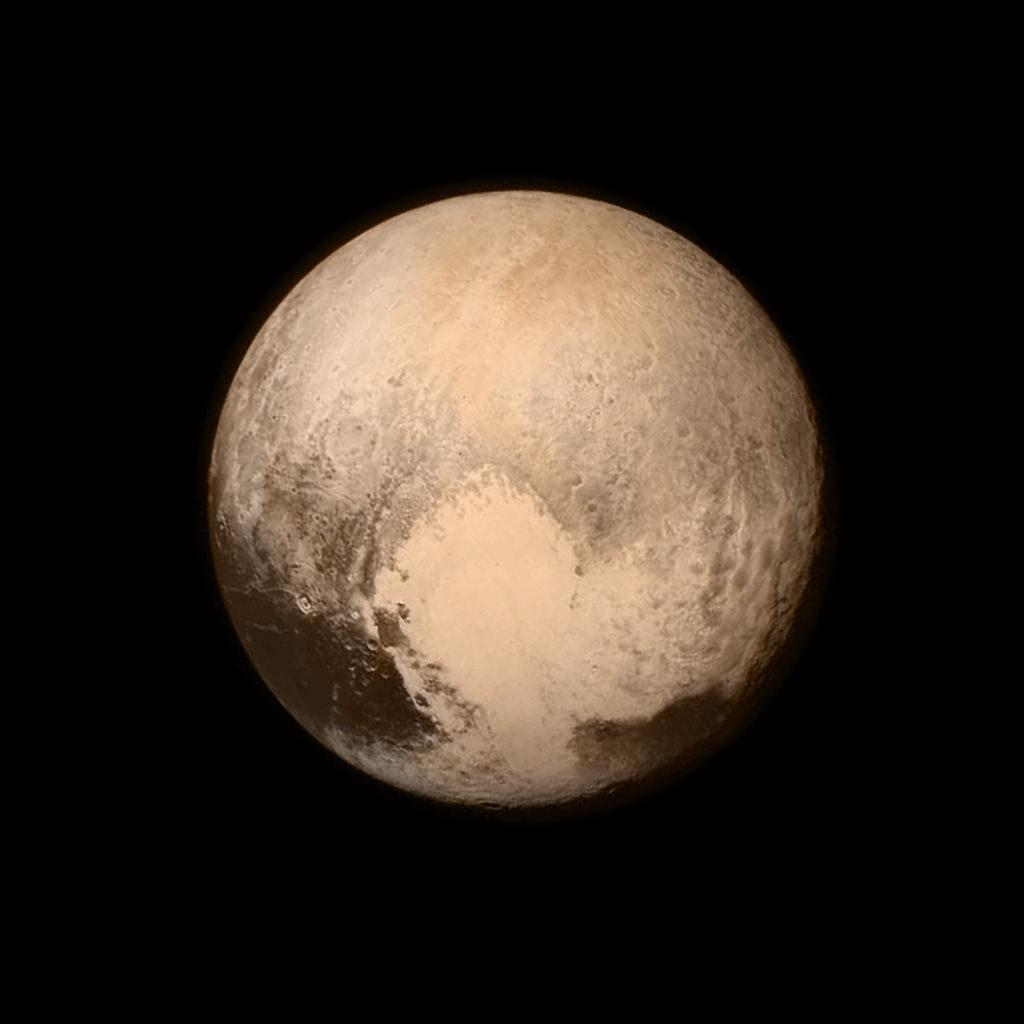
When New Horizons reached Pluto on July 14, 2015, it sent back images that silenced any remaining question about whether Pluto was interesting enough to deserve our attention. The heart-shaped region now called Tombaugh Regio, named for the farm boy who found this world 85 years earlier, turned out to be a vast plain of nitrogen ice called Sputnik Planitia. It is geologically active. Mountains of water ice rise three kilometres into a thin, hazy atmosphere of nitrogen and methane. There are glaciers. There may be a subsurface ocean. Pluto has weather. Pluto has geology. Pluto has a sky that glows blue when the Sun sets behind it.
Whether you call it a planet or a dwarf planet, it does not care. It simply is.
The nine-planet solar system was a story we told ourselves for convenience: a tidy diagram on a classroom wall, a mnemonic with a punchline. The real solar system is wilder, stranger, and more crowded than any of that. Understanding it requires something like the shift in perspective that astronauts describe when they first see Earth from orbit, except in reverse: instead of seeing your world as small, you learn that everything around it is immeasurably fuller than you imagined. Beyond Neptune, stretching out into distances that make even lightyears feel small, there are hundreds of worlds we have only begun to catalogue. Eris, Sedna, Makemake, Haumea, Quaoar, and thousands more, each with its own orbit, its own composition, its own frozen, patient history.
Clyde Tombaugh died in 1997, nine years before the vote, so he never had to watch Pluto lose its title. But a small portion of his ashes travelled aboard New Horizons, tucked inside the spacecraft in a two-inch aluminium container. On July 14, 2015, he became the first human to visit the world he had discovered. In a way, he was the last person on Earth who could say he had been there.
We did not lose a planet. We found a solar system.

