

Right now, four human beings are farther from Earth than any person has been in 53 years. They are watching the Moon grow in the window of their spacecraft — close enough, Christina Koch reported from deep space, to see it clearly through the docking hatch. “A beautiful sight,” she called it — which is perhaps the most understated thing you could say about being a quarter-million miles from everything you’ve ever known.
That is where Artemis II is today. And after more than half a century, humanity is on its way back.
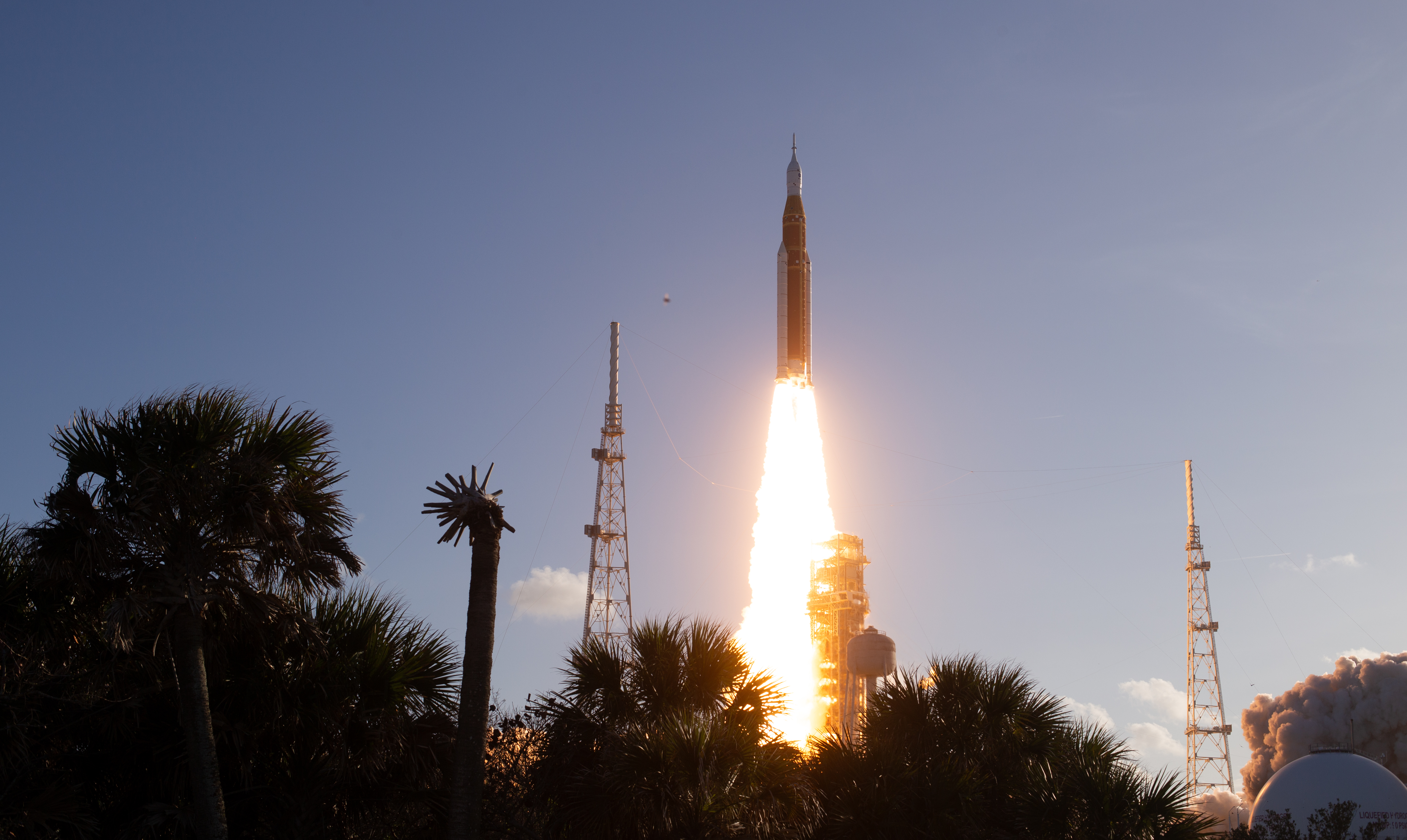
NASA’s Orion spacecraft lifted off from Launch Pad 39B at Kennedy Space Center on April 1, 2026, at 6:35 p.m. EDT, carrying Commander Reid Wiseman, Pilot Victor Glover, and mission specialists Christina Koch and Jeremy Hansen of the Canadian Space Agency. The Space Launch System — the most powerful rocket NASA has ever flown with a crew — sent them first into Earth orbit, then on a translunar injection burn that placed them on a free-return trajectory around the Moon. The moment that burn completed, they became the first humans to leave Earth’s orbit since December 1972.
On April 6, Orion will reach its closest approach to the Moon, beginning a multi-hour flyby at approximately 2:45 p.m. EDT. The crew will photograph and observe the lunar surface — including regions of the far side that human eyes have rarely seen from this proximity. At 7:05 p.m., they will reach maximum distance from Earth: 252,757 miles. That surpasses the previous record of 248,655 miles, set by the Apollo 13 crew in April 1970 during their emergency free-return following an oxygen tank explosion. This crew chose their trajectory.
Fifty-Three Years Is a Long Time to Wait
The last humans to travel beyond low Earth orbit were Harrison Schmitt and Eugene Cernan, who splashed down from the Moon on December 19, 1972, aboard Apollo 17. Schmitt — still alive, still watching — offered his advice to the Artemis II crew before launch: “Every day, every hour, every minute, is a new experience.”
He would know. And now, for the first time in over five decades, others can too.
Artemis II is a rigorous technical demonstration: Orion’s life support systems are being proved with a full crew for the first time, deep-space communications and emergency procedures exercised in the actual environment rather than a simulator. Each verification is a prerequisite for Artemis III, the mission that will land humans on the lunar south pole for the first time. Nothing gets skipped.
But the mission carries a human weight that engineering checklists cannot fully hold. Victor Glover is the first person of color to travel beyond low Earth orbit. Jeremy Hansen is the first non-American. Christina Koch is the first woman. Commander Wiseman becomes the oldest person to make the journey. Every one of them has crossed a threshold that was sealed for over half a century — and in doing so, has expanded the definition of who this story belongs to.
The psychological literature on what happens to people who see Earth from distance — what astronauts call the overview effect — has been written almost entirely by people who never got farther than low orbit. Artemis II is about to generate new testimony from a very different vantage point.
What Comes Next
After the lunar flyby on April 6, Orion will use the Moon’s gravity to redirect toward home. Splashdown in the Pacific Ocean is targeted for approximately April 11, 2026. Recovery teams aboard the USS San Diego are already in position.
The physiological and psychological data gathered on this flight will feed directly into Artemis III planning, currently targeting the lunar south pole in 2027 with a SpaceX Starship Human Landing System. That mission, if it flies, would place human bootprints on the Moon for the first time since Cernan climbed the last rungs of the Challenger ascent ladder in 1972. NASA Administrator Jared Isaacman put it plainly at launch: “Artemis II is the start of something bigger than any one mission. It marks our return to the Moon, not just to visit, but to eventually stay.”
Somewhere out past the orbit of everything familiar, right now, four people are watching the Earth shrink behind them — and the Moon draw close.

