

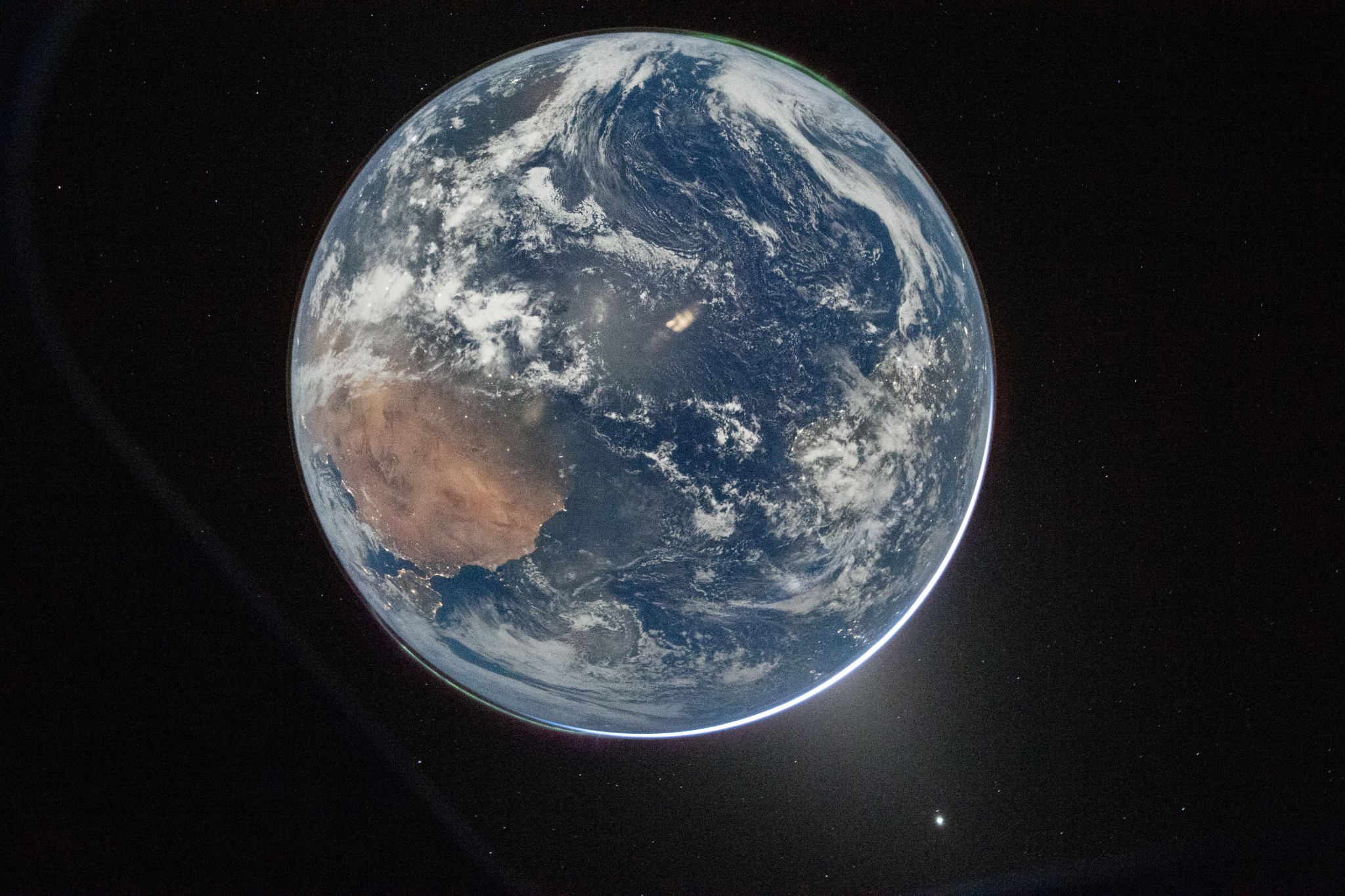
Right now, four humans are hurtling toward the Moon. By tomorrow afternoon, they will be closer to the lunar surface than anyone has been since the last Apollo astronauts lifted off in December 1972 — not touching it, but close enough to see crater rims sharpened by ancient impacts, lava plains frozen mid-flow, and the shadow-carved far side that human eyes have never directly observed. Tomorrow is the moment the Moon stops being background scenery and becomes a destination again.
On Monday, April 6, beginning at 2:45 PM EDT, the Orion spacecraft will enter its lunar flyby window — a nearly seven-hour stretch during which the crew’s windows will be oriented toward the Moon and four people will conduct the closest sustained human observation of another world in over half a century. The flyby window closes at 9:40 PM EDT.
At approximately 7:02 PM EDT, Orion will reach closest approach: 4,066 miles above the lunar surface. Three minutes later, at 7:05 PM, the spacecraft will cross a threshold that has stood for 56 years — becoming the farthest humans have ever traveled from Earth. The crew will reach 252,757 miles from home, breaking the record set by the Apollo 13 crew in April 1970 by more than 4,100 miles. Jim Lovell and his crewmates set that record not in triumph but in crisis, swinging around the Moon on a crippled spacecraft to get home alive. Reid Wiseman, Victor Glover, Christina Koch, and Jeremy Hansen will surpass it on a fully operational ship, looking out the window by choice.
The crew itself carries a weight of history beyond distance. Victor Glover becomes the first person of color to travel beyond low Earth orbit. Christina Koch becomes the first woman. Jeremy Hansen — flying for the Canadian Space Agency — becomes the first non-U.S. citizen. Commander Reid Wiseman is the oldest person to make the journey. In a single crew, Apollo’s unfinished business takes a visible step forward.
What They Will See
Artemis II is not a landing mission. Orion carries no lunar lander — that comes with Artemis III, planned for the Moon’s south polar region. What this mission is, instead, is a human-crewed systems test conducted at full scale: every life-support system, navigation loop, and communications link operating with four people inside, in deep space, under real conditions. But “systems test” undersells what’s actually happening tomorrow.
During the flyby, the crew will photograph ancient impact craters, lava flows, and surface ridges — high-resolution imagery that no Earth-based telescope can match. They will observe a solar eclipse from space, the Moon blocking the Sun for roughly an hour, and analyze the solar corona from an unobstructed vantage unavailable from Earth’s surface. They will see the far side of the Moon — the perpetually Earth-hidden hemisphere — with their own eyes. One pass over the Orientale basin will mark the first time any human has directly observed that structure.
For roughly 40 minutes, beginning around 5:47 PM EDT, Orion will disappear behind the far side and fall silent. Communications severed. Four people unreachable, alone with the oldest object in the night sky. What happens to a person in that silence is difficult to describe from the outside. Astronauts who have experienced even a fraction of that distance speak of a perceptual shift — a recalibration of what “home” means when you can see the whole of it through a window. Researchers call it the Overview Effect. Tomorrow, four people will feel its lunar equivalent, looking out at a world humans once walked on and then, for half a century, simply stopped visiting.
What Comes After
After closest approach, Orion will use the Moon’s gravity to slingshot toward its maximum distance from Earth before beginning the long arc home. Splashdown is expected around April 10, off the coast of San Diego. NASA engineers will then spend months analyzing data from every system Orion operated during the mission — thermal performance, propulsion margins, life support endurance, communications reliability through deep-space blackouts.
Artemis III — the crewed landing — depends on that analysis going well, and on the Human Landing System completing its own qualification milestones. No landing date is set. But the direction of travel is unmistakable. Artemis II is not the destination. It’s the proof that the destination is reachable.
The Moon has been waiting fifty-three years. Tomorrow, it finally gets visitors again.

