


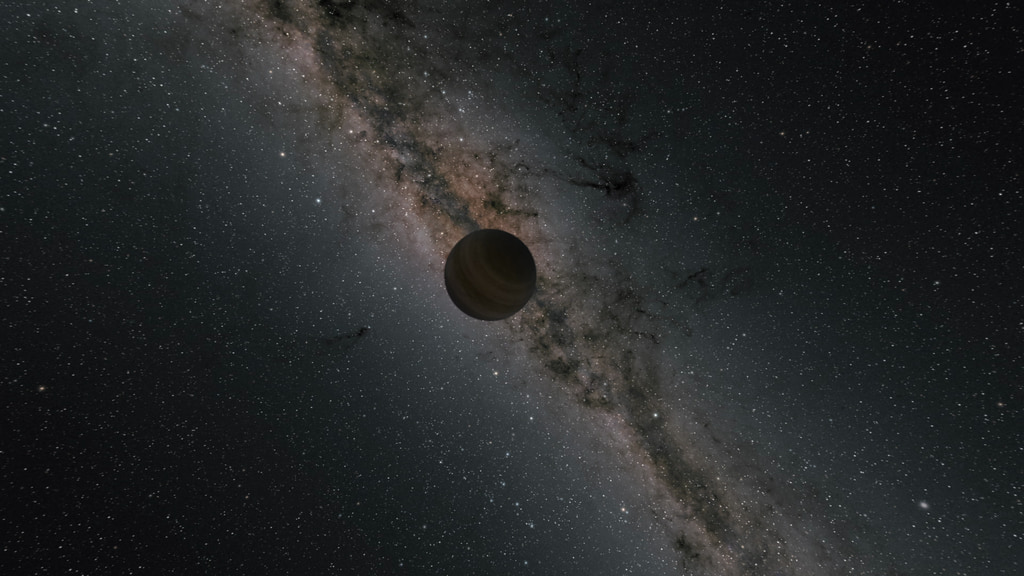
Somewhere in the dark between the stars, a planet the size of Jupiter is drifting alone. It has no sun. No orbit. No seasons. It has been falling through interstellar space for billions of years, and it will never stop. This is not rare. There may be more of these wandering worlds in our galaxy than there are stars.
We call them rogue planets: worlds unbound from any star, moving through the Milky Way in perpetual night. They were not born this way. Most were flung from their home systems during the violent, gravitational chaos of early planetary formation, ejected by encounters with larger siblings before they could settle into a stable orbit. Once cast out, they drift at temperatures close to absolute zero, invisible to optical telescopes, detectable only through the faint bending of light they cause when they pass in front of a distant star.
For decades, rogue planets were theoretical. We suspected they existed, but we could not see them. That changed dramatically in 2023, when the James Webb Space Telescope turned its infrared eye toward the Orion Nebula and found not one, not ten, but 540 planetary-mass objects floating freely in a single region of sky. Some of them were travelling in pairs. That detail alone has upended what we thought we knew about how planets form.
A Census of the Invisible
The discovery came from a near-infrared survey of the Trapezium Cluster and inner Orion Nebula, led by European Space Agency astronomers Samuel Pearson and Mark McCaughrean. Using JWST’s NIRCam instrument across twelve filters spanning 1 to 5 microns, they identified 540 candidate objects with masses ranging from 0.6 to 13 times the mass of Jupiter. These objects are too small to be stars, too cool to be brown dwarfs in the traditional sense, and they orbit nothing.
But the strangest finding was not the sheer number. It was that 42 of these objects were travelling in pairs, gravitationally bound to each other, orbiting one another at separations of roughly 200 times the distance between Earth and the Sun. The team named them Jupiter-Mass Binary Objects, or JuMBOs. They are young (about one million years old), hot by rogue planet standards (surface temperatures near 1,000 °C), and, according to every model of planet and star formation we have, they should not exist.
“A result that is highly unexpected and which challenges current theories of both star and planet formation,” the researchers wrote in their preprint, submitted to Nature.
There is still debate. In 2024, Penn State astronomer Kevin Luhman reanalysed the JWST data and proposed that some of the apparent pairs might be distant background objects captured by coincidence in the same frame. Simulations have also shown that in a dense nebula, gravitational disruption from neighbouring stars would destroy nearly 90% of loosely bound planet pairs within a million years. The JuMBOs, if real, exist on borrowed time. But follow-up radio observations have since confirmed that at least some of these binary objects are genuine, making them one of the most puzzling discoveries in planetary science this decade.
How a Planet Loses Its Star
Young solar systems are not the orderly places we imagine when we look at diagrams of planets circling a sun. They are chaotic arenas of gravitational competition. Multiple giant planets form in close proximity, their orbits still unsettled, their gravitational fields overlapping. Close encounters between them act like slingshots. A smaller planet, caught between two more massive neighbours, can be accelerated beyond the escape velocity of its parent star and sent careening into interstellar space. It is usually the lightest world that gets ejected: the Earths, the Marses, the objects that never had the mass to hold their ground.
This is not a freak accident. Computer simulations of early planetary system dynamics consistently show that these ejections are a routine feature of how solar systems organize themselves. Our own solar system may have once had a fifth giant planet that was flung out by Jupiter during the first few hundred million years after formation. The planets that survive to stable orbits are the ones lucky or massive enough to avoid being thrown out. The rest join the dark census.
There are other paths to exile. A close flyby from a passing star can strip planets from the outer reaches of a system. Some rogue planets may never have orbited a star at all, condensing directly from collapsing gas clouds in the same way brown dwarfs do, but at even lower masses. The diversity of formation routes helps explain the sheer abundance.
How many? The estimates are staggering. Based on microlensing surveys and extrapolations from the known star population, astronomers now believe the Milky Way may contain at least two trillion rogue planets, and some models push the figure much higher. That would mean more wandering worlds than the roughly 200 billion stars in our galaxy. The universe, it turns out, is far more crowded with planets than anyone suspected. Most of them have never seen starlight.
We have known about exoplanets orbiting distant suns for three decades now. But the realization that there may be an even larger population of starless worlds, drifting unseen between the ones we can detect, is newer and stranger. It changes the arithmetic of what a galaxy actually contains.
Weighing a Ghost
For years, the biggest challenge with rogue planets was confirmation. We could see the brief flash of light when one passed in front of a background star (a phenomenon called gravitational microlensing), but we could not determine whether the invisible lens was truly a planet or something else: a faint star, a brown dwarf, an artefact. We could not weigh it.
That changed in January 2026, when a team led by Subo Dong of Peking University published the first direct mass measurement of a rogue planet in the journal Science. The object, catalogued as KMT-2024-BLG-0792, was detected during a microlensing event in May 2024 and observed simultaneously from multiple ground-based telescopes and the European Space Agency’s Gaia spacecraft. By measuring the microlensing signal from two vantage points (Earth and Gaia’s orbit at the L2 Lagrange point, 1.5 million kilometres away), the team could triangulate both the planet’s mass and its distance.
The result: a world roughly the mass of Saturn, sitting about 9,800 light-years from Earth in the direction of the galactic centre. It was the first time anyone had confirmed both the planetary nature and the precise mass of a free-floating world. A ghost, finally weighed.
And in October 2025, the European Southern Observatory reported something equally unexpected. A rogue planet called Cha 1107-7626, located 620 light-years away in the Chamaeleon constellation, was found to be actively consuming gas and dust from its surroundings at a rate of six billion tonnes per second. It was the strongest growth rate ever recorded for a free-floating planetary-mass object, behaviour more commonly associated with young protostars. Even without a solar system, this world was still building itself.
Life in the Dark
The surface of a rogue planet, if you could stand on one, would be unlike anything in our experience. No sunrise. No horizon lit by a star. The sky would be an unbroken field of stars, never changing, because there is no rotation relative to a central light source that defines day and night. The temperature at the surface, in most cases, hovers near −270 °C: just three degrees above absolute zero, barely warmer than the cosmic microwave background radiation left over from the Big Bang.
And yet, there is a case for life.
An Earth-sized rogue planet that retained a thick hydrogen-helium atmosphere from its formation would carry a powerful thermal blanket. Hydrogen does not condense at these temperatures; it remains gaseous, trapping whatever heat the planet generates internally. And that internal heat, from the slow decay of radioactive isotopes in the planet’s core (uranium, thorium, potassium-40), can be substantial. Models show that such a world could maintain surface temperatures above the freezing point of water. Liquid oceans, in perpetual darkness, warmed from below.
If a rogue planet were ejected from its star system early, while still geologically active, the conditions become even more favourable. And if it were ejected together with a large moon, tidal heating (the same force that keeps Europa’s subsurface ocean liquid beneath its ice shell) would add another energy source. The parallels to Europa’s hidden ocean are striking: a world with no sunlight, heated from within, where hydrothermal vents on the ocean floor could provide the chemical gradients that life on Earth uses for metabolism.
This is speculative, of course. No one has detected an atmosphere on a rogue planet, let alone an ocean. But the physics does not forbid it. A 2025 study in Astronomy & Astrophysics modelled the habitability of moons orbiting rogue planets and found that tidal heating alone could sustain liquid water for billions of years, long enough for complex chemistry, perhaps long enough for biology. The authors noted that such moons would be shielded from cosmic radiation by the planet’s magnetic field, adding another layer of protection.
When you consider that there may be trillions of rogue worlds in our galaxy alone, the statistical argument becomes harder to dismiss. Even if only a tiny fraction harbour subsurface water, the total number of potentially habitable rogue planets could rival the number of habitable worlds orbiting stars. Life, if it exists on these worlds, would never know the sky. It would have no concept of a sun. Its entire universe would be the ocean, the rock, and the heat rising from below.
What Comes Next
The Nancy Grace Roman Space Telescope, which completed construction in November 2025 and is on track for launch between late 2026 and May 2027, will transform our understanding of rogue planets. Its Galactic Bulge Time-Domain Survey will monitor 100 million stars for microlensing events over hundreds of days, scanning the dense stellar fields toward the centre of the Milky Way. Current projections suggest Roman could detect approximately 400 Earth-mass rogue planets, along with hundreds or thousands of larger ones. It will be the first true census of these invisible worlds, giving us not just individual detections but population statistics: how many, how massive, how distributed.
China’s Earth 2.0 satellite, planned for launch around 2028, will add another layer of capability, surveying for free-floating planets using transit and microlensing methods optimised for smaller, Earth-mass worlds. Between Roman and Earth 2.0, the next five years could multiply our known rogue planet population by orders of magnitude.
Meanwhile, ground-based surveys continue to refine our understanding. The discovery of Cha 1107-7626’s record-breaking accretion in 2025 and the first rogue planet mass measurement in January 2026 represent a shift from mere detection to characterisation. We are no longer just finding these objects. We are beginning to understand what they are, how they behave, and what they might contain.
The Orion Nebula, where JWST found 540 rogue planet candidates in a single survey, is only 1,344 light-years away. It is one small corner of one spiral arm. If rogue planets are this common in our galactic neighbourhood, the true number scattered across the full disk of the Milky Way is almost beyond imagining. For every star you see in the night sky, there may be ten worlds passing silently between them.
Somewhere right now, closer than the nearest star you can name, a planet is falling through the dark with no sun to guide it, no orbit to hold it, and possibly, in the warmth of its own deep interior, an ocean that has never seen light.

