

Pick up the nearest piece of gold. A ring, a chain, the thin plating inside your phone. Hold it for a moment, and consider what you are actually touching.
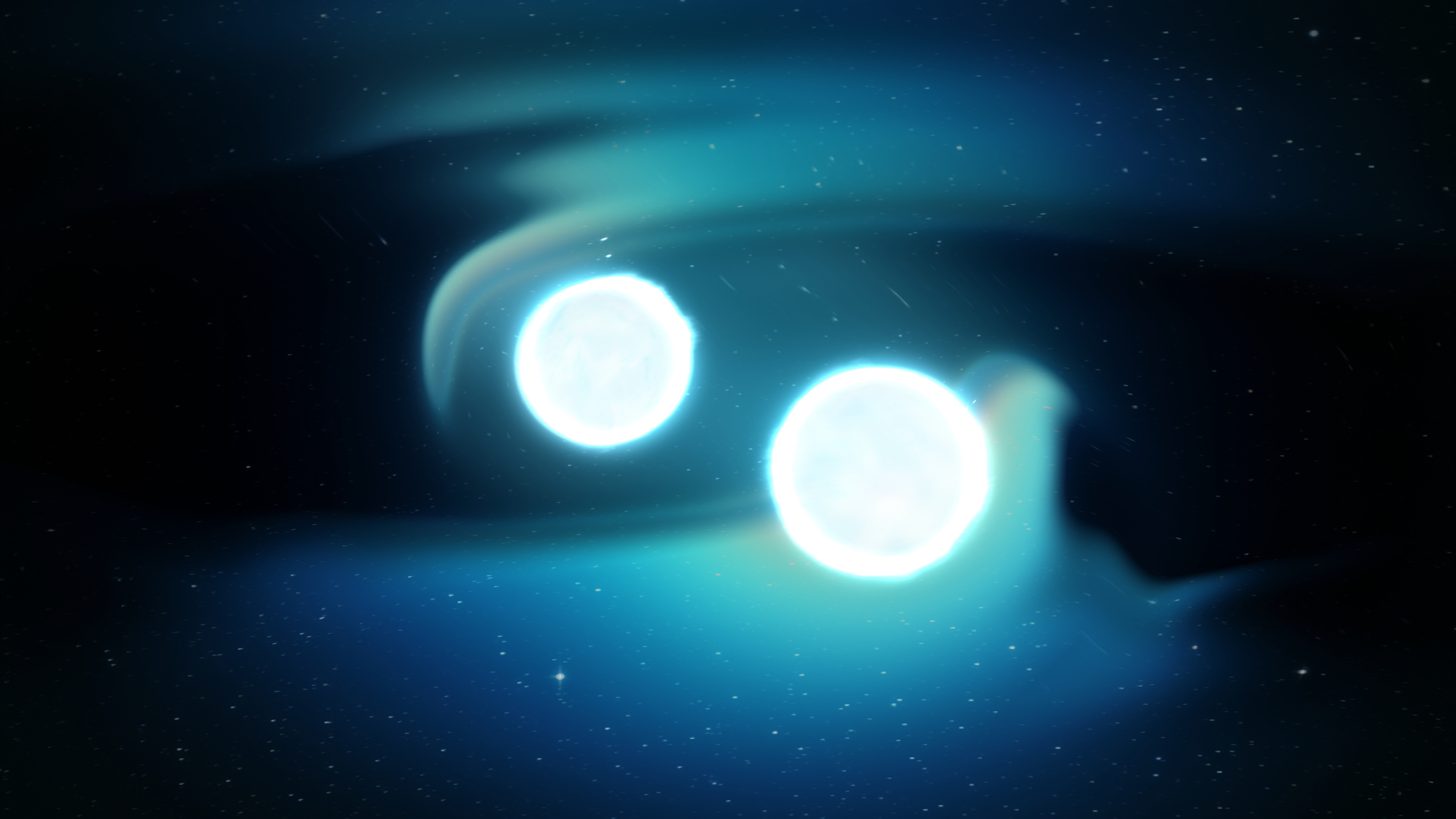
That gold was not made on Earth. It was not made in the Sun. It was not made in any ordinary star, no matter how large or how old. There is no furnace in the known universe hot enough, no pressure great enough, no environment extreme enough to forge a gold atom, except one: the collision of two dead stars, slamming together at a third the speed of light, briefly outshining every other star in their galaxy combined.
Every gram of gold that has ever existed on this planet arrived from somewhere else. It was forged billions of years before anyone was alive to call it precious, in a type of explosion so rare that it happens only a handful of times per galaxy per million years. We had never seen one happen, never caught the light of cosmic alchemy in real time, until August 2017. That was when we finally watched the universe make gold.
To understand what was observed that day, you need to know what a neutron star is. When a star significantly more massive than our Sun exhausts its nuclear fuel, the core collapses under its own gravity. If the original star was massive enough, but not quite massive enough to form a black hole, the collapse crushes protons and electrons together into neutrons. What remains is a neutron star: a sphere roughly 20 kilometres across that contains about 1.4 times the mass of our Sun.
The density defies everyday intuition. A sugar-cube-sized piece of neutron star material would weigh roughly a billion tonnes, comparable to the combined mass of every car, building, and ship on Earth. The surface gravity is about 200 billion times stronger than what holds you to your chair right now. If you dropped a marble from a height of one metre, it would strike the surface traveling at roughly seven million kilometres per hour.
Many neutron stars spin at extraordinary rates, some completing hundreds of rotations per second, sweeping beams of radiation across space like cosmic lighthouses. Astronomers call these pulsars, and their pulses are so predictable they rival atomic clocks in accuracy.
Now imagine two of these objects orbiting each other. Binary neutron star systems form when both stars in a pair are massive enough to end their lives as supernovae, but not so massive that either becomes a black hole. The resulting neutron stars inherit their orbital dance and begin a slow, inexorable death spiral, radiating gravitational waves (ripples in the fabric of spacetime) and losing orbital energy with every revolution. This inspiral takes hundreds of millions of years. The final moments take seconds.
On August 17, 2017, at 12:41 UTC, two detectors in the United States and one in Italy recorded something that had never been observed before. LIGO and Virgo, the gravitational wave observatories designed to detect ripples in spacetime, captured a signal that had been traveling for 130 million years. It was designated GW170817.
The signal lasted roughly 100 seconds, far longer than the fraction-of-a-second chirps produced by colliding black holes. Over that span, it swept through approximately 3,000 oscillations, rising in pitch and intensity as two objects spiraled closer and closer together. The physics was unmistakable: two neutron stars, each roughly 1.4 times the mass of our Sun, with a combined mass of about 2.7 solar masses, locked in a tightening death spiral. In their final orbits, the stars reached a third the speed of light. Then the signal stopped. They had made contact.
In that moment, the collision released more energy than our Sun will produce in its entire 10-billion-year lifetime.
Just 1.7 seconds later, the Fermi and INTEGRAL space telescopes detected a burst of gamma rays from the same direction: GRB 170817A, a short gamma-ray burst lasting about two seconds. Within hours, 70 observatories on seven continents and in orbit turned toward a galaxy called NGC 4993 in the constellation Hydra, roughly 130 million light-years from Earth. Over the following days, this fleet of instruments observed the aftermath in every wavelength of light: X-ray telescopes tracked the expanding jet, infrared instruments followed the cooling debris cloud, and radio telescopes monitored the shock wave as it plowed into surrounding gas. Gravitational waves, gamma rays, X-rays, ultraviolet, visible light, infrared, radio: seven distinct channels of information from a single cosmic explosion. Astronomers call this multi-messenger astronomy, and GW170817 was its defining moment.
A new point of light appeared near the core of NGC 4993. In its first 48 hours it glowed bright blue as lighter newly formed elements in the expanding debris radiated intensely. Over the following two weeks, the glow shifted from blue to red as heavier elements, the lanthanides and actinides, dominated the emission. Astronomers catalogued the transient as AT 2017gfo and recognised it as a kilonova: an explosion powered not by fusion or gravitational collapse, but by the radioactive decay of freshly forged heavy elements. Science magazine named the discovery its Breakthrough of the Year.

The Only Furnace That Can Make Gold
Gold has 79 protons in its nucleus, making it one of the heaviest stable elements on the periodic table. Building an atom that heavy is not simply a matter of temperature and pressure. It requires a specific nuclear process called rapid neutron capture, or the r-process: adding neutrons to an existing nucleus faster than those neutrons can decay.
The r-process is responsible for creating roughly half of all elements heavier than iron: silver, gold, platinum, iodine, uranium, thorium. Without it, the periodic table would effectively end around zinc.
But the r-process demands conditions so extreme that almost nowhere in the cosmos can produce them. You need a torrent of free neutrons, billions per nucleus per second, bombarding atomic nuclei in rapid succession before beta decay can intervene. You need temperatures in the billions of degrees. You need matter so neutron-rich that normal nuclear physics barely applies.
Think of it this way. Stellar fusion works by pressing small nuclei together, climbing the periodic table one step at a time from hydrogen to helium to carbon and onward. But that ladder has a ceiling. Iron sits at the bottom of the nuclear binding energy curve; fusing anything heavier absorbs energy instead of releasing it. Every element beyond iron on the periodic table was made by a fundamentally different mechanism, one that requires violence, not patience.
The r-process solves this through brute force. In an environment saturated with free neutrons, an atomic nucleus can capture neutron after neutron in rapid succession, ballooning in mass before it has time to stabilise through radioactive decay. Once the neutron bombardment ceases, the bloated nuclei shed excess neutrons through beta decay, converting them into protons and climbing the periodic table. Gold, with its 79 protons, is one of the end products of this chain.
For decades, astronomers debated where the r-process occurs. Supernovae were the leading candidate for years, but computational models struggled to reproduce the extreme neutron-rich conditions required. Neutron star mergers, by contrast, were theoretically ideal: they eject enormous quantities of the most neutron-rich material in the universe. The trouble was that no one had ever observed a merger creating these elements. GW170817 settled the argument.
Analysis of the kilonova’s light curves and spectra confirmed what theorists had long predicted. The collision ejected roughly 16,000 Earth masses of material into space, much of it undergoing the r-process in the moments after impact. Atomic nuclei absorbed free neutrons at a staggering rate, building ever-heavier elements almost instantaneously. Within seconds, the debris contained freshly minted atoms of strontium, barium, gold, platinum, uranium, and dozens of other elements.
That single collision produced an estimated 10 Earth masses of gold and platinum. Ten times the mass of our entire planet, in precious metals alone, synthesized in a fraction of a second.
Proof Written in Light
The hypothesis that kilonovae forge heavy elements had circulated since the 1970s. GW170817 offered powerful observational evidence, but the definitive spectroscopic proof arrived two years later.
In October 2019, a team led by Darach Watson at the University of Copenhagen published a landmark study in Nature. Using data from ESO’s X-shooter spectrograph on the Very Large Telescope in Chile, they matched spectral absorption features in AT 2017gfo to strontium (element 38 on the periodic table): a heavy element produced exclusively by the r-process.
It was the first time anyone had spectroscopically identified a specific, freshly forged element in the aftermath of a neutron star collision. The detection confirmed what the kilonova’s evolving colour and brightness had already strongly suggested: that the expanding debris was rich with r-process elements, the same nuclear family that includes gold, platinum, and uranium. Researchers have continued to mine the GW170817 dataset since Watson’s paper, with analyses published as recently as early 2026 exploring whether helium signatures accompany the strontium absorption, further refining our picture of the kilonova ejecta’s temperature, velocity, and composition.
The collision that placed gold in our corner of the galaxy, however, did not happen 130 million years ago. That event was simply the one we managed to observe. The gold on your hand is far older.
Our solar system formed roughly 4.6 billion years ago from a collapsing cloud of gas and dust, the accumulated debris of earlier stellar generations. Somewhere in that cloud’s history, one or more neutron star mergers had enriched it with heavy elements. The gold atoms that ended up on Earth were already ancient by the time they were swept into the disc of material surrounding our young Sun.
When Earth was still largely molten, most heavy metals, gold among them, sank toward the core during a process geologists call planetary differentiation. This gold represents only a fraction of what the protoplanetary disc originally contained; the vast majority lies forever buried in the outer core, thousands of kilometres below the surface.
But during the Late Heavy Bombardment, roughly 4.1 to 3.8 billion years ago, the inner solar system was pummeled by asteroids and comets carrying their own freight of heavy metals. These impacts delivered a fresh veneer of gold, platinum, and iridium to Earth’s crust and upper mantle. The deposits we mine today are, in the most literal sense, extraterrestrial deliveries.
The connection runs deeper than geology. Gold atoms circulate through Earth’s crust, dissolve in superheated water along ocean ridges, precipitate in quartz veins, and concentrate in alluvial deposits along riverbeds. Every gold rush in human history, every ancient temple adorned in the metal, every circuit board soldered with it: all of it traces back to a collision between dead stars that predates our planet by billions of years.
So the atom of gold in your ring was forged in a neutron star collision, drifted through interstellar space, was gathered into a collapsing gas cloud, incorporated into a rocky planet, sank toward its core, and was then delivered back to the surface by an asteroid. It has survived more than you can imagine.
What Comes Next
LIGO and Virgo, now joined by Japan’s KAGRA detector, completed their fourth observing run (O4) in November 2025, cataloguing over 250 merger events. A new observing run is planned to begin in late 2026 with improved sensitivity, expected to detect mergers at greater distances, potentially revealing new kilonovae in the years ahead.
The hunt has already produced surprises. In August 2025, LIGO and Virgo recorded a subthreshold gravitational wave signal designated S250818k, and the Zwicky Transient Facility spotted a coincident optical transient called AT2025ulz at a distance of 1.3 billion light-years. Unusually, the event displayed characteristics of both a supernova and a kilonova. A team led by Mansi Kasliwal at Caltech has proposed in The Astrophysical Journal Letters that it could be the first observed “superkilonova”: a massive star collapsing to form two neutron stars that immediately merged. The identification remains unconfirmed, but if validated, it would open an entirely new channel for heavy element production.
Crucially, each kilonova produces different element ratios depending on the masses of the merging neutron stars and the geometry of their collision. Some mergers eject more material in a tidal tail, rich in the heaviest elements, while others produce a more spherical outflow biased toward lighter species like strontium. Understanding this variation is the key to determining whether neutron star mergers alone can account for every heavy atom we see throughout the Milky Way, or whether rarer, stranger processes are also at work.
The gold in your ring is somewhere between four and five billion years old. It was forged in perhaps ten milliseconds of violence so extreme it briefly outshone a galaxy, then scattered across light-years of empty space. It drifted for aeons, found a young star, fell onto a cooling rock that would eventually become home. You are wearing the wreckage of dead stars. And somehow, against all probability, it fits.

