

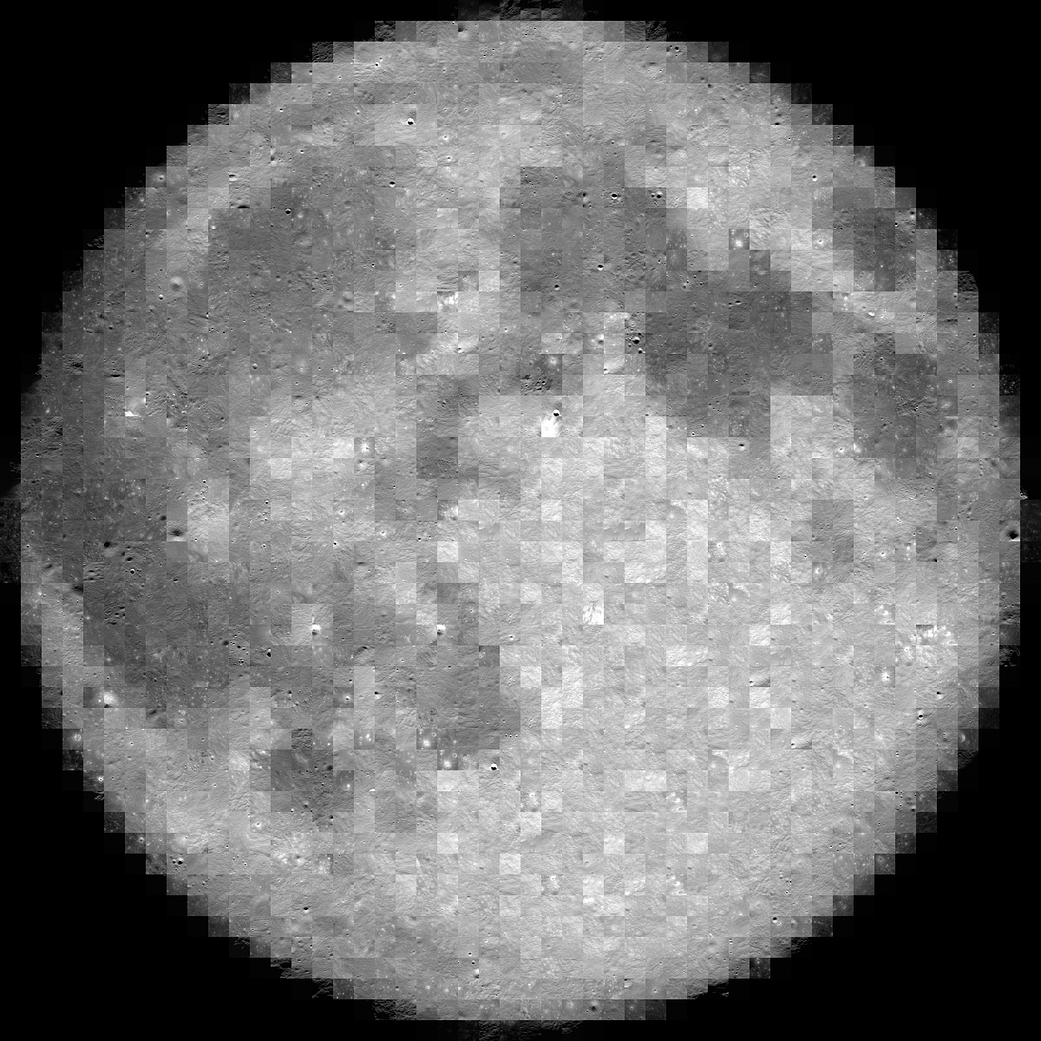
You do not need a telescope. Step outside on any clear night, look up, and you can see them: dark patches spread across the face of the Moon like ink on parchment. They form the shapes that billions of people have recognised for thousands of years. The Man in the Moon. The Jade Rabbit. A woman reading by candlelight.
Those dark areas cover nearly a third of everything visible from Earth. For four hundred years, astronomers have called them seas. Mare Tranquillitatis: the Sea of Tranquility. Mare Imbrium: the Sea of Rains. Oceanus Procellarum: the Ocean of Storms. The names are among the most beautiful in all of science.
They are also completely wrong.
The dark spots on the Moon have never held a single drop of water. What you are looking at is something far stranger and far more violent: the frozen remains of volcanic eruptions that lasted a billion years, filling wounds carved by some of the largest impacts the solar system has ever produced.
This is the story of how the Moon got its scars. It begins with a telescope, passes through four hundred years of beautiful mistakes, and ends with an astronaut holding a piece of volcanic rock on the shore of a sea that never existed.
When Galileo Galilei pointed his telescope at the Moon in late 1609, he saw what no one had seen so clearly before: craters, mountains, and deep shadows. He published his observations in 1610 in Sidereus Nuncius, describing a rugged, rocky world, nothing like the smooth celestial sphere that philosophers had assumed. Galileo saw rock. He did not call the dark areas seas.
But the idea that the Moon held oceans was older than any telescope. Ancient observers, seeing the stark contrast between bright and dark terrain with the naked eye alone, had long concluded that the dark areas were water. The telescope should have settled the matter. Instead, it deepened the assumption.
In 1645, Michael van Langren, a Flemish astronomer serving as royal cosmographer to King Philip IV of Spain, published the first known map of the Moon that labelled its dark regions as maria, Latin for “seas.” He was putting into formal cartography what generations of sky-watchers had believed: that those dark patches were lunar oceans.
Six years later, the Italian astronomer Giovanni Battista Riccioli went further. Working with his colleague Francesco Grimaldi, he published Almagestum Novum in 1651, giving the maria the evocative names we still use today. He named them after weather and states of mind: the Sea of Tranquility, the Sea of Serenity, the Sea of Crises, the Sea of Rains, the Sea of Clouds, the Ocean of Storms. Each more poetic than the last.
Riccioli’s system was adopted across Europe almost immediately and remains the standard nearly four centuries later. Every major dark feature on the near side of the Moon still carries the name he chose. There is just one problem: every name describes something that does not exist. There are no seas on the Moon. There never were.
What the Moon’s Dark Patches Actually Are
To understand the lunar maria, you have to rewind nearly four billion years, to a period of violence so extreme it has its own name: the Late Heavy Bombardment.
Around 3.9 billion years ago, the inner solar system was rearranging itself. A shift in the orbits of the giant planets, Jupiter, Saturn, Uranus, and Neptune, destabilised the asteroid belt and scattered its debris inward. Asteroid-sized bodies, some hundreds of kilometres across, slammed into the Moon, Mars, Mercury, and Earth at enormous speed.
The Moon took the worst of it. With no atmosphere to slow anything down, every impact struck at full force. The largest collisions carved basins more than a thousand kilometres wide. The Imbrium Basin, one of the most prominent, stretches roughly 1,145 kilometres in diameter, comparable to the distance from London to Barcelona. The object that created it may have been 250 kilometres across. A 2016 study by researchers at Brown University argued the impactor was even larger: a protoplanet-sized body, a world in its own right, that struck the Moon with enough force to reshape an entire hemisphere.
These impacts did not merely shatter rock. They fractured the Moon’s crust down to depths of hundreds of kilometres, opening channels from the still-molten interior to the battered surface above.
Then, slowly, the lava came.
Driven by residual heat and the decay of radioactive elements deep inside, the Moon’s mantle began producing magma. That magma pushed upward through the impact fractures and, over tens of millions of years, reached the surface. What followed was not the explosive volcanism of an Earthly stratovolcano. There were no towering cones, no pyroclastic clouds. Instead, fluid basaltic lava rose through fissures and spread in vast sheets across the basin floors, pooling in the lowest points like water filling a bath. Some individual eruptions may have covered areas the size of small countries before the lava cooled and solidified.
Layer upon layer, flow upon flow, the lava buried the ancient impact terrain under hundreds of metres of dark volcanic rock. The eruptions lasted roughly a billion years, from about 3.9 billion years ago to around 3 billion years ago. When the Moon’s interior finally cooled enough that magma could no longer reach the surface, the volcanic epoch ended.
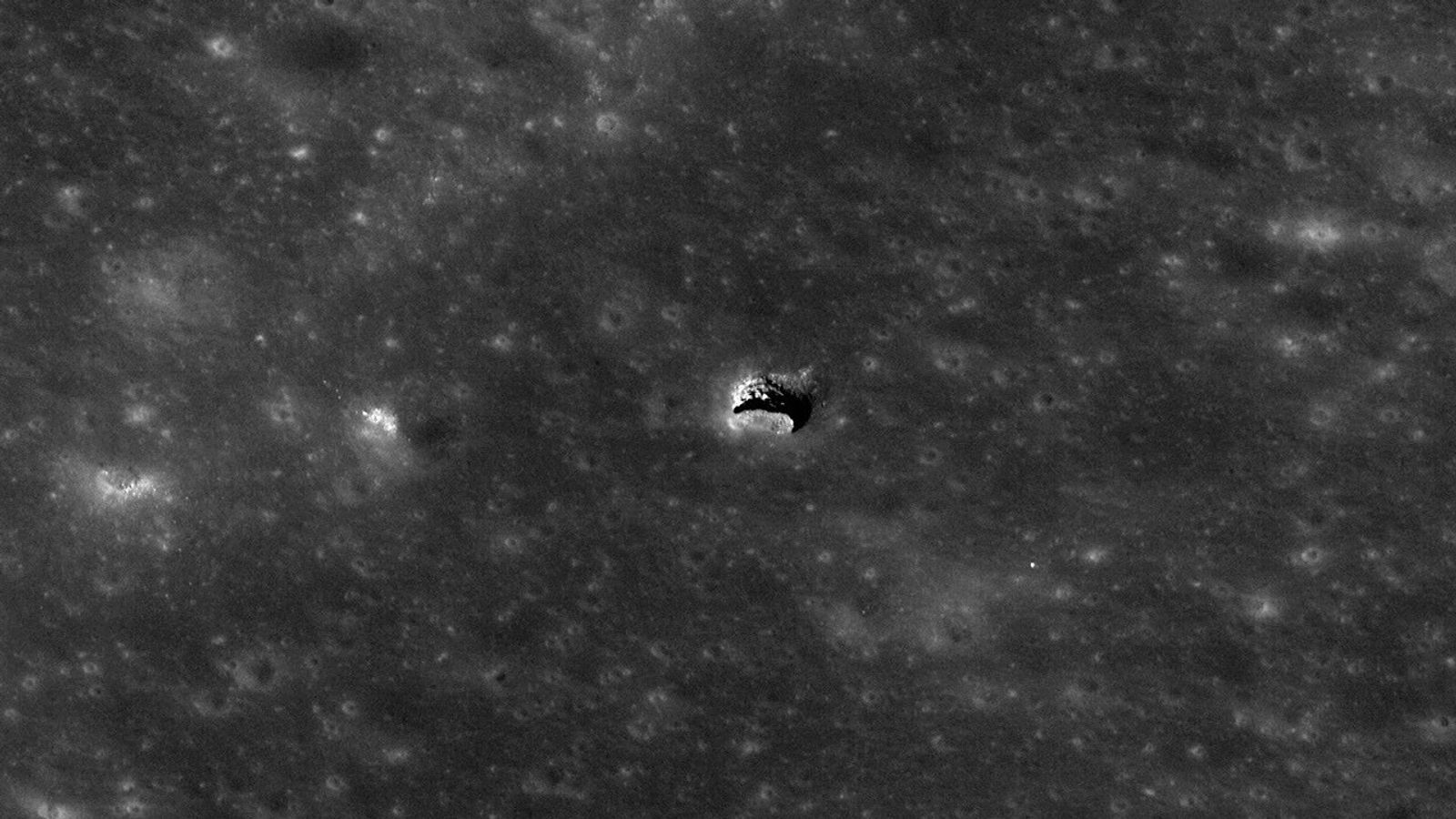
What the eruptions left behind was basalt: a dense, fine-grained rock rich in iron and titanium. The same type that forms the ocean floors on Earth and the volcanic islands of Hawaii. Basalt is far darker than the pale anorthosite of the lunar highlands, the ancient, heavily cratered crust that predates the bombardment. That contrast, bright highlands against dark volcanic plains, is what creates the pattern you see from 384,000 kilometres away. The “face” in the Moon is not painted on. It is the boundary between the original crust and the rock that filled its deepest wounds.
The volcanic plains are not perfectly smooth. Up close, they reveal wrinkle ridges where cooling basalt compressed and folded, sinuous rilles carved by flowing lava, and younger craters punched through the dark surface by later impacts. The basalt itself is buried beneath a thin layer of regolith, the powdery soil created by billions of years of micrometeorite bombardment grinding rock into fine dust. Beneath that grey powder, the basalt remains: dark, dense, and three billion years old.
One more mystery completes the picture. The far side of the Moon, the hemisphere that always faces away from Earth, has almost no dark patches at all. While volcanic rock covers about 31 percent of the near side, it makes up barely one percent of the far side.
NASA’s GRAIL mission solved this puzzle in 2012, spending nine months mapping the Moon’s gravitational field in unprecedented detail. The answer lay in the crust itself. On the near side, it averages roughly 40 kilometres thick. On the far side, about 60 kilometres. Where the crust was thin, magma could break through and flood the impact basins. Where it was thick, the same magma was trapped below, never reaching the surface. One hemisphere got its volcanic seas. The other stayed scarred, cratered, and pale.
What the Astronauts Found
For three centuries after Riccioli named the seas, no one could prove what the dark patches really were. Telescopes showed shapes and shading, but they could not identify rock from a distance of nearly 400,000 kilometres.
On July 20, 1969, Apollo 11 landed on Mare Tranquillitatis. When Neil Armstrong and Buzz Aldrin collected rocks from the surface of the Sea of Tranquility, they held volcanic basalt from another world for the first time in human history.
The 21.6 kilograms of samples told a story no telescope ever could. The basalts were 3.6 to 3.9 billion years old, dating them to the era of mare volcanism. They were unusually rich in titanium, with titanium dioxide concentrations between 9 and 13 percent. Most importantly, they had once been molten. The hypothesis that the Moon had always been a cold, undifferentiated body died that day on the surface of the Sea of Tranquility. The Moon had been geologically alive: a world with a hot interior, volcanic eruptions, and rivers of lava spreading across crater floors.
Two years later, Apollo 15 pushed the story further. In July 1971, astronauts David Scott and James Irwin landed in the southeastern reaches of Mare Imbrium, between the Hadley Rille (a channel carved by ancient lava) and the Apennine Mountains (part of the basin’s towering rim wall). Using the first lunar rover ever deployed on another world, they collected 77 kilograms of samples. Among them was specimen 15555: a 9.6-kilogram block of basalt from one of the lava flows that had flooded the Sea of Rains billions of years ago.
Between them, the Apollo missions settled the question. The dark patches on the Moon are not seas. They are not oceans. They are the frozen surfaces of ancient lava plains, filling impact basins so vast they are visible with the naked eye from a quarter of a million miles away. Volcanic wounds, healed in basalt, that the Moon has carried for three billion years.
The most recent chapters are still being written. NASA’s Artemis programme has returned astronauts to lunar orbit, with surface missions to follow. China’s Chang’e 6 mission successfully collected the first samples from the Moon’s far side in 2024, where the maria are almost entirely absent, offering fresh data on why the two hemispheres diverged so dramatically. Every new sample and every new measurement adds detail to a story that began with a telescope in Padua and now spans the entire Moon.
Next time the Moon is full, step outside and look up. Find the Sea of Tranquility. Find the Sea of Rains. Find the Ocean of Storms. Let the names settle over you. They are some of the most beautiful in all of astronomy, and every single one of them is wrong. But the truth needs no correction. You are looking at a world that bled fire for a billion years, and the scars it carries to prove it.

