

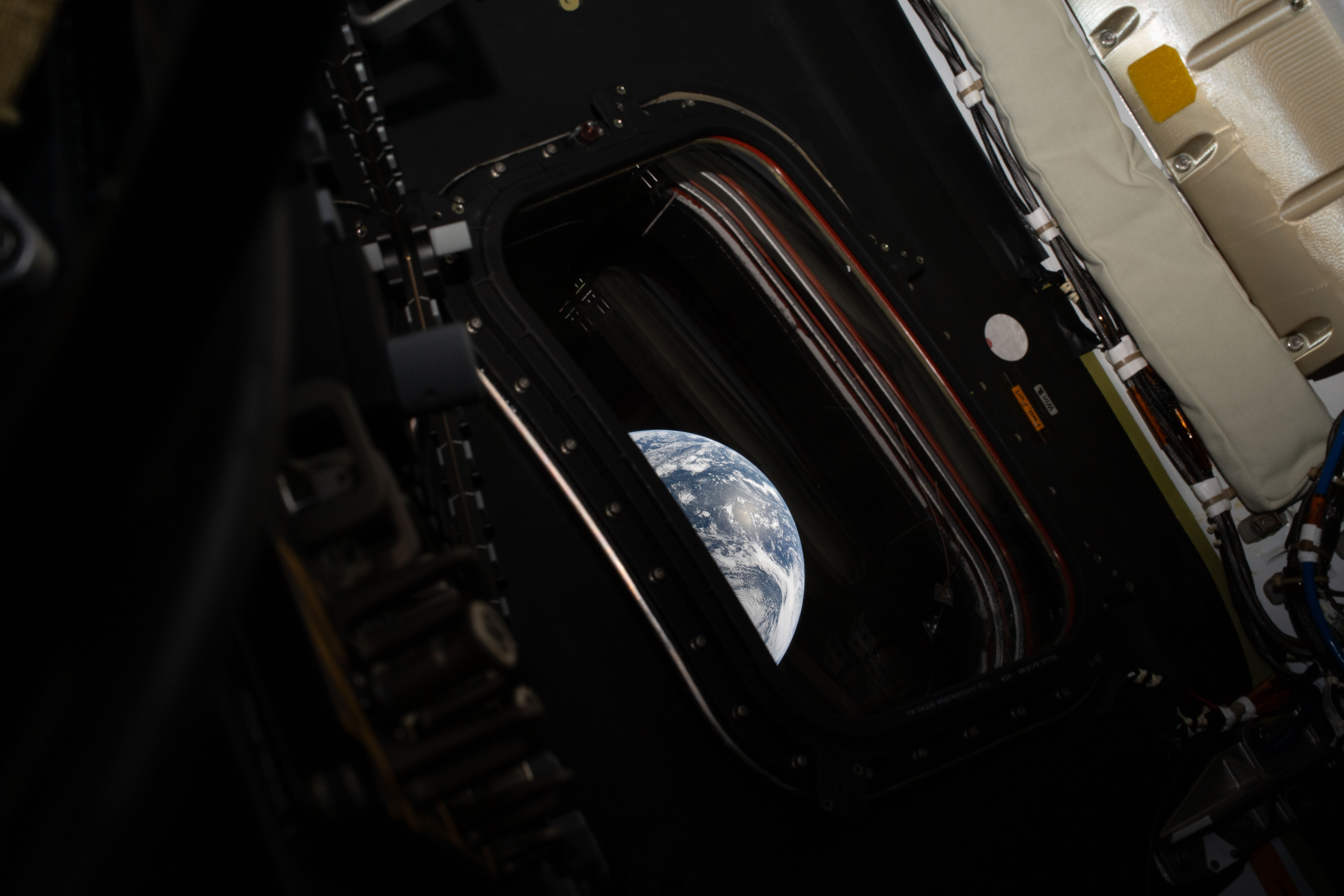
Right now — as you read this sentence — four people are farther from Earth than any human being has been since December 1972. Not in simulation. Not in training. They are in an Orion spacecraft, crossing the dark between Earth and the Moon, watching our planet shrink in a porthole window.
Their names are Reid Wiseman, Victor Glover, Christina Koch, and Jeremy Hansen. And they are the first human beings to leave low Earth orbit in more than fifty years.
Four Days Out
Artemis II lifted off from Kennedy Space Center on April 1, 2026, atop NASA’s Space Launch System — the most powerful rocket ever to fly. The mission’s ten-day trajectory takes Orion on a high free-return flyby around the Moon, with the closest lunar approach expected on April 6.
On April 2, the crew completed the translunar injection burn: a six-minute firing of the European Service Module engine that accelerated Orion to escape Earth’s gravitational grip and begin the outbound journey. As of April 5, the spacecraft is more than halfway to the Moon and tracking so precisely that mission controllers cancelled the first planned trajectory correction burn — it simply wasn’t needed.
The crew carries historic firsts: Glover is the first person of color to travel beyond low Earth orbit; Hansen is the first non-U.S. citizen; Koch is the first woman; and Wiseman, at 58, is the oldest human ever to make the journey. Together, they are the most diverse crew ever sent beyond Earth.
What Fifty-Three Years of Waiting Looks Like
The last time humans were this far from home, the mission was Apollo 17. Eugene Cernan and Harrison Schmitt had just walked on the Moon. Jack Schmitt had taken the photograph that became the Blue Marble. They splashed down on December 19, 1972 — and since that day, no human being had ventured beyond low Earth orbit.
That’s 53 years. Skylab, the shuttle, Mir, the ISS — all of it within a few hundred kilometres of the surface, close enough that Earth still fills the entire sky. Artemis II is something different: a ship leaving the neighbourhood.
This is also the first truly international crewed deep-space mission in history. Orion is powered by ESA’s European Service Module, a contribution from the European Space Agency that makes the spacecraft’s journey possible. Hansen’s place on the crew — as a Canadian Space Agency astronaut — marks another quiet milestone: deep space is no longer a destination that belongs to any single nation.
Artemis II will not land on the Moon. Its purpose is something more fundamental: prove that the human systems — life support, navigation, propulsion, and the four people inside — can make the journey and come home. If they do, the next crew lands. The cognitive shift that comes from seeing Earth from this distance has only ever been described secondhand. This week, four more people will experience it firsthand.
What Happens Next
Orion is scheduled to make its closest lunar approach on April 6, skimming past the Moon before using lunar gravity to sling the spacecraft back toward Earth. Splashdown in the Pacific Ocean is expected around April 10–11. Every reading taken, every system tested, feeds directly into the design of Artemis III — the mission that lands.
NASA’s Nancy Grace Roman Space Telescope, meanwhile, recently completed construction and is wrapping up pre-launch testing at Goddard Space Flight Center. A new generation of instruments is coming. But for now, the eyes of the space community are on four people in a capsule, half a million kilometres from home.
In 1972, the crew of Apollo 17 looked back and saw a marble — fragile, luminous, impossibly alone. This week, four more people get to see it.

