Saturn Is Losing Its Rings — And Nobody Can Stop It
273,000 kilometres wide. Ten metres thick. The most spectacular structure in the solar system is almost flat enough to slide under a door — and it will not be there forever.
The Number That Breaks Your Brain
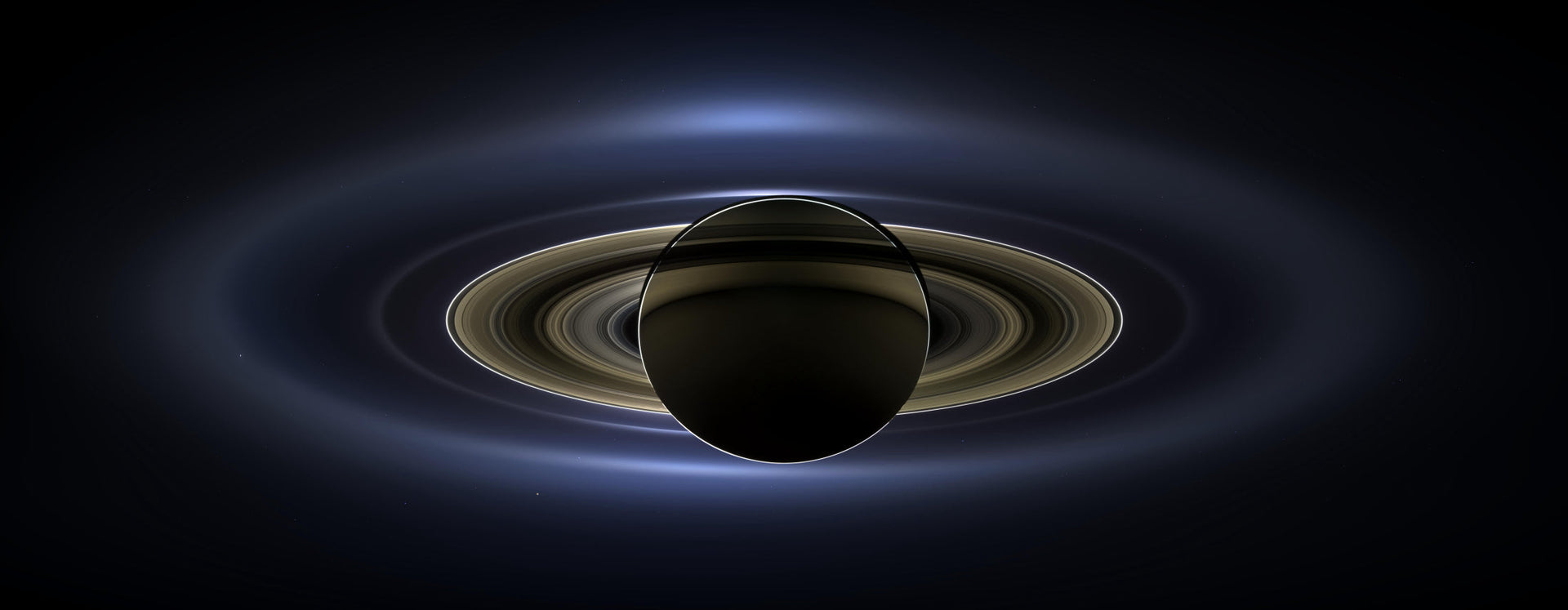
Saturn’s rings stretch roughly 273,000 km from inner edge to outer edge. That is about 70% of the distance from Earth to the Moon. If you could drive across them at motorway speed, the trip would take four months.
Their thickness? About 10 metres. In many places, less.
Read that again. A structure wider than most things humans have ever measured is thinner than a three-storey building is tall.
Making the Scale Click
Numbers like these are hard to feel. So let’s shrink everything down.
Imagine Saturn’s rings as a DVD. A standard DVD is 12 cm across and 1.2 mm thick. That gives it a width-to-thickness ratio of 100 to 1. Impressive for a piece of plastic.
Saturn’s rings? Their ratio is roughly 27 million to one.
If you scaled the rings down to the width of a football pitch — about 100 metres — they would be four thousandths of a millimetre thick. That is thinner than a single red blood cell.
A sheet of copy paper at that same scale would tower above them like a cliff.
What Are They Actually Made Of?
The rings are not a solid sheet. They are billions of individual chunks of water ice and rock, ranging from grains of sand to boulders the size of houses. Each piece orbits Saturn independently, and together they form a disc so thin it sometimes vanishes.
When Galileo first observed Saturn through his early telescope in 1610, the rings confused him. A few years later, he looked again and they had disappeared. He was seeing them edge-on — a disc this thin, turned sideways, is invisible from 1.2 billion kilometres away.
This still happens. Every 13 to 15 years, Earth’s orbit lines up with the ring plane, and the rings seem to wink out of existence. The last ring-plane crossing was in March 2025. Astronomers watched the mighty rings compress to a bright line, then nothing.
“A disc this thin, turned sideways, is invisible from 1.2 billion kilometres away.”
Why So Flat?
The rings started as a chaotic cloud of debris — possibly a shattered moon, possibly captured comet material. Over millions of years, collisions did the rest.
Particles that drifted above or below the main plane kept smacking into other particles. Each collision stole a little vertical energy. Horizontal speed was preserved, but vertical motion got damped out. Bit by bit, the cloud pancaked into a sheet.
It is the same physics that flattened the solar system itself into a disc, and the same reason galaxies are flat rather than spherical. Rotation plus collisions equals flat.
They Will Not Last
Here is the part that surprises most people: Saturn’s rings are temporary.
NASA’s Cassini mission measured ice particles raining from the rings into Saturn’s atmosphere at a rate that would drain the entire ring system in roughly 100 million years. Some models put the figure even lower. In cosmic terms, the rings are a passing phase.
Saturn is 4.5 billion years old. The rings may be only 100 to 200 million years old — younger than the dinosaurs. We happen to exist during the relatively brief window when Saturn wears its most famous feature.
“The rings may be only 100 to 200 million years old — younger than the dinosaurs. We happen to exist during the relatively brief window when Saturn wears its most famous feature.”
One Last Comparison
Take a standard piece of A4 paper. It is about 0.1 mm thick and 297 mm long — a ratio of roughly 3,000 to 1.
Saturn’s rings beat that by a factor of nine thousand.
If the rings were made of paper, the sheet would be 27 kilometres wide.
The next time someone shows you a photo of Saturn and its glorious rings, remember: you are looking at something vast, ancient, and — improbably — almost two-dimensional. A cosmic sheet of ice, thinner than a parking garage is tall, stretching wider than you can meaningfully imagine.
And it will not be there forever.