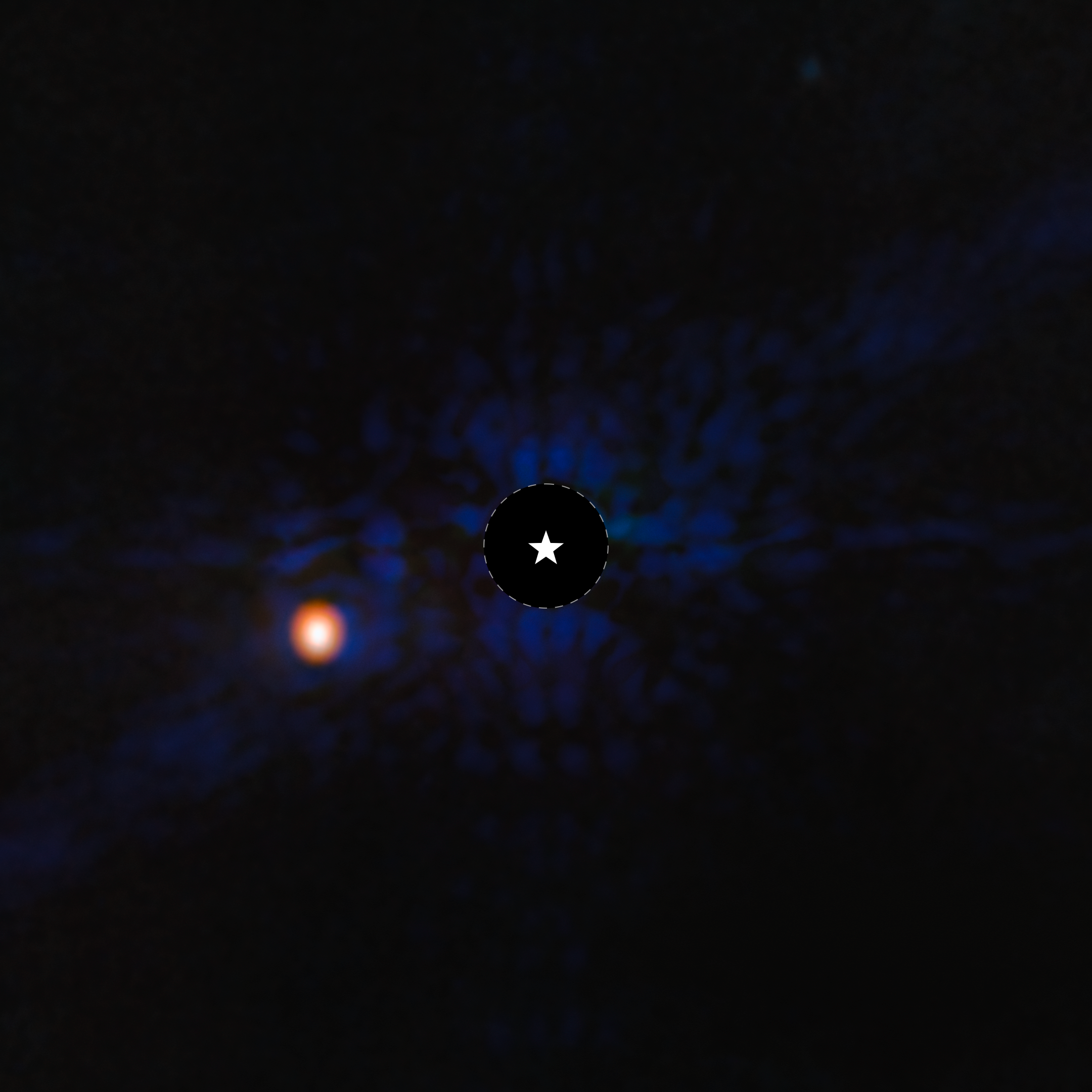
The James Webb Space Telescope was looking for ammonia. Every model said it would be there, thick and readable in the upper atmosphere of a cold giant planet 11.8 light-years away. When astronomers compared the two mid-infrared images and the signal came back far too low, they didn’t assume an error. They started looking for what was hiding it.
What they found were clouds. Dense, irregular patches of water ice drifting high in the frozen atmosphere of a world called Epsilon Indi Ab, at temperatures where nothing in our theoretical frameworks had predicted they would form. In a region of space closer to us than almost any other planetary system, the sky on an alien super-Jupiter looks, in at least one way, like a winter morning on Earth.
The discovery
Epsilon Indi Ab orbits its host star, Epsilon Indi A, at a distance of roughly 11.8 light-years, making it one of the nearest planets beyond our solar system ever directly imaged. A team led by Elisabeth Matthews at the Max Planck Institute for Astronomy (MPIA) returned to the planet in 2026 using JWST’s Mid-Infrared Instrument, MIRI, comparing new observations at 11.3 micrometers against baseline measurements taken in 2024 at 10.6 micrometers. That wavelength ratio probes the concentration of ammonia in the planet’s upper atmosphere.
The ammonia was there, confirmed by the data. But far less of it than expected. The team’s best explanation: thick, patchy water-ice clouds, analogous to high-altitude cirrus on Earth, obscuring the ammonia from view. The planet’s temperature sits between roughly −70 and +20 degrees Celsius, cold enough for water ice to condense and persist at altitude in a way our models had not accounted for.
The results were published on April 22, 2026, in the Astrophysical Journal Letters, in a paper titled “A second visit to Eps Ind Ab with JWST: new photometry confirms ammonia and suggests thick clouds in the exoplanet atmosphere of the closest super-Jupiter.”
Why it matters
Most atmospheric models used to simulate cold exoplanets have, until now, treated clouds as a secondary factor or ignored them entirely. The assumption rested on the idea that at the low temperatures Epsilon Indi Ab occupies, planets would offer relatively clean spectral windows: easy to read, easy to interpret. That turns out to be wrong.
Epsilon Indi Ab is not a typical JWST target. At 7.6 Jupiter masses and roughly 12 light-years from Earth, it sits at the cold, massive end of the exoplanet spectrum. JWST captured its light directly, using a coronagraph to block the glare of the host star and separate the planet’s faint infrared signal from a source millions of times brighter. Most exoplanet atmosphere studies rely on transit spectroscopy, catching starlight as it filters through a planet’s edge-on atmosphere during a transit. Direct imaging gives something rarer: light from the planet itself, not borrowed from its star.
The infrared photons MIRI recorded left Epsilon Indi Ab in roughly 2014, before the James Webb Space Telescope existed as anything more than engineering drawings. By the time they arrived and were measured, the planet they came from had been drifting through its orbit for more than a decade. The discovery you’re reading about describes weather from the past.
What comes next
The Matthews team plans additional MIRI observations to map the cloud structure in more detail, tracking how the cloud patterns shift as the planet rotates. If the clouds are as variable and patchy as the data suggests, Epsilon Indi Ab may offer astronomers their first real look at dynamic weather on a cold super-Jupiter: not a stable atmosphere, but a living one, cycling through periods of clearing and overcast on a world we will never reach.
More broadly, the discovery will press theorists to incorporate water-ice cloud physics into their simulations of cold giant exoplanets. If patchy ice clouds are common in this temperature range, they may be systematically suppressing chemical signals on dozens of similar worlds already catalogued by JWST, reshaping what we think we know about their compositions.
Somewhere 11.8 light-years away, thick cold clouds drift above a frozen world, hiding its chemistry from view. For over a decade those clouds were already there. We are only now learning to see them.