
May 05, 2026
The Pillars of Creation Are Already Gone
The Pillars of Creation may already be gone. Explore JWST/Hubble views, supernova evidence, and the light-travel paradox in this immersive deep dive.
Read moreThe Feed
Dispatches from the edge of atmosphere and attention.
May 07, 2026
Scroll through 13.8 billion years of cosmic history in 3D. From the Big Bang to the death of our Sun — nine phases of the universe in one interactive journey.
Read moreMay 05, 2026
The Pillars of Creation may already be gone. Explore JWST/Hubble views, supernova evidence, and the light-travel paradox in this immersive deep dive.
Read more
April 21, 2026
Venus takes 243 days to spin but only 225 to orbit the Sun. It also spins backwards. An interactive guide to the paradox of our nearest planetary twin.
Read more
April 21, 2026
You are made of dead stars. Explore nucleosynthesis from the Big Bang to neutron star mergers with interactive periodic table and body-composition visuals.
Read more
April 21, 2026
Image: Katherine Cain / Carnegie Institution for Science Picture the system to scale. The host star, TOI-5205, has a radius just 39 perce...
Read more
April 21, 2026
Unlisted QA test article for expanded Kardashev Scale interactive. Not for indexing.
Read moreApril 19, 2026
The storm Cassini saw in 1665 is gone. The Great Red Spot was born around 1831 — and after shrinking by half, it may not survive. Interactive deep dive.
Read more
April 18, 2026
JWST directly imaged CO₂ in a super-Jupiter 133 light-years away. Its carbon ratio reveals how it formed — and blurs the line between planet and star.
Read more

April 18, 2026
Image: NASA/Goddard Space Flight Center Orbital mechanics is supposed to be the steadiest thing in the universe. Planets settle into thei...
Read more
April 16, 2026
Four astronauts. 252,756 miles. Ten days. The Artemis II crew returned to the Moon's vicinity for the first time in 54 years, and today they tried to describ...
Read more
April 14, 2026
Image: NASA/JPL-Caltech/SSI. “The Day the Earth Smiled”: Saturn backlit by the Sun, captured by Cassini on July 19, 2013. Earth is the pale blu...
Read more
April 14, 2026
Image: NASA/Apollo 8/Bill Anders. “Earthrise”: the first photograph of Earth rising above the lunar horizon, taken by astronaut William Anders ...
Read more
April 14, 2026
Image: NASA/ESA/NRAO/AUI/NSF/G. Dubner (University of Buenos Aires). The Crab Nebula: the expanding remnant of a supernova witnessed in 1054 AD...
Read more
April 13, 2026
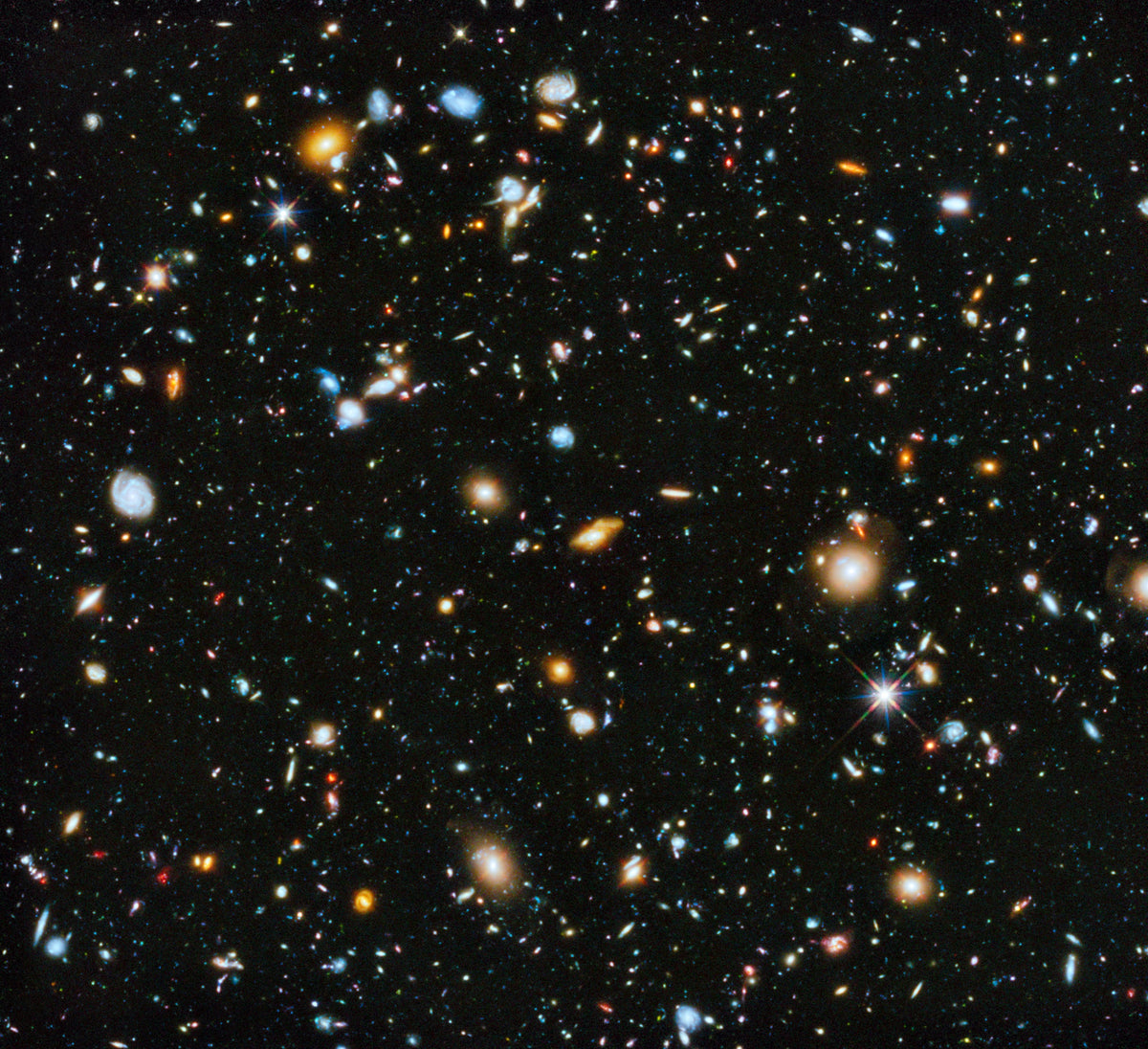
Image: NASA/ESA/S. Beckwith (STScI)/HUDF Team. The Hubble Ultra Deep Field: nearly 10,000 galaxies in a patch of sky smaller than a grain of sa...
Read more
April 12, 2026
The moon looks grey from Earth. It is not. Its surface carries blue titanium seas, green olivine plains, and volcanic orange glass waiting to be found.
Read more
April 11, 2026
Image: NASA/U.S. Navy At 8:07 p.m. Eastern time on Friday, April 10, 2026, four human beings fell out of the sky and into the Pacific Oce...
Read more
April 09, 2026
Trillions of planets drift between stars with no sun, no orbit, no seasons. JWST found hundreds in the Orion Nebula. Some may harbor life.
Read more

April 09, 2026
Every gold atom on Earth was forged when two neutron stars collided before our solar system formed. The 2017 kilonova GW170817 proved it.
Read more
April 09, 2026
On September 14, 2015, LIGO detected a ripple in spacetime from two black holes colliding 1.3 billion years ago. The story of how we learned to hear the univ...
Read more
April 09, 2026
Voyager 1 and 2 have been traveling for 47 years and are now in interstellar space. The Golden Record they carry may outlast the Earth itself.
Read more
April 09, 2026
Beneath Europa's ice shell lies an ocean with more water than Earth. Europa Clipper is on its way to find out if anything lives there.
Read more
April 09, 2026
From Karl Schwarzschild's battlefield equations to the first photograph of M87's shadow — how black holes went from mathematical curiosity to observed reality.
Read more
April 09, 2026
From pulsars to hot Jupiters to Earth-sized worlds in habitable zones — how we discovered 6,000+ exoplanets and what their atmospheres reveal.
Read more
April 09, 2026
A collapsed star the size of a city, spinning hundreds of times per second, keeping time more precisely than atomic clocks. How pulsars work.
Read more
April 09, 2026
Image: NASA/JPL-Caltech/ASU/MSSS If you stood on Mars right now, you would not see the planet you think you know. The red marble f...
Read more
April 09, 2026
Image: NASA, ESA, CSA, STScI, CXC Eighty-five percent of all the matter in the universe is something we have never seen, never touched, n...
Read more
April 09, 2026
Image: ESA and the Planck Collaboration Two teams of physicists have spent more than a decade measuring the same number. They are using t...
Read more
April 09, 2026
Image: NASA/CXC/SAO Somewhere in the northern sky, a collapsed star the size of a city is spinning on its axis once every 1.337 seconds. ...
Read more
April 08, 2026
Image: NASA/GSFC/Arizona State University Imagine a place 240,000 miles from where you sit right now. The temperature has dropped to minu...
Read more
April 08, 2026
Image: NASA/Johns Hopkins University Applied Physics Laboratory/Southwest Research Institute You grew up with nine planets. You learned t...
Read more
April 08, 2026
Image: NASA, ESA, CSA, STScI Something is pushing the universe apart. Not slowly, not gently, and not in the way anyone expected. The spa...
Read more
April 08, 2026
Image: NASA, ESA, CSA, J. Olmsted (STScI) The James Webb Space Telescope was not designed to find life. It was designed to see light, spe...
Read more
April 08, 2026
Image: EHT Collaboration / ESO Right now, at this very moment, the top of your head is aging faster than the soles of your feet. The diff...
Read more
April 08, 2026
Image: ESO/S. Steinhöfel Somewhere around five billion years from now, the Sun will run out of hydrogen fuel in its core and begin to die...
Read more
April 08, 2026
Image: NASA/SDO The telegraph operator watched his paper catch fire. His machine was disconnected from its battery. It was th...
Read more
April 08, 2026
Image: NASA/Artemis II Go outside tonight and look at the Moon. You don’t need a telescope. The dark shapes are right there, pooli...
Read more
April 08, 2026
An interactive 3D visualization of the Artemis II free-return trajectory. Scroll through the mission, reach closest approach, and explore what the crew saw f...
Read more
April 08, 2026
Image: NASA/GSFC/Arizona State University You do not need a telescope. Step outside on any clear night, look up, and you can see them: da...
Read more
April 08, 2026
Image: NASA Step outside tonight and look up. Find the Moon, and find the dark plain that dominates the upper-left quadrant of its face: ...
Read more
April 08, 2026
Image: NASA At 7:00 p.m. EDT on April 6, 2026, the Moon was not above the crew of Artemis II. It was beside them, beneath them, everywher...
Read more
April 08, 2026
JWST captures a protoplanet forming in real time inside a young star's disc. We are watching planetary birth as it happens.
Read more
April 08, 2026
Five points in space where gravity balances perfectly. JWST orbits one. GPS uses another. Lagrange points quietly shape our exploration.
Read more
April 08, 2026
A dead star 50,000 light-years away shook Earth's magnetosphere in 0.2 seconds. Magnetars are the most magnetic objects in the universe.
Read more
April 08, 2026
Run a black hole backward and physics says a white hole emerges. Carlo Rovelli argues they are real — and quantum gravity demands them.
Read more
April 08, 2026
Every gold atom on Earth was forged when two neutron stars collided. The kilonova that made your ring happened before the Sun was born.
Read more
April 08, 2026
If Mars once had life, it would be the worst news in human history. The Great Filter explains why — and why a dead Mars gives us hope.
Read more
April 08, 2026
JWST captured the first clear images of auroras on Uranus — glowing rings around a sideways magnetosphere unlike anything in our solar system.
Read more
April 08, 2026
A pulsar's gravity squeezes a companion into a lemon. Inside, carbon crystallises into diamond. The strangest planet ever found.
Read more
April 08, 2026
Europa Clipper is hunting for an ocean hidden beneath 15 km of ice on Jupiter's moon. 49 flybys to find out if anything is swimming.
Read more